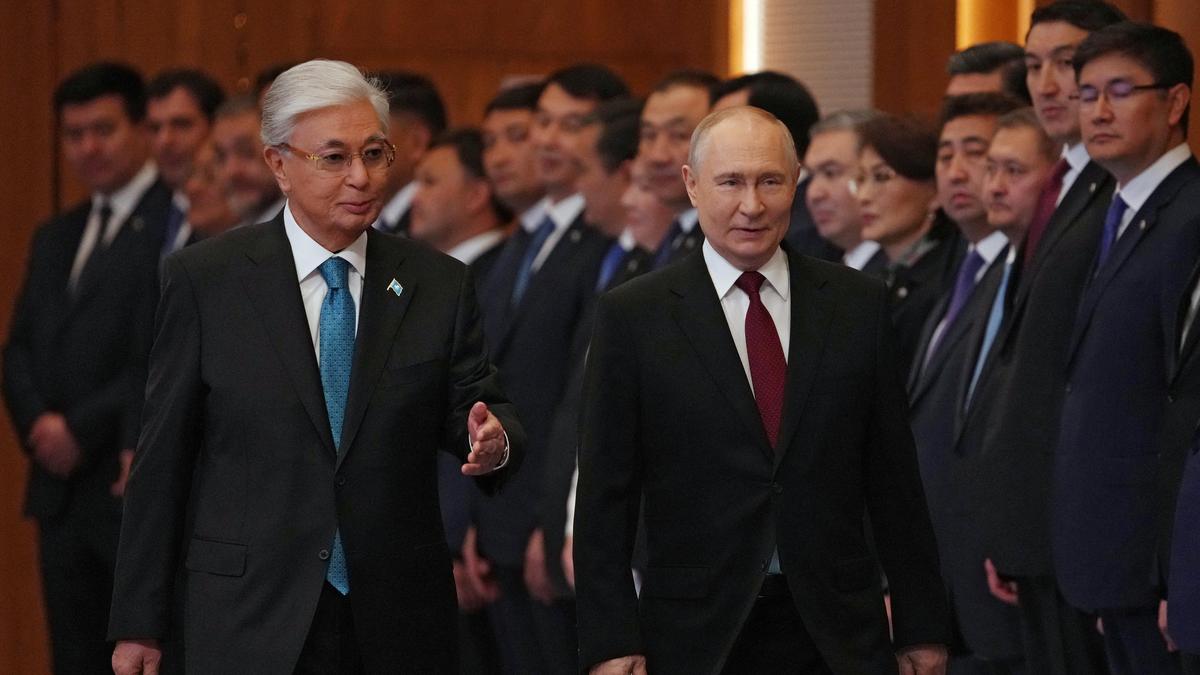
Russia just secured the keys to Central Asia's energy spine for the next century. Under the guise of a bilateral summit in Astana, Moscow and Kazakhstan signed a definitive agreement to build the first nuclear power plant in the Central Asian republic since the fall of the Soviet Union. The headline figures are staggering. Russia’s state nuclear corporation, Rosatom, will lead a project carrying a $16.5 billion price tag, bankrolled by a massive Russian state export loan covering 85% of the total investment.
By financing and building the twin VVER-1200 Generation III+ reactors near the village of Ulken on the shores of Lake Balkhash, Moscow is not merely exporting industrial hardware. It is locking an ostensibly multi-vector Kazakh foreign policy into an inescapable orbit of economic and technical dependence that will endure long past the mid-2030s commissioning date.
The Mirage of Multi Vector Diplomacy
For years, Astana prided itself on playing major global powers against one another. Western oil giants like Chevron, ExxonMobil, and Shell dominate the Tengiz and Kashagan oil fields, while China consumes vast quantities of Kazakh minerals and infrastructure bonds. When President Kassym-Jomart Tokayev engineered a national referendum in October 2024 to approve nuclear energy, the official line was that any future plant would be built by an international consortium. Officials repeatedly teased a balanced partnership involving France’s EDF, South Korea’s KHNP, China National Nuclear Corporation (CNNC), and Russia’s Rosatom.
The newly signed deal exposes that rhetoric as a geopolitical face-saver. Rosatom is the undisputed kingpin of this project. While Tokayev’s administration still floats the idea of a multinational consortium to save diplomatic face, the structural reality is monochrome. Moscow is providing the design, the primary engineering, and most importantly, the money.
Capital is the ultimate leverage in the nuclear industry. Western vendors require sovereign guarantees, clear regulatory frameworks, and market-driven returns that cash-strapped developing economies struggle to meet. Rosatom operates on an entirely different playbook. Backed by the Russian state, it offers vendor financing that commercial Western banks cannot match. By supplying 85% of the capital via an export credit, Moscow removes the immediate financial pain for Astana while creating a structural debt instrument that guarantees Russian leverage for generations.
The Cruel Irony of the Uranium King
There is a profound, almost tragic irony at the heart of this agreement. Kazakhstan is the world's absolute heavyweight in uranium mining, extracting over 43% of the global supply of the raw material needed to fuel the planet's nuclear reactors. Yet, despite sitting on the world's richest reserves of atomic fuel, the country cannot power its own lightbulbs without foreign intervention.
The roots of this paradox run deep into the soil of the Semipalatinsk test site. For four decades, the Soviet military detonated more than 450 nuclear weapons on Kazakh territory, exposing over a million citizens to devastating radiation and rendering massive swaths of land uninhabitable. This historical trauma created a deep-seated public allergy to all things nuclear. It explains why successive governments since 1997 have kicked the civilian atomic energy can down the road, and why Tokayev needed to expend immense political capital to manufacture a 71% "Yes" vote in the 2024 referendum.
But history has collided with cold, hard arithmetic. Kazakhstan’s industrial heartlands and growing urban centers are running out of power. The country’s electricity grid is an aging, crumbling relic of the Soviet era, heavily reliant on low-grade, highly polluting coal-fired thermal plants.
Kazakhstan Projected Power Balances (By 2030-2035)
--------------------------------------------------
Projected Shortfall by 2030:   > 6.0 GW
Target Nuclear Capacity (2035):  2.4 GW
Current Nuclear Capacity:        0.0 GW
With an electricity production deficit projected to exceed 6 gigawatts by 2030, rolling blackouts are no longer a distant threat; they are a routine economic disruption. Astana did not choose Rosatom out of newfound affection for Moscow. It chose Rosatom because its back was completely against the wall.
The Lake Balkhash Ecological Time Bomb
Beyond the geopolitical maneuvers lies an environmental vulnerability that could derail the project long before the first concrete pour in 2027. The chosen site, Ulken, sits on the edge of Lake Balkhash. It is one of the largest lakes in Central Asia, and it is dangerously unstable.
Nuclear power plants are notoriously thirsty beasts. They require constant, immense volumes of water to cool their reactor cores. The VVER-1200 design utilizes a closed-loop cooling system, but it still demands a steady supply of makeup water to compensate for evaporation.
Local ecologists and hydrologists have been sounding the alarm for years that Lake Balkhash is mirroring the tragic, slow-motion disappearance of the Aral Sea. The lake is shallow, highly sensitive to climatic shifts, and heavily dependent on the Ilí River, which originates across the border in China. As Beijing diverts more water upstream for its own agricultural and industrial needs, Balkhash’s water levels are fluctuating wildly.
Placing a dual-reactor nuclear facility on a shrinking body of water is a high-stakes gamble. If water levels drop below critical thresholds, the plant's operational capacity will be compromised, creating a scenario where a $16.5 billion investment could be forced to run at reduced capacity just when the national grid needs it most.
Moving Up the Value Chain or Sinking Deeper
Astana’s technocrats insist they have mitigated the risks of overdependence. They point to the Ulba Metallurgical Plant in eastern Kazakhstan, which already manufactures nuclear fuel assemblies for Chinese reactors using French technology. The official narrative holds that Kazakhstan will act as an independent owner and operator, supplying its own uranium and retaining ultimate control over the technological process.
This argument conflates mining raw materials with mastering a highly complex tech stack. Mining uranium ore is an extractive industry; enriching it and managing the lifecycle of a Generation III+ pressurized water reactor is a highly specialized scientific enterprise.
For the first twenty to thirty years of the Balkhash plant's lifecycle, Kazakh engineers will be dependent on Russian training, Russian spare parts, and Russian software updates. When a component fails, or when the reactor requires refueling with highly specific, enriched uranium configurations, the road will lead directly back to Rosatom's headquarters in Moscow. Furthermore, the management of highly radioactive spent fuel rods remains a thorny issue. Rosatom typically offers to repatriate spent fuel, but that service comes at a financial and political price that further binds the client state to the vendor.
This reality is already visible across the region. Uzbekistan is pursuing a similar path with Rosatom, and Kyrgyzstan has signed memorandums for small modular reactors. Moscow is systematically building a regional atomic monopoly across Central Asia.
The Cost of Sovereignty
The agreement signed in Astana is a calculated compromise. President Tokayev has secured a path toward domestic energy security and a modernized industrial base capable of meeting its Paris Agreement climate goals. In return, Vladimir Putin has demonstrated that despite severe Western sanctions and international isolation, Russia remains an indispensable technological powerhouse in Eurasia.
Construction will begin next year with the development of the foundational installation base. The true cost of this project will not be measured in the billions of dollars that Kazakhstan will eventually repay to the Russian treasury. It will be measured in the subtle, daily concessions that Astana must make to Moscow to keep its factories running and its lights on.