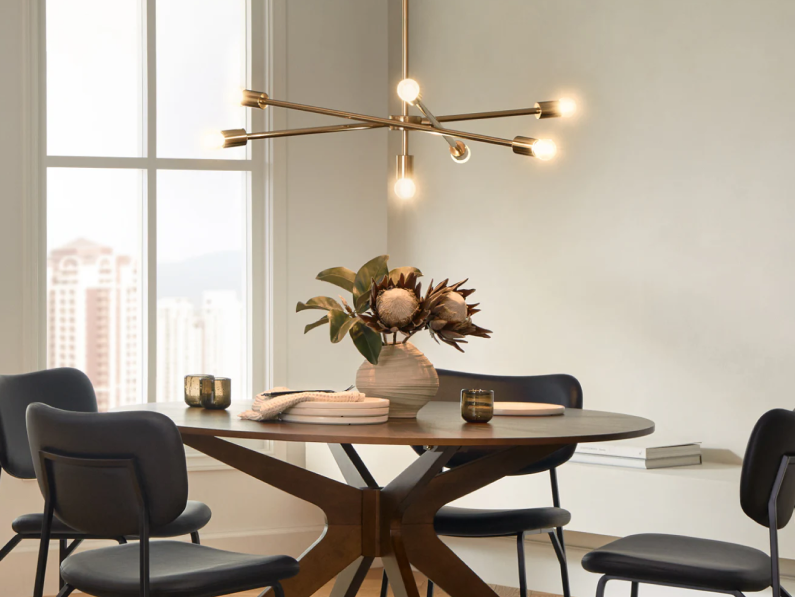
Most people try to fix a dark, cramped room by buying a bigger overhead fixture or slapping a mirror on the wall. It rarely works. In fact, blasting a single bright light from the dead center of your ceiling usually does the exact opposite—it casts harsh shadows into the corners, shrinks the visual footprint of the room, and makes your living space feel like an interrogation cell.
If you want your home to feel genuinely larger and brighter, you don't need a sledgehammer or a massive renovation budget. You need to change how light moves across your walls and ceilings. When you push light outward to the perimeters of a room instead of pooling it in the middle, your eyes perceive the boundaries as being much further away than they actually are.
After spending years fixing terrible apartment lighting and helping friends overhaul dim, boxy houses, I've seen firsthand which tweaks actually trick the eye and which ones are just expensive clutter. Here are nine practical lighting upgrades that will instantly open up your space.
Ditch the Single Overhead Fixture for Perimeter Grazing
Stop relying on the "big light." Interior designers hate central ceiling fixtures for a reason, and it isn't just snobbery. A single light source in the middle of the ceiling creates a bright hotspot directly underneath it while leaving the edges of the room in gloom. Your brain reads those dark corners as tight, enclosing walls.
Instead, you want to wash your walls with light. Wall grazing—placing light sources close to a vertical surface so the beam rakes down the texture—draws the eye upward and outward.
You don't need to hire an electrician to wire recessed ceiling cans to pull this off. Track lighting with adjustable heads works brilliantly if you aim every single bulb at the walls rather than the floor. Even simpler, plug-in architectural spotlights placed on the floor behind a sofa or a large potted plant can shoot a clean column of light straight up into a dark corner. Once those corners disappear into a soft glow, the entire room instantly feels wider.
Master the Art of Color Temperature and CRI
Walk down the lightbulb aisle at any hardware store and you'll see a wall of confusing numbers. Most folks grab whatever is cheapest or accidentally mix warm and cool bulbs in the same room. That's a fast track to making your home look disjointed and dingy.
To make a space feel bright without feeling sterile like a hospital waiting room, you need to pay attention to two numbers on the box: Kelvin (K) and CRI (Color Rendering Index).
- Kelvin measures warmth. Anything at 2700K gives off that cozy, golden-hour glow you want in bedrooms and living rooms. If you have a room with zero natural sunlight, bumping up to 3000K provides a crisp, clean white light that mimics morning sun without turning blue and harsh. Stay away from 4000K or 5000K daylight bulbs unless you're lighting a garage or a laundry room; they wash out warm paint colors and make skin tones look gray.
- CRI measures color accuracy. Cheap LEDs often have a CRI around 80, which makes rich wood tones, rugs, and wall paint look muddy. Look for bulbs rated at 90 CRI or higher. High-CRI bulbs make colors pop and whites look genuinely white, which trickles down into a much cleaner, airier atmosphere.
Swap Heavy Lampshades for Translucent Glass and Linen
Take a look at your current table and floor lamps. If they're topped with dark, opaque drum shades—like navy blue velvet, black metal, or thick parchment—they're acting like blinders. Those shades trap light and force it straight up and straight down, leaving the mid-level of your room in shadow.
Swapping those out is a five-minute fix with a massive payoff. Switch to shades made from white linen, sheer pleated fabric, or frosted opal glass. These materials diffuse light in a 360-degree radius, filling the middle tier of your room with a soft, ambient glow.
Globe lamps and mushroom-style glass lamps are particularly effective here. Because the entire shade illuminates, the fixture itself becomes a glowing orb rather than a dark silhouette blocking your sightlines.
Use Under-Cabinet LED Strips in More Than Just the Kitchen
Everyone knows under-cabinet lighting makes chopping vegetables easier, yet almost nobody thinks to use low-profile LED strips anywhere else. That's a missed opportunity. Dark gaps under floating shelves, deep bookshelves, and bathroom vanities create heavy visual blocks that weigh a room down.
Modern plug-in and battery-operated COB (Chip on Board) LED strips have completely changed the game. Unlike older LED strips that left annoying little dots of light reflected on countertops, COB strips produce a completely smooth, unbroken line of illumination.
Stick them underneath the front lip of your bookshelves to illuminate the spines and objects below. Run a strip along the bottom edge of a floating bathroom vanity to create a soft nightlight effect that makes the floor appear to extend endlessly underneath it. You can even tuck them behind the back edge of a media console or headboard to create a halo of backlighting that relieves eye strain and adds serious depth to a flat wall.
Upgrade to Smart Dimmers for Layered Control
Brightness without control is just glare. A room feels largest when it has contrast and depth, which you can only achieve by layering different light levels throughout the day. If all your lamps are either 100% on or completely off, you're stuck with flat, one-dimensional lighting.
Installing smart dimmer plugs on your existing floor and table lamps lets you fine-tune the exact output of every corner. During a cloudy afternoon, you can run your perimeter lamps at 100% to mimic natural daylight pouring in from windows. At night, dropping them down to 30% or 40% creates a cozy, layered environment where your eye travels smoothly from one warm pool of light to the next.
If you own your home, swapping standard toggle switches for Lutron Caséta smart dimmers is one of the best investments you can make. Just make sure the LED bulbs you buy are explicitly labeled as dimmable—non-dimmable LEDs will flicker, buzz, and drive you crazy.
Bounce Light Off the Ceiling with Uplights
Low ceilings are the biggest culprit behind claustrophobic rooms. When a ceiling sits in shadow, it feels like it's pressing down on top of you. The easiest way to visually raise a ceiling by a foot or two is to bounce light directly off of it.
Torchiere floor lamps got a bad reputation in the 1990s because of those cheap, halogen-burning monstrosities that nearly set dorm rooms on fire. Today's versions are sleek, minimalist, and run cool with integrated LEDs. Place a slim uplight in the darkest corner of your living room and aim it at the ceiling.
Because white or light-colored drywall acts like a giant reflector, the ceiling catches that beam and scatters soft, shadowless light back down across the entire room. It mimics the natural diffusion of an overcast sky, eliminating harsh shadows under furniture and instantly lifting the visual height of the space.
Replace Bulky Plug-In Cords with Rechargeable Sconces
Wall sconces are magic for small spaces. They free up valuable floor and tabletop real estate while putting light right at eye level, where it's most flattering and expansive. Traditionally, though, adding sconces meant tearing open drywall and paying an electrician hundreds of dollars to run new Romex cable.
Not anymore. The market for magnetic, USB-C rechargeable wall sconces has exploded, and the good ones look indistinguishable from hardwired designer fixtures. You simply screw a small mounting bracket into the drywall, snap the sconce onto the magnet, and pop the bulb puck out every few weeks to charge it.
Flank your sofa, bed, or a large piece of framed art with a pair of swing-arm or brass sconces. Having light sources mounted directly to the vertical plane of the wall breaks up large expanses of blank drywall and adds architectural polish that makes a rental or starter home feel custom-built.
Pair Mirrors Strategically with Light Sources
Hanging a mirror across from a window is the oldest trick in the book, and yes, it works. It doubles the natural daylight coming into the room and creates the illusion of an extra window.
What most people miss, however, is that a mirror does nothing for you after sunset unless it has an artificial light source to reflect. At night, a massive mirror on a dark wall just reflects a black void.
Place a tall table lamp, a pair of wall sconces, or a glowing floor lamp right in front of or immediately flanking your largest mirror. When you turn that lamp on at night, you instantly get double the lumens for the exact same electricity cost. Just watch your angles—sit down on your couch and look into the mirror to make sure you aren't staring directly at a bare, blinding bulb in the reflection.
Swap Out Yellowed, Dated Flush Mounts
If your hallway, entryway, or bedroom still has a builder-grade "boob light" or a yellowed plastic fluorescent diffuser from twenty years ago, rip it out immediately. Thick, aged glass and yellowed acrylic swallow up to 30% of a bulb's actual lumen output before the light even enters the room.
Replace those dated fixtures with modern, low-profile LED flush mounts or semi-flush fixtures with clear or thin milk-glass diffusers. Look for fixtures that sit tight against the ceiling—ideally under four inches deep—with a wide diameter. A wider diffuser spreads light across a broader angle of the ceiling plane, eliminating the tight spotlight effect of small, cramped fixtures.
Start by picking just one dark room this weekend—probably your living room or entryway—and audit your bulbs. Check the Kelvin rating, ditch any opaque shades, and push at least one light source into the darkest corner against the wall. Once you see how quickly the shadows retreat and the walls seem to step back, you'll never look at a ceiling fixture the same way again.