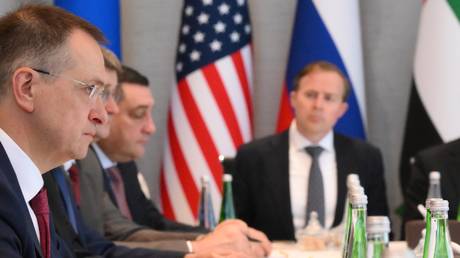
The venue tells you the whole story before a single diplomat opens their mouth. Moving high-level discussions around the Ukraine peace process to Abu Dhabi signals a decisive break from Western-led diplomatic theater and an acceptance of cold, transactional mediation. For years, public summits in European capitals operated as echo chambers, generating sweeping communiques while the front lines remained frozen in mud and artillery fire. By shifting the gravity of these talks to the United Arab Emirates, Kyiv, Moscow, and their respective backers are acknowledging that any durable off-ramp requires a broker with financial skin in both camps and zero interest in ideological lectures.
This is not a sudden eruption of goodwill. It is exhaustion meeting arithmetic.
When traditional Western intermediaries—whether in Geneva, Brussels, or Washington—host peace frameworks, they bring inherent structural baggage. They are simultaneously the primary weapons suppliers, sanctions enforcers, and proposed arbiters. Moscow refuses to treat them as neutral ground, and Kyiv often finds itself navigating domestic political pressures tied to Western electoral cycles. Abu Dhabi bypasses that entire gridlock. The Emirates have spent the better part of a decade positioning themselves as the indispensable clearinghouse for conflicts that the traditional post-1945 order can no longer contain.
The Architecture of Transactional Diplomacy
To understand why the Ukraine peace process is finding traction in the Persian Gulf rather than on the shores of Lake Geneva, you have to look at how the UAE operates. Emirati foreign policy does not run on moral alignment. It runs on de-escalation as an economic asset.
Abu Dhabi has maintained open flight corridors, banking channels, and high-level diplomatic access to Moscow since the conflict escalated, even while maintaining deep defense and intelligence ties with Washington and providing humanitarian and energy infrastructure aid to Kyiv. That dual posture irritated Western capitals early on. Now, it is the exact mechanism making backchannel diplomacy possible.
Consider the track record. Long before broader political frameworks hit the news cycle, Emirati mediators quietly brokered some of the largest prisoner of war exchanges between Russia and Ukraine. Those swaps were not symbolic gestures. They were stress tests for trust. In intelligence and diplomatic circles, prisoner transfers serve as the foundational plumbing for larger negotiations. If two warring intelligence services can coordinate the exact timing, flight paths, and bus manifests for hundreds of detainees without a double-cross, they prove that command-and-control structures still hold and that quiet commitments can be honored.
The shift from humanitarian swaps to broader political and security talks in Abu Dhabi follows a predictable diplomatic progression. You start with narrow, verifiable transactions. You build a shared vocabulary between mid-level intelligence officials. Only after the plumbing works do you turn on the main water line.
What Makes Abu Dhabi Different From Istanbul and Riyadh
Observers with short memories often lump all non-Western mediation efforts together, treating Abu Dhabi as interchangeable with the early 2022 talks in Istanbul or subsequent gatherings in Jeddah and Riyadh. That is a mistake. Each venue carried distinct geopolitical liabilities that ultimately capped its usefulness.
| Venue | Primary Diplomatic Dynamic | Core Structural Limitation |
|---|---|---|
| Istanbul (2022) | Early war crisis management under Turkish brokerage | Ankara's NATO membership and direct drone sales to Kyiv created persistent friction with Moscow, while neither side had yet tested its maximum military capacity. |
| Jeddah / Riyadh | Broad international coalition building | Focused heavily on rallying the Global South around Ukrainian peace formulas without Russian presence at the table, making them consensus-building exercises rather than actual negotiations. |
| Abu Dhabi | Quiet, bilateral, and trilateral transactionalism | Lacks the military weight to unilaterally enforce a ceasefire, requiring outside security guarantors to backstop any deal struck in its hotels. |
Turkey played its hand aggressively in the spring of 2022, leveraging its control over the Bosporus Strait and President Recep Tayyip Erdogan's personal rapport with Vladimir Putin. Yet Ankara's dual role as a NATO member supplying Bayraktar drones to Ukrainian forces meant Moscow always viewed Turkish mediation with deep suspicion. Saudi Arabia, meanwhile, hosted high-profile summits designed to bring nations like India, Brazil, and China into the conversation. Those meetings successfully broadened the diplomatic map, but because Russian delegates were absent, they functioned more as multilateral workshops than hard negotiations.
Abu Dhabi offers something entirely different: absolute discretion and commercial leverage.
The UAE has no ambition to rewrite the global security architecture or claim credit on a televised stage. Emirati officials prefer private villas, unmarked motorcades, and zero press releases until ink is dry. More importantly, Abu Dhabi holds quiet economic cards that matter to both sides. For Russia, the Emirates represent a vital financial and logistical artery—a hub for trade, capital flows, and energy coordination outside the reach of European Union jurisdiction. For Ukraine and its Western partners, the UAE is a sovereign wealth powerhouse capable of underwriting massive post-war reconstruction contracts and stabilizing global energy markets.
The Hard Math Driving Both Sides to the Table
Diplomacy never moves because leaders suddenly discover a shared humanity. It moves when the cost of continuing the war exceeds the political risk of compromising. By late 2026, the strategic calculus for every major actor in this conflict has tightened considerably.
On the ground, attrition has become the defining reality. Modern industrial warfare consumes artillery shells, air defense interceptors, armored vehicles, and—above all—trained infantry faster than defense industrial bases can replace them. Ukraine faces acute demographic strain and the constant challenge of maintaining grid resilience through successive winters. Russia, despite shifting its economy onto a war footing, faces mounting fiscal pressures, labor shortages, and the long-term degradation of its conventional military reserves.
Then there is the political calendar. Western defense budgets are finite, and voter patience across Europe and North America is not an endless resource. Decision-makers in Kyiv understand that negotiating from a position of relative strength requires locking in security arrangements before external funding mechanisms face severe political bottlenecks. Conversely, Moscow recognizes that prolonging a high-intensity war indefinitely carries diminishing territorial returns while deepening its economic dependence on Beijing.
A hypothetical scenario illustrates the exact dilemma facing both capitals. Imagine a commander holding a fortified ridge line with dwindling ammunition reserves, facing an adversary whose assault troops are taking unsustainable losses for every hundred meters gained. Neither side can achieve a decisive operational breakthrough, yet neither can unilaterally pull back without risking a collapse of morale. The only rational exit is a negotiated freeze brokered by a third party that neither side views as an existential enemy. That is the precise psychological and material space Abu Dhabi occupies right now.
The Unspoken Core of the Negotiations
Strip away the diplomatic jargon, and any serious Ukraine peace process comes down to four interlocking problems. If the Abu Dhabi talks are to produce more than temporary pauses, negotiators must resolve how these four pieces fit together without triggering political collapse in Kyiv or Moscow.
Territorial Realities Versus Legal Recognition
No Ukrainian government can survive signing away sovereign territory in perpetuity, nor will the international community formally recognize borders altered by force. Yet Moscow will not withdraw from the land bridge connecting Crimea to mainland Russia without a catastrophic military defeat that is not currently on the horizon. The middle ground—historically seen in places like the Korean Peninsula or divided Cyprus—involves a de facto ceasefire line paired with a de jure refusal to recognize annexation. Negotiators in Abu Dhabi are looking closely at demarcation mechanisms, buffer zones, and satellite verification protocols that freeze the front without forcing Kyiv to amend its constitution.
Security Guarantees That Actually Deter
Ukraine learned the hard way after the 1994 Budapest Memorandum that paper assurances without enforcement mechanisms are worthless. If full NATO membership remains off the table as an immediate condition for a ceasefire, Kyiv requires bilateral defense treaties backed by automatic weapons deliveries, intelligence sharing, and domestic defense manufacturing integration. Russia, in turn, demands strict limits on foreign troop deployments and long-range strike systems stationed on Ukrainian soil. Reconciling Ukraine's need for hard deterrence with Russia's obsession over strategic depth is the toughest knot in the room.
Sanctions Relief and Frozen Assets
This is where Abu Dhabi's financial DNA becomes indispensable. Hundreds of billions of dollars in immobilized Russian central bank reserves sit in Western clearinghouses, primarily in Europe. Western capitals want those funds used to rebuild Ukraine; Moscow demands their release alongside the lifting of banking and energy sanctions. A phased, conditional mechanism—where sanctions relief is tied strictly to verified compliance with ceasefire milestones, managed through neutral financial escrow—is the exact kind of structured deal Emirati financial architects understand.
Humanitarian and Infrastructure Corridors
Before any grand political settlement takes shape, interim agreements must cover the protection of critical energy infrastructure, Black Sea shipping lanes, and the return of displaced civilians and prisoners. These operational deals act as circuit breakers. If a ceasefire holds around nuclear power plants and port facilities for six months, the political space opens up for broader governance talks.
The Spoilers and Blind Spots
Treat any claim of an imminent, sweeping peace treaty with heavy skepticism. Moving talks to Abu Dhabi changes the dynamic, not the underlying hostility. Several massive obstacles threaten to derail the process before it ever reaches a formal signing ceremony.
First, the enforcement gap. The UAE is an exceptional mediator, but it is not a military superpower capable of policing a thousand-kilometer front line. If a ceasefire is signed in Abu Dhabi, who monitors it? The Organization for Security and Co-operation in Europe proved largely toothless during the pre-2022 Minsk agreements. A new monitoring mission would require a multinational coalition acceptable to both sides—likely drawing heavily from non-NATO countries in Asia, the Middle East, and Latin America—backed by commercial satellite oversight and strict rules of engagement. Without teeth, a ceasefire simply becomes an operational pause for both armies to rearm and regroup.
Second, the European exclusion problem. Major European powers—particularly those on NATO's eastern flank like Poland and the Baltic states—view any backchannel deal struck without their direct input with deep alarm. Their fear is straightforward: a rushed settlement that leaves Russia with territorial gains and intact military production will simply set the stage for another conflict in five years. If Brussels and key European capitals feel sidelined by an Abu Dhabi-Washington-Moscow axis, they have ample leverage to complicate sanctions relief and delay European Union accession pathways for Ukraine.
Third, domestic legitimacy. Agreements brokered behind closed doors in luxury Gulf hotels often suffer from a severe deficit of public buy-in back home. Ukrainian society has endured immense sacrifice; any compromise sold as a fait accompli without clear, tangible security guarantees risks triggering fierce internal backlash. Similarly, the Kremlin must frame any pause in hostilities as a strategic victory to its domestic audience and hardline military factions.
A New Playbook for Modern Conflict
What is unfolding in Abu Dhabi points to a broader structural shift in how twenty-first-century wars end. The era when Western diplomatic capitals held a monopoly on peace conferences is over. Power has diffused, and with it, the capacity to mediate.
Middle powers like the UAE have realized that neutrality is no longer passive non-alignment. It is an active, high-stakes business model. By keeping doors open to sanctioned states while remaining indispensable partners to Western security and financial networks, Abu Dhabi has built a diplomatic bridge that neither Washington nor Brussels could construct on its own.
For analysts watching the Ukraine peace process, the metrics of success have changed. Stop looking for dramatic handshakes on the steps of European palaces or sweeping declarations of universal principles. Watch instead for quiet regulatory adjustments in Gulf financial centers, unannounced cargo flights landing in neutral airports, and technical working groups hammering out the coordinates of demilitarized zones. The real deal, if it happens at all, will not look like a triumph of diplomacy—it will look like an exhausted business merger signed in a windowless room.


