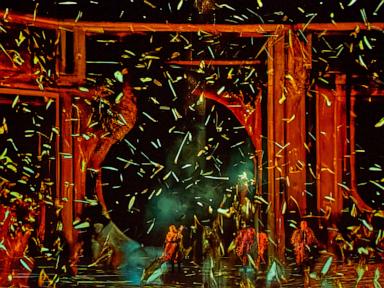
The intersection of generative computation and traditional performance arts exposes a fundamental structural flaw: software excels at pattern recognition across historical archives, yet lacks the intentionality required to direct dramatic tension. This failure mode became starkly visible during the 150th-anniversary staging of Richard Wagner's Der Ring des Nibelungen at the Bayreuth Festival. Titled Ring 10010110 and curated by Marcus Lobbes alongside Nils Corte and Andri Hardmeier, the production integrated an array of AI models—anchored by Stable Diffusion running on specialized NVIDIA hardware—to dynamically generate stage projections. While the musical execution under conductor Christian Thielemann earned a protracted seventeen-minute ovation, the production team faced an immediate chorus of boos and whistles during the final curtain call. Evaluating this reception requires moving past cultural platitudes about tradition versus innovation to analyze the operational mechanics of automated stagecraft.
The Three Structural Failure Modes of Computational Production
Integrating software into theatrical mise-en-scène introduces distinct operational liabilities that traditional directing avoids. A human director establishes a continuous semantic thread, mapping subtext to physical blocking. The Bayreuth experiment traded this deliberate agency for stochastic generation, resulting in three systemic breakdowns. You might also find this related story insightful: Clay and Ink: The Uncompromising Artistry of Reinata Sadimba and Raymond Tsham.
1. The Semantic Disconnect of Algorithmic Collagen
The system was fed approximately one thousand visual assets drawn from fifteen prior Bayreuth productions, alongside historical milestones ranging from 1876 sketches by Josef Hoffmann to modern sociopolitical events. By segmenting the score into short windows of two to six minutes and tasking text-to-image models with matching text and music cues, the curation team produced a rapid-fire collage.
Viewers were confronted with rapid visual transitions featuring historical touchstones such as Theodor Herzl, the World Trade Center towers, and domestic postage stamps. Because the software executed associative retrieval rather than narrative editing, these images functioned as isolated non-sequiturs. The cognitive cost of resolving these disparate historical references broke the audience's immersion in the operatic drama. As extensively documented in detailed reports by Deadline, the effects are worth noting.
2. The Absence of Actor-Environment Coupling
Traditional opera relies on spatial tension between the performer and the set. In this production, minimal blocking was enforced, restricting singers to the role of fixed observation points amid a shifting digital cosmos.
The actors spent a compressed nine-hour rehearsal window interacting with the production team in small groups rather than developing spatial dynamics across a unified directorial vision. Without reciprocal feedback loops between performer movement and environmental projection, the stage presentation devolved into a disconnected diptych: world-class acoustic performance occurring independently of a background slide show.
3. The Fallacy of Stochastic Curation
Producers defended the software outputs as a neutral reflection of what an artificial intelligence perceived as the primary political topics of a given year. This approach misinterprets the function of curation.
A computational model trained on historical archives performs interpolation, finding the centroid of past aesthetic choices. Theatre requires extrapolation and critique. By substituting calculated provocation for compositional intent, the software produced an encyclopedia of past interpretations rather than an autonomous artistic statement.
The Cost Function of Creative Automation
Evaluating the utility of machine learning in high-stakes cultural production requires examining its resource allocation relative to output quality.
[Historical Archive] + [Libretto Text]
         │
         ▼
[Stochastic Model / Stable Diffusion]
         │
         ▼
[Unfiltered Visual Output] ──(Lacks Intentionality)──► [Cognitive Overload for Audience]
The economic and technical parameters of the Bayreuth deployment highlight an efficiency paradox. Building the system required custom-built hardware running high-end graphics processing units, merging multiple diffusion architectures, and breaking the four-night, fourteen-and-a-half-hour masterwork into roughly two hundred and fifty discrete computational scenes.
Yet, the labor saved on traditional stage design was offset by an exponential rise in audience cognitive friction. The production substituted human directorial labor—which mediates meaning and resolves ambiguities—with automated generation that amplified ambiguity.
When software generates scenery based purely on immediate token associations with the musical score, it treats art as a classification problem. Wagnerian drama operates on structural irony, leitmotif accumulation, and emotional pacing—variables that resist flat probability distributions. The audience's hostile reaction at the Götterdämmerung curtain was a rejection of this category error.
Operational Takeaways for Digital Integration in Arts
The backlash at Bayreuth establishes clear boundary conditions for deploying generative systems in live performance environments.
- Enforce Directorial Agency: Computational tools must remain subordinate to a human showrunner who edits outputs for narrative consistency. Unfiltered generative streams invariably produce cognitive noise.
- Maintain Spatial Synergy: Projections cannot function as ambient wallpaper. Unless visual assets respond directly to performer kinetics in real time, the staging fractures.
- Prioritize Friction Reduction: Audiences attend complex theatrical works to experience emotional resolution, not to decode an uncurated archive of historical trauma and political iconography.
Deploying generative models as primary visual drivers without an underlying dramatic syntax guarantees audience rejection. Future digital experiments in classical performance must treat software as a paint-brush rather than an author, ensuring that human intent anchors every frame projected onto the stage.