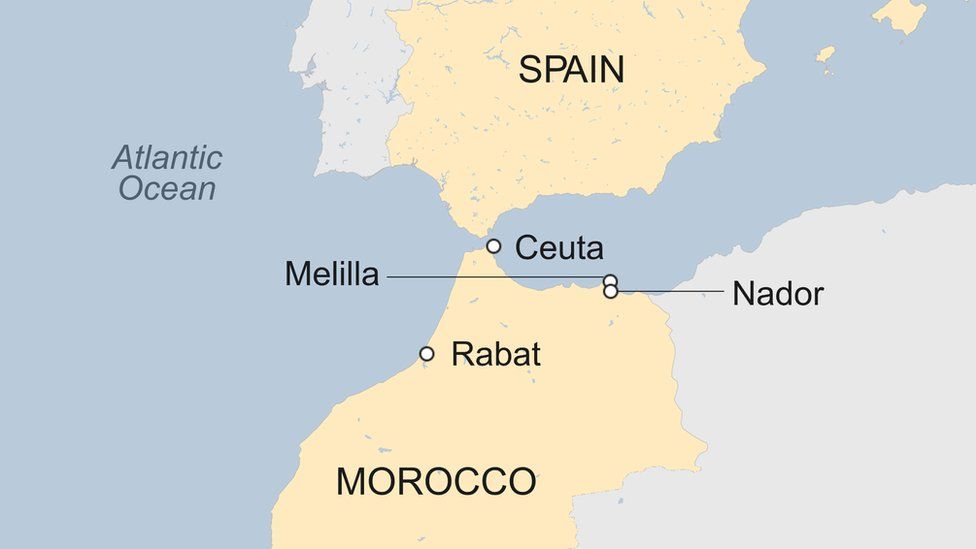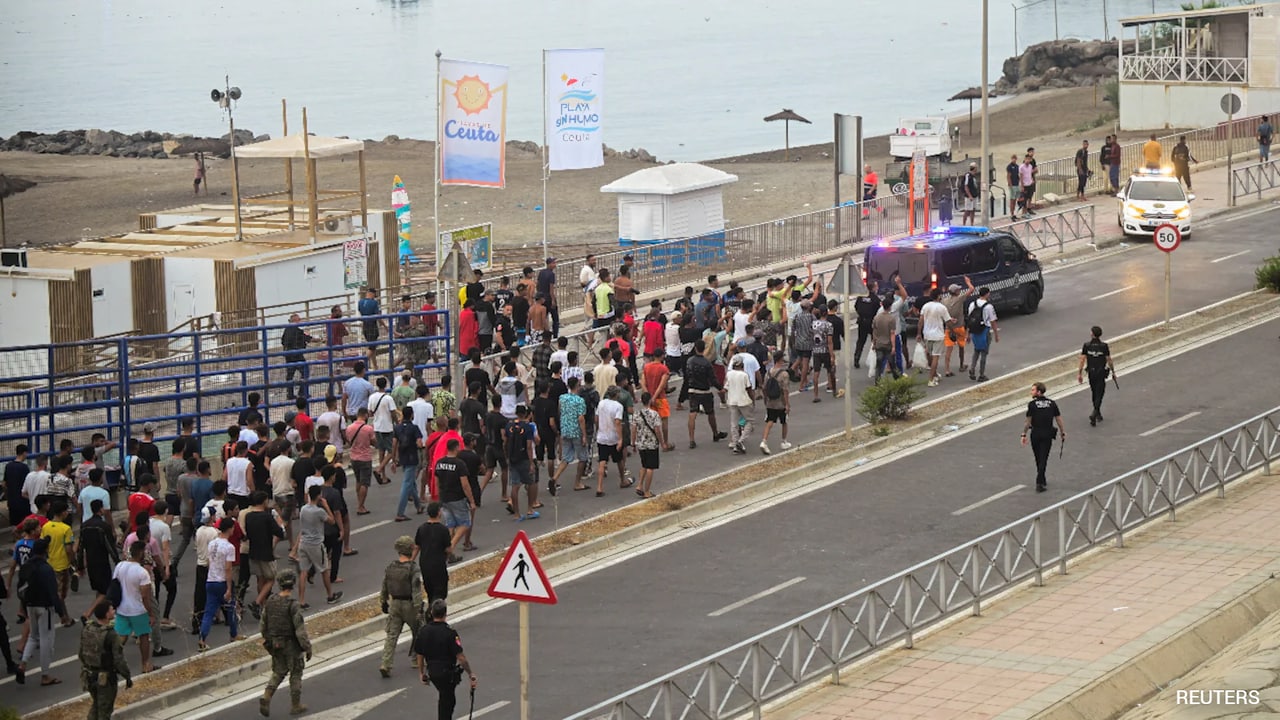
The recent humanitarian pressure points within the Spanish enclave of Ceuta expose structural vulnerabilities in European border management and bilateral migration containment. When thousands of individuals cross municipal perimeters within a 24-hour operational window, the event transcends a localized public order issue. It functions as a stress test for international asylum protocols, regional municipal resources, and bilateral enforcement agreements between Madrid and Rabat. Understanding this phenomenon requires stripping away emotional rhetoric to analyze the actual cost functions, institutional friction, and mechanical drivers behind mass irregular border movements.
The Economic Push Factors and Structural Labor Market Failure
Migration velocity is dictated by the differential between local economic output and the cost of basic social reproduction. In many North African urban centers, structural underemployment and compressed wage scales prevent workers from clearing basic survival thresholds.
Consider the macroeconomic indicators driving individuals from urban employment into irregular transit systems. When average regional wages hover near static local currency floors—such as three thousand dirhams monthly—while housing, inflation, and family formation costs scale with European import prices, the local purchasing power parity breaks.
This creates a high-pressure labor imbalance. Skilled workers, automation technicians, and tradespeople find themselves caught in structural stagnation where upward mobility is mathematically impossible within the domestic economy. The decision to undertake a high-risk maritime or terrestrial border crossing is therefore calculated against a near-zero expected lifetime wealth accumulation in the country of origin. The risk of mortality during transit is weighed against the certainty of economic irrelevance at home.
The Operational Mechanics of Enclave Vulnerability
Ceuta and Melilla occupy a unique geopolitical niche as the European Union’s only land borders on the African continent. This geographic reality creates acute operational friction.
[Origin Markets & Structural Underemployment]
       │
       ▼ (Cost Function Threshold Crossed)
[Border Enclave Proximity (Ceuta/Melilla)]
       │
       ▼ (Enforcement Saturation / Institutional Bottleneck)
[Municipal Resource Exhaustion & Urban Encampments]
When local security forces face a sudden, coordinated surge of tens of thousands of arrivals, standard processing pipelines collapse under volume. The institutional capacity of a municipality with a population under ninety thousand cannot absorb an instantaneous demographic influx of equivalent scale without immediate systemic failure.
- Processing Bottlenecks: Asylum adjudication bodies operate under strict statutory timelines that assume linear, predictable volumes. Exponential surges saturate intake infrastructure, forcing administrative gridlock.
- Municipal Saturation: Sanitation, potable water grids, and primary healthcare facilities face acute supply shocks. Outbreaks of communicable ailments, such as scabies and gastrointestinal infections, reflect infrastructure strain rather than epidemiological vectors originating exclusively from migrant populations.
- Diplomatic Friction: The enforcement mechanisms rely on cooperation between destination states and transit hubs. When diplomatic vectors fracture, border management shifts from a cooperative security model to a political bargaining chip.
Legal Ambiguities in Mass Repatriation Protocols
The legal architecture governing border enforcement in Spanish enclaves is bound by domestic statutes, European Union directives, and international human rights treaties. This creates a multi-layered compliance matrix that complicates rapid deportation or administrative return.
Minors possess specific legal protections that prohibit immediate collective expulsions. For adult cohorts, individuals who formally articulate a claim for international protection trigger mandatory procedural safeguards. Authorities cannot effectuate summary deportations without assessing individual risk profiles.
This legal reality produces a prolonged limbo state on urban beaches and municipal peripheries. Populations sleep in open-air encampments, staging public demonstrations to assert legal standing, while central ministries issue conflicting administrative directives regarding mainland transfer eligibility. The friction between domestic interior ministry deterrence goals and supranational judicial mandates creates permanent policy paralysis.
Geopolitical Fallout and Schengen Zone Integrity
Migration crises rarely remain contained within municipal borders. They propagate upward into broader geopolitical alignments. When a sudden influx overwhelms regional infrastructure, destination countries often respond with intra-alliance friction. Proposals to suspend freedom of movement protocols within the Schengen zone highlight how border management failures ripple across broader regional integration frameworks.
Diplomatic exchanges between Madrid and neighboring European capitals expose divergent strategic priorities. Southern maritime entry states demand mandatory burden-sharing and centralized EU financial support for border fortifications. Northern and interior member states push for strict enforcement of external borders and penalization of regularization programs that they argue incentivize human trafficking networks.
Strategic Play
Establish a synchronized, multi-tier transit screening architecture directly at regional consular outposts to decouple asylum evaluation from physical breach events. Reallocate European border management funding away from reactive physical barriers toward digitized, pre-arrival biometric registration and expanded legal labor mobility corridors that render high-risk maritime crossings mathematically obsolete.
Sudanese migrant who reached Spain's Ceuta enclave says he would rather die than return
This video provides a direct, on-the-ground account of the personal risks and geopolitical factors driving individuals to make the perilous journey into Ceuta.