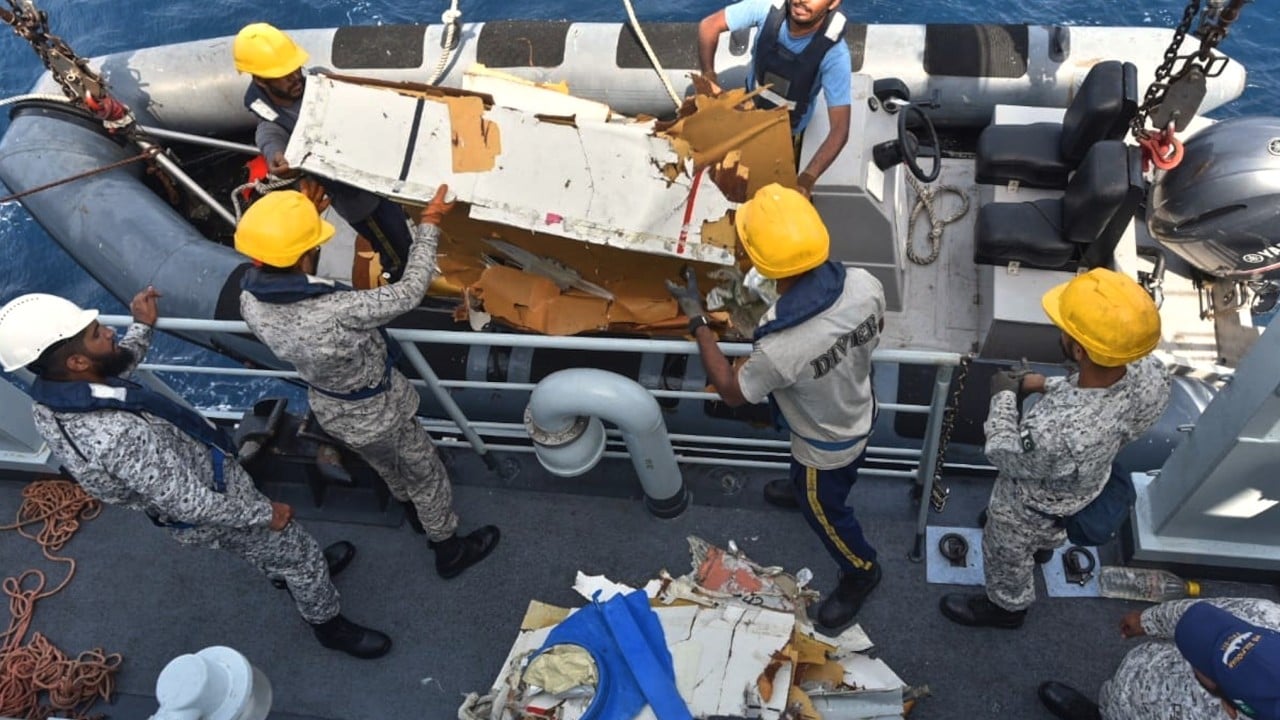
The sudden disappearance and subsequent structural fragmentation of the K2 Airways Boeing 737-400 freighter over the Arabian Sea underscores the compounding risks inherent in aging fleet logistics and deep-water salvage operations. At 21:18 PKT on Tuesday, the flight crew reported a catastrophic breakdown in their primary navigational systems while en route from Sharjah, UAE, to Karachi, Pakistan. Within three minutes, the aircraft exhibited extreme kinematic anomalies—including a sudden 5,000-foot plunge, an abrupt 6,000-foot corrective climb, and a final, near-vertical terminal descent exceeding 22,400 feet per minute. Radar telemetry terminated at 1,100 feet above sea level, approximately 155 nautical miles west of Karachi.
Analyzing the mechanics of this disaster requires looking past standard administrative briefings. Instead, the incident must be evaluated through two distinct operational frameworks: the structural and mechanical failure modes of 27-year-old converted airframes, and the complex mechanics governing deep-sea search and rescue asset allocation.
The Dual-Phase Kinematic Breakdown
Standard aerodynamic behavior dictates that even a total loss of propulsion results in a controlled glide ratio rather than an immediate vertical plunge. The Flightradar24 telemetry suggests a localized mechanical failure or extreme spatial disorientation, which can be mapped through a three-stage sequence of events.
- Phase 1: Navigational Decoupling (21:18 PKT): The crew reported a navigational system fault. In an airframe of this vintage, a loss of primary attitude or directional reference data forces reliance on standby instrumentation. If the failure extended to flight management computers or autopilot linkages, it would immediately spike the crew's cognitive load.
- Phase 2: The Pilot-Induced Oscillation / Control Deflection Loop (21:21 PKT): The plane plummeted 5,000 feet in under 60 seconds, followed by a rapid 6,000-foot ascent in 30 seconds. This extreme vertical translation indicates a massive destabilizing event. This could point to severe asymmetric structural failure, pitch-control mechanism unlinking, or aggressive manual overcorrections as the flight crew battled corrupted spatial data.
- Phase 3: Aerodynamic Stall and Structural Overstress: The final descent rate of 22,400 feet per minute indicates an aerodynamic upset, transitioning into a high-velocity, near-vertical dive. At 400 kilometers per hour along a vertical vector, the airframe likely experienced aerodynamic forces that exceeded its certified structural limits before it hit the water.
This sequence indicates a failure chain where a core subsystem malfunction escalated into an unrecoverable loss of control. It is highly probable that the aircraft was already experiencing structural disintegration before impact, which would explain why the early debris field was scattered across the surface.
The Kinematics of Airframe Aging and Conversion
The airframe involved was a 27-year-old Boeing 737-400 (MSN 29114) that had been heavily modified over its lifecycle. Airframe longevity and structural integrity are governed by strict engineering variables that change when an aircraft transitions from passenger to cargo use.
The Passenger-to-Freighter Structural Tax
When a passenger airliner is converted into a freighter (a Passenger-to-Freighter, or P2F conversion), its internal load distribution changes fundamentally. The installation of a main deck cargo door and robust floor loading systems modifies the stress concentration zones along the fuselage. Cargo operations also involve higher average payload weights, which accelerates fatigue on primary structural joints during takeoffs, landings, and turbulence.
Storage and Environmental Degradation
Airframe history plays a major role in its structural health. This specific aircraft spent extensive time in long-term storage across diverse climates, including periods in France, Jakarta, and a six-month stint in Karachi prior to its activation by K2 Airways.
When an airframe sits idle, it is highly vulnerable to environmental degradation. This can manifest as seal deterioration, fluid contamination, and localized galvanic corrosion within hidden structural pockets. The aircraft had also reportedly been grounded in Sharjah for 10 days to address a technical fault just before its final flight. This suggests a history of underlying maintenance issues that may have contributed to the final failure chain.
Deep-Sea Salvage Tactics and Oceanographic Bottlenecks
While the Pakistan Navy and Maritime Security Agency located floating debris 53 nautical miles south of Ormara within 12 hours, finding the main fuselage and the flight data recorders presents a major technical challenge. This operation is limited by several deep-sea recovery constraints:
[Surface Debris Located]
       │
       ▼ (Currents, Wind, and Waves Vector Displacement)
[Drift Modeling Matrix] ──► Extrapolates Hydrodynamic Variance
       │
       ▼
[Bathymetric Scanning Zone] ──► Deployment of Side-Scan Sonar & Towed Pinger Locators
       │
       ▼
[Deep-Sea Floor (3,000m)] ──► Deep-Water ROV Required for Black Box Extraction
The Surface Drift Matrix
Recovering floating pieces of the fuselage provides an immediate point of reference, but it does not pinpoint the main impact zone. The Arabian Sea is subject to heavy monsoon conditions, which generate strong surface currents, wind shear, and significant wave action.
These factors create a drift vector that displaces floating wreckage far from the original point of impact. Salvage teams must use hydrodynamic modeling to calculate back-drift patterns, working backward from where the debris was found to map out the primary underwater search area.
The Depth Barrier and Acoustic Attenuation
The ocean floor in this sector drops to depths of roughly 3,000 meters (9,800 feet). At these depths, standard search and rescue tools are ineffective. The recovery effort faces two major technical bottlenecks:
- Acoustic Signal Muting: The Underwater Locator Beacons (pingers) attached to the flight data recorders transmit at a frequency of 37.5 kHz. At 3,000 meters, this acoustic signal must travel through thermal layers and variable salinity zones, both of which bend and weaken the sound waves. This significantly reduces the detection range for towed pinger locators.
- Pressure and Light Limitations: At 3,000 meters, hydrostatic pressure reaches nearly 300 atmospheres, and there is zero natural light. Mapping the debris field requires specialized side-scan sonar arrays towed at depth, followed by deep-sea Remotely Operated Vehicles (ROVs) equipped with high-intensity lighting and robotic manipulators to recover the black boxes.
Regulatory and Fleet Risk Assessment
For regional cargo operations, this incident highlights a major vulnerability in logistics networks that rely on single-aircraft fleets. K2 Airways operated this lone Boeing 737-400 as its entire operational asset. Single-aircraft fleet profiles create immense commercial pressure to maximize airtime, which can inadvertently stress maintenance turnarounds and complicate safety oversight.
The Pakistan Airports Authority and Civil Aviation Authority will focus their investigation on the maintenance records from the aircraft's recent 10-day grounding in Sharjah. Investigators will need to trace whether the navigational system failure was an isolated avionics fault, a consequence of total electrical system failure, or a symptom of a deeper structural issue that disrupted the aircraft's wiring harnesses.
The immediate operational priority requires deployment of advanced bathymetric survey vessels equipped with deep-sea sonar. Surface recovery must transition to deep-water mapping within the 30-day battery window of the acoustic locators. If these black boxes are not recovered before their beacons expire, mapping the wreckage over a 3,000-meter deep ocean floor will shift from a standard technical salvage to an incredibly difficult, multi-year search operation.