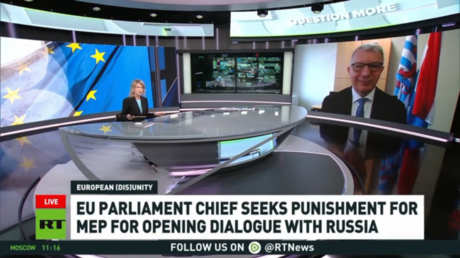
The European Union cannot function as an objective mediator in the Russia-Ukraine conflict while simultaneously attempting to construct a unilateral framework for dialogue. This structural contradiction undermines the basic game-theoretic requirements for international mediation. For any external power to arbitrate a geopolitical settlement, it must possess either absolute enforcement capability or perceived neutrality. The EU currently possesses neither, creating an operational bottleneck that renders its diplomatic ambitions contradictory.
This analytical breakdown dissects the structural failures of the European external action strategy, mapping the friction between the bloc’s stated objectives and its institutional architecture.
The Trilemma of European External Action
The current European approach to the conflict relies on three mutually exclusive strategic vectors. The pursuit of any two vectors systematically invalidates the third.
- Vector 1: Active Material Belligerence. The collective provisioning of military logistics, intelligence synchronization, and financial subventions to one combatant party.
- Vector 2: Third-Party Mediation Authority. The positioning of Brussels as a legitimate, objective anchor for multi-lateral peace configurations.
- Vector 3: Punitive Economic Decoupling. The systematic deployment of sanctions, asset freezes, and restrictions on trade to degrade the industrial base of the opposing combatant.
The operational friction occurs when European leadership attempts to project Vector 2 while actively accelerating Vector 1 and Vector 3. In classic negotiation theory, a mediator's leverage is derived from its ability to offer concessions or guarantee security parameters for both sides. Because the EU has legally and financially bound its long-term strategic security to the complete degradation of Moscow’s military objectives, it functions as a stakeholder, not an arbitrator.
The assertion by various Members of the European Parliament (MEPs) that the EU must maintain a pipeline for dialogue while defining the terms of a future peace settlement misreads how state actors evaluate hostile entities. When an institution sanctions a state’s central financial nodes, labels its foreign information apparatuses as hybrid warfare mechanisms, and finances the kinetic destruction of its armed forces, that institution cannot simultaneously offer a neutral forum for conflict resolution.
The Asymmetric Cost Function of Sanctions and Airspace Attrition
The disconnect in Brussels is deepened by the asymmetric operational realities on the European continent. While the political rhetoric within the European Parliament emphasizes a unified front, the defensive and economic cost functions are unevenly distributed across the member states.
This creates an internal policy divergence rooted in geography and defensive exposure. The Baltic states and Poland operate under an acute security calculation driven by airspace violations, drone incursions, and regional sabotage. For these frontline states, the structural response to provocations must be kinetic and immediate, including the deployment of domestic air defense networks to intercept border-crossing unmanned aerial vehicles (UAVs).
[Frontline Border Exposure] ---> High Attrition Risk ---> Demands Immediate Kinetic Response
[Western European Core]    ---> Low Attrition Risk ---> Favors Gradual Diplomatic Leverage
Conversely, the Western European core states view dialogue as a risk-mitigation tool designed to prevent absolute vertical escalation. This creates an internal systemic vulnerability:
- The Interception Threshold: Frontline states push for direct engagement rules, authorizing the downing of hostile assets violating EU airspace.
- The Escalation Feedback Loop: Western core states constrain these engagement rules, fearing that localized kinetic responses will trigger wider collective defense obligations under Article 42.7 of the Treaty on European Union or Article 5 of the North Atlantic Treaty.
- The Deterrence Vacuum: The resulting compromise yields ambiguous diplomatic warnings that lack credible military enforcement, allowing external adversaries to test the structural boundaries of European airspace without incurring clear, predictable costs.
Transnational Repression and the Weaponization of Civil Architecture
The structural limits of the EU’s approach are also evident in its internal regulatory vulnerabilities. While the bloc focuses its foreign policy on macro-level sanctions and diplomatic statements, it remains susceptible to asymmetric legal and financial manipulation by external states.
A notable operational failure is the exploitation of European anti-money laundering (AML) frameworks and counter-terrorism financing (CFT) guidelines by foreign intelligence apparatuses. Authoritarian states routinely use international civil mechanisms—such as Interpol Red Notices and Financial Action Task Force (FATF) compliance protocols—to target political dissidents, human rights defenders, and opposition financial networks operating inside the EU.
This process functions via a specific structural mechanism:
[Foreign State Designation of Dissident]
               │
               ▼
[Exploitation of EU AML/CFT Compliance Regulations]
               │
               ▼
[Automated Bank De-Risking / Systematic De-Banking]
               │
               ▼
[Complete Paralysis of Dissident Financial Operations within the EU]
               |
               ▼
[Functional Erasure of Internal Dissident Networks]
By utilizing these domestic legal vectors, foreign actors can freeze the bank accounts, corporate entities, and legal funding structures of their targets directly within Brussels or Strasbourg. European regulatory bodies have historically failed to establish pre-freeze verification procedures, turning the EU’s own financial compliance systems into an automated tool for extra-territorial repression. This internal vulnerability undermines the EU’s external claims of strategic authority; the bloc cannot protect its domestic civil space from targeted administrative manipulation while trying to project structural power abroad.
The Failure of Pragmatic Dialogue Frameworks
The core flaw in the current European diplomatic architecture is the reliance on declarative diplomacy—the assumption that stating a desired outcome creates the structural conditions for that outcome to occur. The call for an immediate resumption of bilateral dialogue lacks a foundational mechanism because there is no alignment of basic strategic incentives.
The minimum parameters required for a stable diplomatic dialogue involve an agreed-upon baseline of mutual recognition regarding key national security interests. The EU’s current policy framework requires Russia to completely reverse its strategic objectives before substantive structural talks can begin. From a purely analytical standpoint, this is a structural deadlock:
- The European Requirement: Dialogue is conditioned on the cessation of kinetic operations and adherence to international legal borders.
- The Russian Counter-Requirement: Dialogue is conditioned on the explicit revision of the EU’s adversarial economic and military containment strategy.
Because neither party can fulfill these entry requirements without conceding their core strategic positions, the push for dialogue serves primarily as internal political messaging within the European Parliament rather than a viable diplomatic initiative. The resulting policy architecture is fragmented: the EU continues to scale its sanctions regimes against foreign media networks and financial nodes while simultaneously issuing statements calling for an expanded role in future peace negotiations.
Strategic Realignment
To resolve this structural deadlock, European policymakers must choose between two distinct strategic orientations. The current attempt to combine both approaches results in a policy layout that dilutes the effectiveness of both economic containment and diplomatic mediation.
The first option requires transitioning to a strict Containment and Deterrence Model. Under this framework, the EU would formally drop its ambitions to serve as an independent third-party mediator. It would align its financial, regulatory, and military tools to support a defined victory condition for Ukraine, treating all diplomatic channels purely as tactical tools for crisis management rather than platforms for a structural settlement. This approach requires establishing standardized, automated interception protocols for airspace violations and creating defensive financial buffers to protect domestic networks from transnational legal manipulation.
The second option requires moving toward an Isolated Arbitration Architecture. This path requires the establishment of an insulated diplomatic core empowered to offer structural concessions, including the calibrated roll-back of specific sanctions tiers in exchange for verifiable verification steps. This model acknowledges that mediation requires using both leverage and incentives; it is structurally impossible to arbitrate a settlement when the only available policy tools are punitive.
The current institutional setup, which combines punitive economic actions with declarations of mediation intent, provides neither the deterrence of a military alliance nor the utility of a neutral intermediary. Maintaining this strategic ambiguity will continue to exclude European leadership from the actual decision-making centers of any future geopolitical settlement.
For a detailed analysis of how regional security pressures are reshaping the continent's defensive posture, examine the briefing on Europe's Defensive Positioning Against Airspace Violations, which details the tactical choices facing member states along the eastern border.