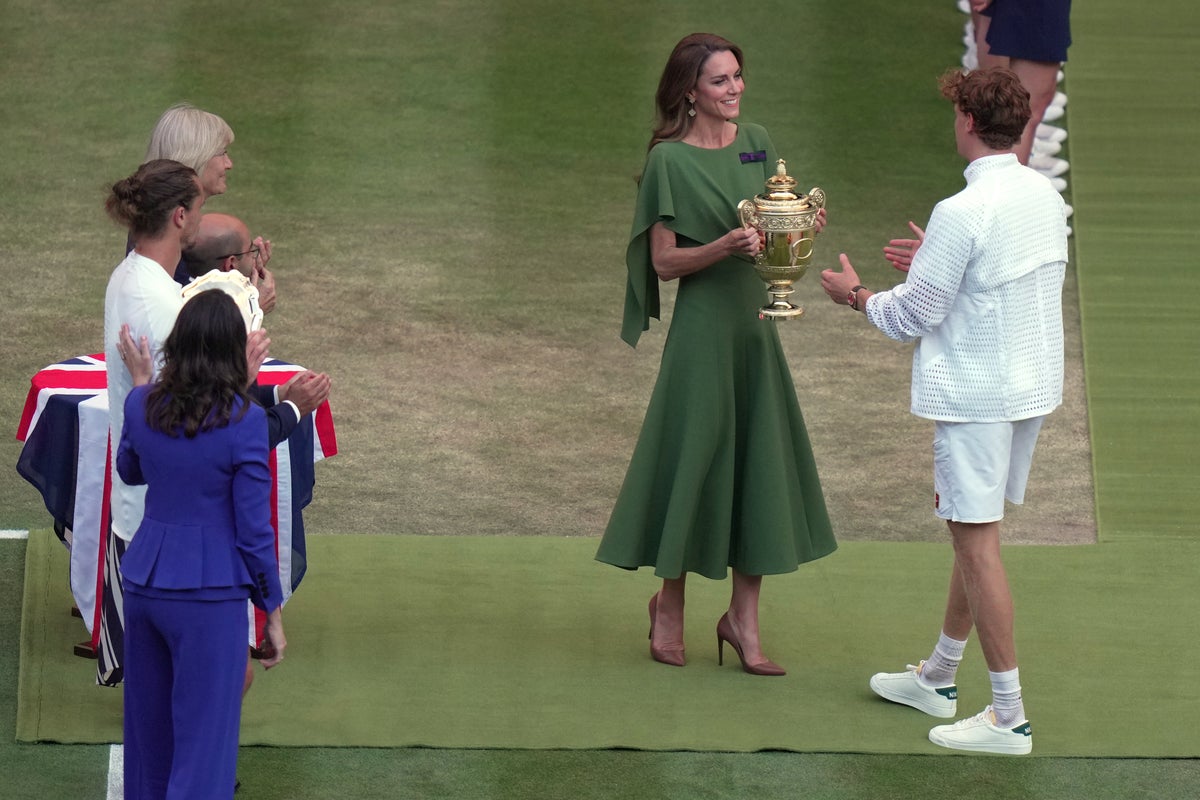
Elite grass court tennis is governed by a punishing mathematical reality: when two premier spot-servers meet on a low-friction surface, the margin of victory shrinks to a handful of high-leverage points. The 2026 Wimbledon gentlemen's singles final, a 3-hour, 46-minute engagement where Jannik Sinner defeated Alexander Zverev 6-7(7), 7-6(2), 6-3, 6-4, serves as a definitive case study in modern court geometry, mechanical degradation under pressure, and strategic risk management.
Traditional sports journalism attributed Sinner’s victory to vague concepts of "mental toughness" or a "momentum shift" following Zverev’s physical mishap in the third set. A cold review of the match dynamics reveals a far more clinical reality. The outcome was dictated by a measurable divergence in second-serve efficiency, structural imbalances in baseline movement patterns, and Sinner’s superior tactical adjustment to counter Zverev's hyper-aggressive first-serve execution.
The First Serve Efficiency Matrix and Surface Constraints
The primary competitive variable on grass is the absolute preservation of service games. Grass at SW19 presents a low-bounce, high-velocity profile that naturally compresses the time a receiver has to organize a return. Throughout the first two sets, both competitors operated at a functional equilibrium where breaking serve was functionally impossible without catastrophic mechanical failure.
Zverev built his early advantage on an elite first-serve display, finishing the match with 17 aces and a 76% first-serve landing rate. This high percentage acted as an insurance policy against Sinner's world-class return game. When Zverev landed his first serve, he won 72% of those points. However, the internal mechanics of his service architecture carry a structural vulnerability that Sinner successfully exploited as the match progressed.
The first set tiebreak demonstrated how microscopic variance dictates outcomes on this surface. The first 15 points of the tiebreak strictly followed the server's advantage. Zverev secured the set 9-7 because his technical execution remained completely stable under maximum stress, allowing him to find a flat, high-velocity forehand winner to close the opening stanza.
Sinner's service profile, while yielding a lower overall landing percentage at 64%, operated with a higher terminal efficiency. He converted 80% of his first-serve points and hit 15 aces. The fundamental difference lay not in the first-serve volume, but in the protection mechanisms of the second serve.
Second Serve Vulnerabilities and the Break Point Bottleneck
The structural divide between world number one and world number two becomes evident upon isolating second-serve data. On fast surfaces, the second serve is not merely a point-starter; it is a defensive metric testing a player's technical threshold under direct attack.
Service Performance Breakdown: Sinner vs. Zverev
+-----------------------------------+---------------+-----------------+
| Metric                            | Jannik Sinner | Alexander Zverev|
+-----------------------------------+---------------+-----------------+
| First Serve Percentage            | 64%           | 76%             |
| First Serve Points Won            | 80% (70/87)   | 72% (76/105)    |
| Second Serve Points Won           | 68% (32/47)   | 63% (20/32)     |
| Break Points Faced / Conceded     | 1 / 0         | 5 / 2           |
| Total Points Won                  | 145           | 130             |
+-----------------------------------+---------------+-----------------+
Sinner won 68% of his second-serve points, whereas Zverev fell to 63%. Because Zverev surrendered a higher percentage of neutral baseline points when missing his first delivery, he faced five break points across the four sets, surrendering two. Sinner, conversely, faced exactly one break point during the entire match, which he neutralized immediately.
This data exposes a critical systemic bottleneck for Zverev. His high first-serve percentage disguised an underlying passivity in secondary rallies. Sinner consistently applied depth through the center of the court on second-serve returns, taking away the extreme angles Zverev relies on to dictate points with his backhand. By denying Zverev immediate spatial control, Sinner systematically eroded the German's baseline rhythm.
Mechanical Asymmetry and The Low Bounce Penalty
The turning point of the match occurred at 3-all in the third set, an event commonly described as a freak accident but better understood through the lens of biomechanics and court surface physics. Zverev had earned his solitary break point of the match. Sinner executed a highly disguised drop shot, forcing Zverev into an explosive linear sprint followed by a rapid deceleration on grass—a surface notorious for its lack of traction when moving forward.
Zverev slipped, losing his balance and briefly clutching his right knee. While he escaped structural injury and avoided a repeat of his severe 2022 Parisian ankle trauma, the psychological and physical consequences altered his movement mechanics for the remainder of the set.
On grass, tall players must constantly bend from the knees to establish a low center of gravity. This position is mandatory to handle low-skidding slices and deep, flat groundstrokes. Following the slip, Zverev's movement patterns showed a quantifiable hesitation:
- Kinetic Chain Disruption: In the service game immediately following the fall, Zverev failed to drop his hips sufficiently when approaching low forehands and backhands. This lack of vertical flexion forced him to strike the ball with an open racket face, causing his groundstrokes to float.
- Deceleration Hesitation: Zverev's lateral recovery speed dropped noticeably. His willingness to plant his outside foot and change direction under maximum load was compromised by a protective cognitive bias against slipping again.
- The Baseline Unraveling: Sinner capitalized on this mechanical stiffness by immediately attacking Zverev's footwork. Sinner hit a flat forehand winner to break for 4-3 in the third set, an execution enabled entirely by Zverev's delayed recovery step.
This structural breakdown explains why Zverev threw his racket across the turf after looping a routine forehand long on break point. The error was not a failure of intent, but a direct consequence of a compromised kinetic chain.
Tactical Asymmetry in High-Density Baseline Rallies
With both players playing high-velocity tennis, the baseline exchanges became a contest of geometric restriction. Sinner hit 58 winners against 25 unforced errors across the 275 total points contested. This positive differential (+33) demonstrates an aggressive profile that remained highly accurate under pressure.
Sinner utilized a specific linear tactical framework to neutralize Zverev's elite crosscourt backhand. Instead of entering extended crosscourt backhand-to-backhand exchanges—where Zverev possesses a structural reach advantage—Sinner consistently altered the height and depth of his shots down the line.
Sinner's Baseline Distribution Strategy
1. Deep Center Return -> Restricts initial angle options for Zverev.
2. High-Velocity Low Slice -> Forces Zverev (1.98m) to alter his strike zone.
3. Aggressive Down-the-Line Forehand -> Explosive change of direction targeting Zverev's forehand wing on the move.
This strategy forced Zverev into lateral movement patterns that grew increasingly taxing after his third-set slip. Sinner's defensive flexibility allowed him to complete slides and full splits on grass without losing his baseline positioning, a physical capability that remains a massive differentiator in five-set tennis.
The Fourth Set Efficiency Variance
The fourth set illustrated Zverev’s elite baseline resilience, yet it simultaneously highlighted his tactical limitations against Sinner's current form. Zverev recovered his ball-striking depth, matching Sinner for the first six games of the set. The underlying issue, however, was that Sinner had unlocked Zverev’s service timing.
At 3-all in the fourth, Sinner manufactured the definitive break of the match. He achieved this by stepping inside the baseline to take Zverev's 130-mph first serves on the rise, shortening the German's recovery time. By converting defensive return positions into neutral baseline rallies instantly, Sinner forced Zverev into high-risk groundstroke selections. Zverev eventually overcooked a forehand long to surrender the break.
In the final game, serving at 5-4, Sinner faced immense resistance. Zverev produced two of the highest-quality defensive points of the tournament at 30-all, testing Sinner's lateral coverage to its absolute limit. Sinner responded with an extraordinary defensive sequence, scrambling across the baseline to execute a defensive lob before finishing the match with an emphatic forehand winner on his first championship point.
Long-Term Grand Slam Competitive Forecast
The data from this Wimbledon final establishes a clear developmental trajectory for both athletes moving into the hardcourt season and the remaining major championships.
For Alexander Zverev, the primary obstacle to securing a debut Grand Slam title remains his second-serve optimization and his tactical rigidity under pressure. Despite achieving his career-best run at SW19 and proving he can match the world number one across consecutive tiebreaks, his performance ceiling drops sharply when his first-serve landing rate dips below 70%. Future opponents will look to replicate Sinner's strategy of deep, central returns to lock Zverev into lateral movement tests.
For Jannik Sinner, this successful title defense cements a multi-surface dominance that will be exceptionally difficult to disrupt. His ability to maintain a positive winner-to-unforced-error ratio (+33) against an opponent serving at a 76% clip is a performance baseline that few players in the modern era can replicate. His tactical evolution suggests that his current hold on the world number one ranking is insulated by a sophisticated understanding of surface mechanics and point construction, making him the definitive favorite for any upcoming fast-court tournaments.