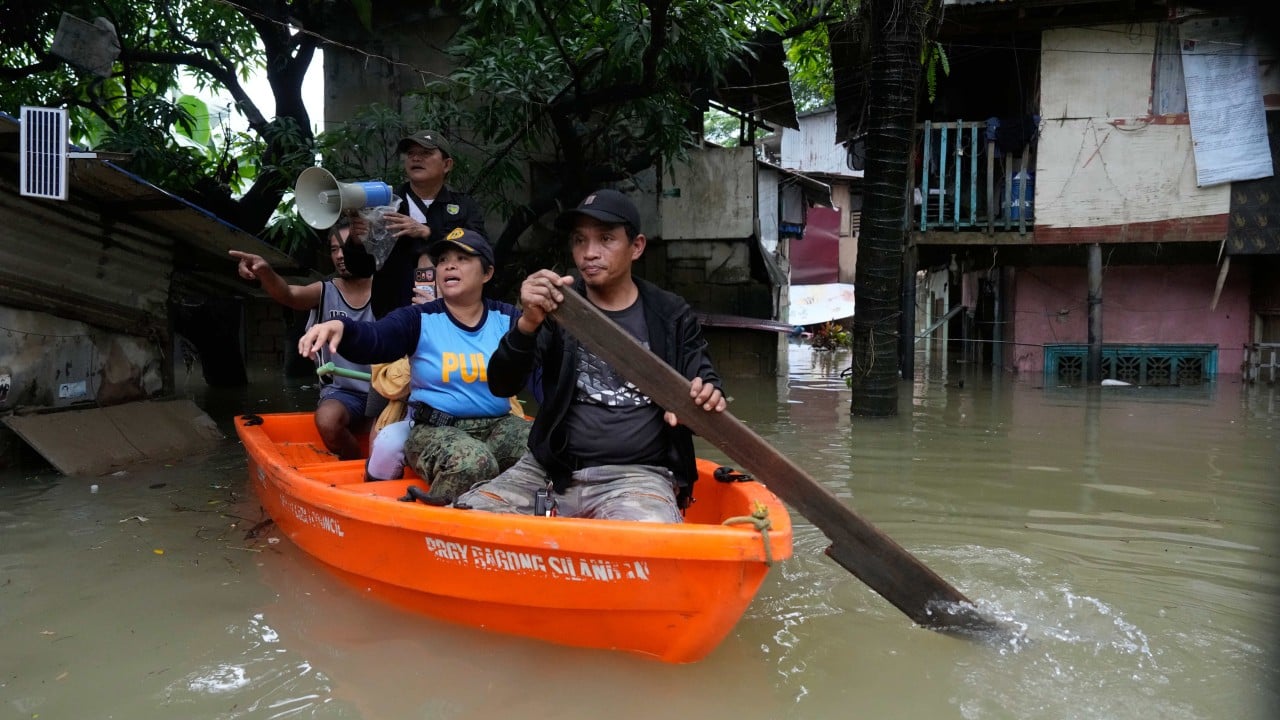
The convergence of the southwest monsoon and concurrent tropical cyclone activity across the Western Pacific basin exposes structural vulnerabilities in archipelagic disaster management. When continuous precipitation metrics exceed historical monthly averages by margins nearing fifty percent within a single decade-fraction—such as the over fourteen hundred millimeters recorded in mountainous urban centers like Baguio—standard emergency response functions collapse under systemic strain. Dissecting the mechanics of these recurring crises requires moving past raw casualty counts to evaluate the hydraulic, geological, and administrative vectors that turn seasonal weather patterns into systemic catastrophes.
The Tripartite Vector of Environmental Failure
The mechanics of disaster propagation in the Philippine archipelago operate through three distinct, compounding physical channels. Understanding these channels explains why standard evacuation protocols frequently fail to mitigate life safety risks.
- Hydrological Saturation and Runoff Velocity: Urban centers and low-lying alluvial plains experience rapid hydraulic saturation. When soil absorption capacities reach zero, precipitation transforms instantly into high-velocity surface runoff. This kinetic energy overwhelms urban drainage architectures, which are frequently compromised by decades of substandard infrastructure maintenance and localized subsidence.
- Geotechnical Mass Movement: Steep topographical profiles, particularly across Luzon and central regional cordilleras, create high susceptibility to slope failure. Continuous antecedent rainfall elevates pore-water pressure within colluvial soils. Once internal shear stress surpasses the shear strength of the sub-surface strata, structural slope collapse occurs without warning, burying informal settlements located on marginal hillsides.
- Cyclonic Force Multipliers: The interaction between the southwest monsoon and active tropical systems acts as a thermodynamic engine. This interaction funnels moisture-laden maritime air continuously against coastal and high-altitude barriers, locking affected provinces into prolonged, multi-day precipitation loops that prevent floodwaters from receding between tidal cycles.
The Economic and Administrative Cost Function
Macro-level disruptions follow a predictable economic arc that impacts regional productivity and national fiscal stability. The cost function of these hydro-meteorological events is defined by immediate asset destruction offset against long-term continuity failures.
Administrative downtime represents the primary economic drain during acute weather events. When the executive branch mandates remote work and suspends public schooling across Metro Manila and dozens of surrounding provinces, the immediate friction affects millions of knowledge and service sector workers. While these interventions successfully reduce traffic-related exposure and prevent mass transit strandings, they expose the fragility of economic output in service-dependent emerging markets where remote infrastructure lacks universal redundancy.
Concurrently, supply chain blockages isolate regional production nodes. Port closures and inter-island maritime suspension trap thousands of cargo handlers and passengers, halting the flow of goods across domestic shipping lanes. The physical destruction of bridges, arterial highways, and municipal power grids shifts state expenditure away from productive capital investment toward emergency response, rehabilitation, and reactive infrastructure repair.
Institutional Bottlenecks in Risk Mitigation
Disaster response in high-frequency hazard zones is frequently hampered by structural gaps between predictive modeling and localized enforcement. While national meteorological agencies provide accurate advance warnings regarding rainfall volume and cyclone trajectories, municipal execution faces severe constraints.
Informal settlements present the most acute operational bottleneck. Rapid urbanization and economic displacement force significant portions of the population to inhabit high-risk ecological zones, including steep landslide-prone scarps and active riverbanks. Standard pre-emptive evacuation protocols often encounter resistance due to a lack of secure, long-term alternative housing and fears of asset theft among displaced communities. Consequently, evacuation efforts frequently transition from pre-emptive relocation to reactive search and rescue operations after structural collapses occur.
Furthermore, historical compromises in public works engineering compound current risk profiles. Decades of substandard flood-control implementation—ranging from under-engineered drainage canals to compromised sea walls—mean that capital injections into disaster mitigation yield diminished returns. Without rigorous, independent engineering audits of past interventions, new capital spending flows into systems that fail under standard 25-year return-period flood events.
Strategic Resource Allocation and Operational Realignment
Mitigating the recurrence of high-casualty flood and landslide events requires an operational pivot from reactive emergency management to proactive structural hardening. Municipal authorities must decouple disaster management from political cycles, enforcing strict zoning laws that permanently prohibit permanent human habitation within high-angle geotechnical hazard zones and active floodways.
Capital expenditure must prioritize decentralized, nature-based infrastructure solutions, including upland afforestation to regulate runoff velocity, paired with engineered retention basins designed to capture peak discharge before it reaches densely populated urban basins. Regional logistics networks require dedicated secondary staging areas to maintain supply chain integrity when primary maritime and land routes face closure.
Ultimately, reducing systemic vulnerability depends on transitioning from crisis response tracking to predictive asset resilience. Until the structural integrity of public works matches the increasing frequency of high-energy weather systems, the archipelago will remain bound to a cycle of administrative disruption and preventable loss.
:max_bytes(150000):strip_icc()/ar-American-Cheese-taste-test-horizon-4x3-54cc339550cd44b9a818c17bdfd5428d.jpg)