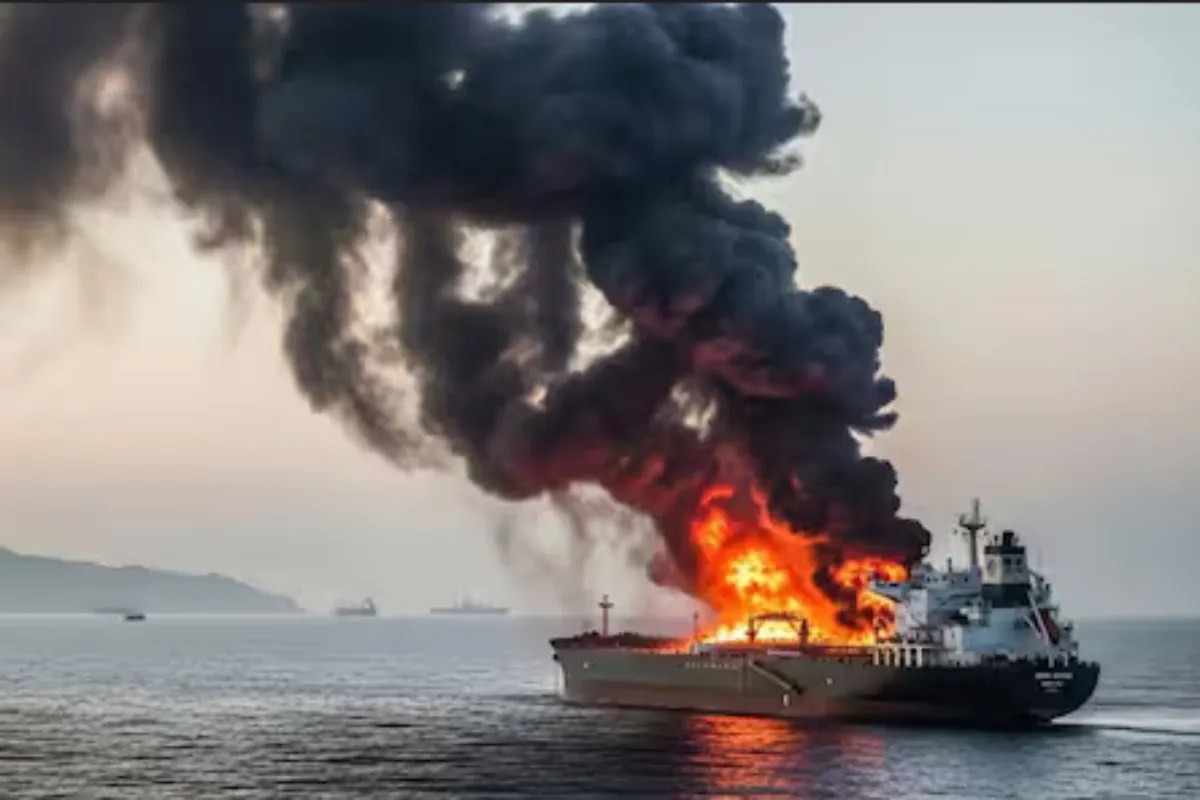
The escalation of kinetic operations in the Gulf of Oman highlights a structural shift in maritime trade enforcement. The deployment of precision-guided munitions against commercial tankers—specifically the Palau-flagged M/T Settebello, the Guinea-Bissau-flagged M/T Jalveer, and the unladen Marivex—represents a transition from traditional legal and economic sanctions to direct tactical interdiction.
This environment creates an acute operational vulnerability for third-party labor suppliers, particularly India, which provides a significant portion of global seafaring personnel. Deconstructing these events requires an evaluation of the strategic logic of the naval blockade, the tactical mechanics of the kinetic strikes, and the geopolitical friction generated between allied nations when economic warfare results in civilian casualties.
The Structural Mechanics of a Naval Blockade
A naval blockade operates as an instrument of economic warfare designed to sever an adversary's commercial supply lines, restricting both import capabilities and export-derived revenue. In the current geopolitical alignment, the United States has instituted a strict maritime blockade targeting Iran-linked shipping and vessels operating in non-compliance with international sanctions or unilateral mandates.
The strategic architecture of this enforcement mechanism relies on three distinct operational categories of commercial shipping:
- OFAC-Sanctioned Vessels: Ships explicitly designated by the United States Department of the Treasury’s Office of Foreign Assets Control due to direct ownership, management, or financial ties to sanctioned regimes.
- Non-Compliant Logistics: Vessels caught transporting illicit cargo, such as Iranian crude or petroleum products, or attempting to enter restricted maritime zones without authorization.
- Compliant and Humanitarian Transit: Merchant shipping that adheres to routing directives, submits to verification protocols, or carries verified humanitarian aid, which is structurally permitted to pass through the contested corridor.
A blockade is legally and operationally unsustainable without consistent enforcement. If a non-compliant vessel successfully bypasses naval checkpoints, the systemic deterrent threshold degrades. This logic explains the escalation from standard hailing procedures to kinetic intervention when the M/T Settebello and M/T Jalveer attempted to navigate through the Gulf of Oman.
The Kinetic Enforcement Hierarchy
The use of military force against a commercial merchant vessel follows a strict, escalating protocol designed to minimize unintended casualties while ensuring compliance. The operational breakdown of the recent engagements reveals a calculated sequence that ultimately failed to secure verbal cooperation, resulting in kinetic strikes.
Phase One: Broad-Spectrum Communication and Intercept
Enforcement forces establish contact via international maritime hailing frequencies (VHF Channel 16) and specialized military channels. The enforcing warship issues clear transit restrictions, commanding the targeted vessel to alter its course, halt its engines, or prepare for a board, search, and seizure operation. In the case of the Marivex, the vessel reportedly altered its trajectory three separate times following initial warnings, illustrating a deliberate attempt to probe the boundaries of the enforcement zone before attempting a final high-speed run through Omani territorial waters.
Phase Two: Tactical Escalation and Non-Compliance
When a merchant hull ignores verbal and electronic directives, the legal framework shifts from passive monitoring to active interdiction. The defiance of multiple warnings over multi-week periods—as reported by crew members aboard the Settebello—signals to naval command that the vessel is operating under explicit instructions to run the blockade. At this junction, the enforcing authority assumes a hostile intent to violate international mandates, triggering the authorization for a precision strike.
Phase Two: Surgical Engineering Interdiction
The tactical objective of the strike is not to sink the vessel, which would cause an catastrophic environmental disaster and completely block vital shipping lanes. Instead, the mechanism relies on disabling the ship’s propulsion and steering capabilities.
To achieve this, aircraft such as the F/A-18 Super Hornet launched from the USS Abraham Lincoln utilize precision-guided munitions—specifically Hellfire missiles or low-yield laser-guided bombs—directed exclusively at the ship's engineering spaces. By targeting the engine room, the strike neutralizes the vessel’s operational mobility. However, this exact tactical choice introduces an inherent human risk: the ship’s engineering crew (fitters, oilers, and engineers) are directly positioned within the primary impact and thermal blast zone.
The Human Cost Function of Flag of Convenience Shipping
The deaths of three Indian seafarers aboard the M/T Settebello—Aditya Sharma (deck cadet), Shivanand Chaurasiya (engine fitter), and Patnala Suresh (chief engineer)—and the subsequent strike on the M/T Jalveer expose a critical structural vulnerability in global maritime logistics. This vulnerability is governed by the economics of the "Flag of Convenience" (FOC) system and the demographic realities of maritime labor.
[Global Ship Owners / Charterers]
             │
             ▼ (Financial Arbitrage)
[Flags of Convenience: Palau / Guinea-Bissau]
             │
             ▼ (Labor Outsourcing)
[Third-Party Manning Agencies]
             │
             ▼ (Operational Risk)
[Third-Country Mariners: Indian Seafarers]
Under the FOC framework, ship owners register their vessels in nations like Palau, Panama, or Guinea-Bissau to take advantage of minimal tax environments, relaxed regulatory oversight, and flexible labor laws. The actual operational crew, however, is routinely sourced from third-country nationals through international manning agencies. India represents one of the largest global exporters of highly skilled seafaring labor.
This creates a severe decoupling of risk and accountability:
- Sovereignty Dissociation: The state whose flag the ship flies (e.g., Palau) rarely possesses the diplomatic clout or naval capability to protect the vessel or its crew in a combat zone.
- Labor Exposure: Merchant mariners from developing or emerging economies accept contracts on these vessels without possessing real-time intelligence regarding the shifting geopolitical profile or sanction status of the cargo they are transporting.
- Targeting Asymmetry: Enforcing naval forces categorize the vessel based entirely on its flag, its destination, and its cargo profile. The national identity of the civilian crew on board does not alter the tactical status of the hull once it is deemed non-compliant.
When the engine room of the Settebello was struck, the tactical success of disabling the ship was directly offset by the human cost inside the engineering space. The chief engineer and engine fitter were positioned precisely where the kinetic energy and subsequent thermal fire occurred, highlighting how third-party civilian mariners bear the direct physical cost of macroeconomic blockades.
Diplomatic Friction and Sovereign Realignment
The diplomatic fallout following these kinetic actions illustrates how tactical enforcement can disrupt broader strategic partnerships. India’s decision to summon the United States Embassy’s Deputy Chief of Mission in New Delhi to lodge a "strong protest" underscores a deep systemic tension.
For New Delhi, the situation presents a dual challenge. India is a key partner in maritime security frameworks, yet its foreign policy remains intensely protective of its citizens working abroad. The Ministry of External Affairs must balance its structural alignment on global freedom of navigation with the domestic political necessity of protecting Indian laborers from allied military action.
The official Indian position—calling for an immediate de-escalation and declaring that the targeting of commercial shipping must end—highlights a fundamental disagreement on the boundaries of blockade enforcement. While the United States views the strikes as legal, surgical measures to maintain the integrity of a critical blockade, India categorizes them as disproportionate kinetic actions that place civilian mariners in unacceptable peril.
This friction creates an operational bottleneck for future maritime enforcement. If the United States continues to utilize kinetic disables against FOC vessels crewed by Indian nationals, it risks alienating a critical Indo-Pacific partner. Conversely, if it grants immunity or reduces enforcement severity based on the crew's nationality, the efficacy of the entire blockade drops significantly, as non-compliant networks will simply exploit this loophole.
Operational Risk Mitigation for Commercial Maritime Interests
To navigate this highly volatile environment, maritime shipping companies, cargo charterers, and national labor boards must abandon passive risk management and implement rigorous verification frameworks. Relying entirely on traditional maritime law or flag-state protections is no longer sufficient when operating in contested choke points.
- Continuous Sanction and Cargo Auditing: Manning agencies and maritime unions must implement real-time tracking of vessel ownership, ultimate beneficial owners, and Office of Foreign Assets Control compliance status. Seafarers must be granted the legal right to refuse deployment on any hull flagged as non-compliant or under active investigation without facing contractual or financial penalties.
- Establishment of De-confliction Thresholds: National governments exporting maritime labor must negotiate clear operational rules of engagement with blockading forces. These frameworks should mandate extended electronic verification windows, mandatory non-kinetic boarding attempts prior to weapon release, and automated distress broadcasts directly to regional consulates when a ship enters a non-compliance status.
- Engineering Space Vulnerability Adjustments: Ship designers and operators must recognize that as long as precision engineering interdictions remain the primary tool for naval disabling actions, the engine room is functionally a high-risk combat zone. Standard operating procedures during transit through contested blockades must minimize the physical footprint of personnel in these spaces, utilizing remote telemetry and automated monitoring systems whenever a vessel is hailed or challenged by naval forces.