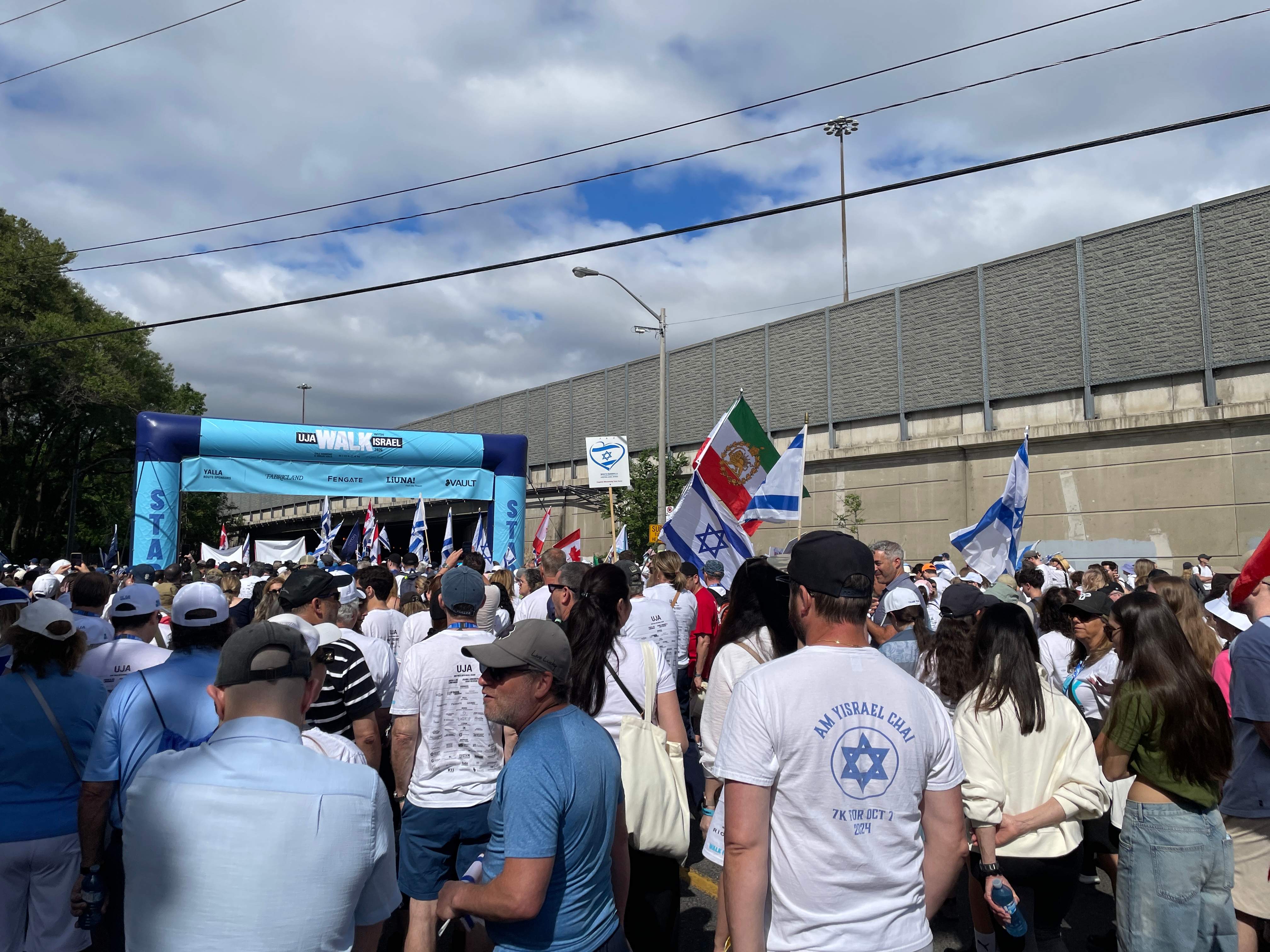
The annual Walk With Israel in Toronto provides a textbook case study in mass event risk management within a highly polarized urban environment. On June 7, 2026, an estimated crowd matching previous benchmarks of 56,000 to 60,000 participants moved along a 3.9-kilometer corridor in North York, extending from the Temple Sinai Congregation on Wilson Avenue to the United Jewish Appeal (UJA) Sherman Campus on Bathurst Street.
Managing a gathering of this scale under elevated geopolitical tension cannot rely on general policing. It requires a structured framework that treats urban space as a dynamic containment system. The success of the operation depended on balancing public assembly rights with asymmetric threat mitigation.
The Three Pillars of Tactical Containment
To prevent ideological friction from escalating into physical violence, the Toronto Police Service (TPS), in coordination with regional partners, implemented a security architecture built on three distinct structural layers.
[Outer Perimeter: Mobile Interdiction] -> [Buffer Zone: Intersectional Containment] -> [Inner Route: Linear Segregation]
1. Spatial Segregation and Perimeter Hardening
The primary tactical objective was the complete elimination of cross-contamination between the main demonstration body and counter-protest factions. This was achieved through rigid physical infrastructure. Heavy barricades sealed off the entire 3.9-kilometer route, converting public thoroughfares into isolated transit corridors. Vehicle access was completely restricted from 7:00 a.m. to 4:00 p.m. across critical arteries, including Wilson Avenue, Avenue Road, and Bathurst Street up to Ellerslie Avenue. To counter the threat of vehicular ramming attacks, hostile vehicle mitigation (HVM) devices—including heavy physical blockers and strategically positioned tactical vehicles—were deployed at every major intersection.
2. Multi-Jurisdictional Force Multiplication
The scale of the perimeter necessitated a massive deployment of personnel that exhausted local municipal capacity. The operational response relied on a coordinated framework incorporating assets from multiple tiers of Canadian law enforcement:
- Municipal Assets: Toronto Police Service units, including specialized bicycle, public order, and mounted units.
- Regional Reinforcements: Personnel drawn from the Peel Regional Police, York Regional Police, and Durham Regional Police services.
- Provincial Oversight: Ontario Provincial Police (OPP) units acting as strategic reserves.
This multi-agency approach expanded the visible footprint of law enforcement to establish immediate psychological deterrence along the boundary lines.
3. Asymmetric Asset Integration
Beyond visible static personnel, the security framework integrated specialized units designed to handle non-traditional threat vectors:
- Aerial Domain Management: The deployment of low-altitude surveillance assets to monitor crowd density and movement patterns. This operational layer included counter-drone enforcement, resulting in the immediate arrest and ticketing of an unauthorized drone operator under Canadian aviation regulations near Earl Bales Park.
- Tactical Deterrence: The deployment of specialized Public Order units equipped with helmets and long guns at high-friction flashpoints, specifically the intersection of Bathurst Street and Sheppard Avenue West.
- Information Gathering: Undercover intelligence officers embedded within peripheral crowds to identify agitators before they could disrupt the primary march column.
The Cost Function of Flashpoint Deflection
The core operational challenge of managing mass public assembly under tension is that conflict cannot be entirely prevented; it can only be displaced or minimized. Law enforcement operated under a strict zero-tolerance enforcement mandate for boundary breaches, leading to four distinct tactical interventions over the course of the day.
| Incident Time | Location | Charge / Action | Tactical Implication |
|---|---|---|---|
| 08:40 a.m. | Bathurst St. & Sheppard Ave. W. | Obstruction of a Peace Officer | Early intervention preventing a breach of the forming perimeter before the march commenced. |
| 10:20 a.m. | Earl Bales Park | Assaulting a Peace Officer | Immediate isolation of physical resistance within a known high-friction zone. |
| 11:00 a.m. | Earl Bales Park Area | Drone Operation Violation | Elimination of unauthorized aerial surveillance and potential payload delivery vectors. |
| 11:45 a.m. | Route Perimeter | Breach of the Peace | Preventive detention to halt escalating verbal hostility from turning into physical altercations. |
The concentration of these incidents around the intersection of Bathurst Street and Sheppard Avenue West confirms that urban bottlenecks act as natural attractors for counter-demonstrators. The data shows that the tactical decision by law enforcement to build an aggressive, resource-heavy buffer zone at this specific intersection prevented these localized disruptions from collapsing the broader security perimeter.
Operational Constraints and Long-Term Vulnerabilities
While the security deployment successfully maintained physical separation and prevented mass-casualty incidents, the framework reveals significant structural limitations when evaluated from a long-term urban planning and economic perspective.
The first limitation is fiscal and resource sustainability. Deploying hundreds of officers from five distinct law enforcement agencies for a single-day event creates an massive financial burn rate. This level of resource concentration requires shifting personnel away from standard municipal policing duties, creating a temporary security deficit in other sectors of the Greater Toronto Area.
The second limitation involves the friction generated within the local economy. The complete closure of major commercial corridors for nine hours inflicts a direct economic cost on local businesses that rely on vehicular traffic and weekend foot traffic.
This creates a bottleneck where city administration must choose between two suboptimal outcomes: either incur high financial and logistical costs to guarantee absolute safety, or reduce the security presence and accept a significantly higher risk of civil unrest.
The operational blueprint executed in Toronto demonstrates that securing highly polarized mass events requires moving away from reactive policing toward proactive spatial engineering. Future municipal strategies must rely less on raw numbers of personnel and more on permanent, rapidly deployable physical barrier infrastructure and advanced counter-drone technology to lower the overall cost function of public safety management.