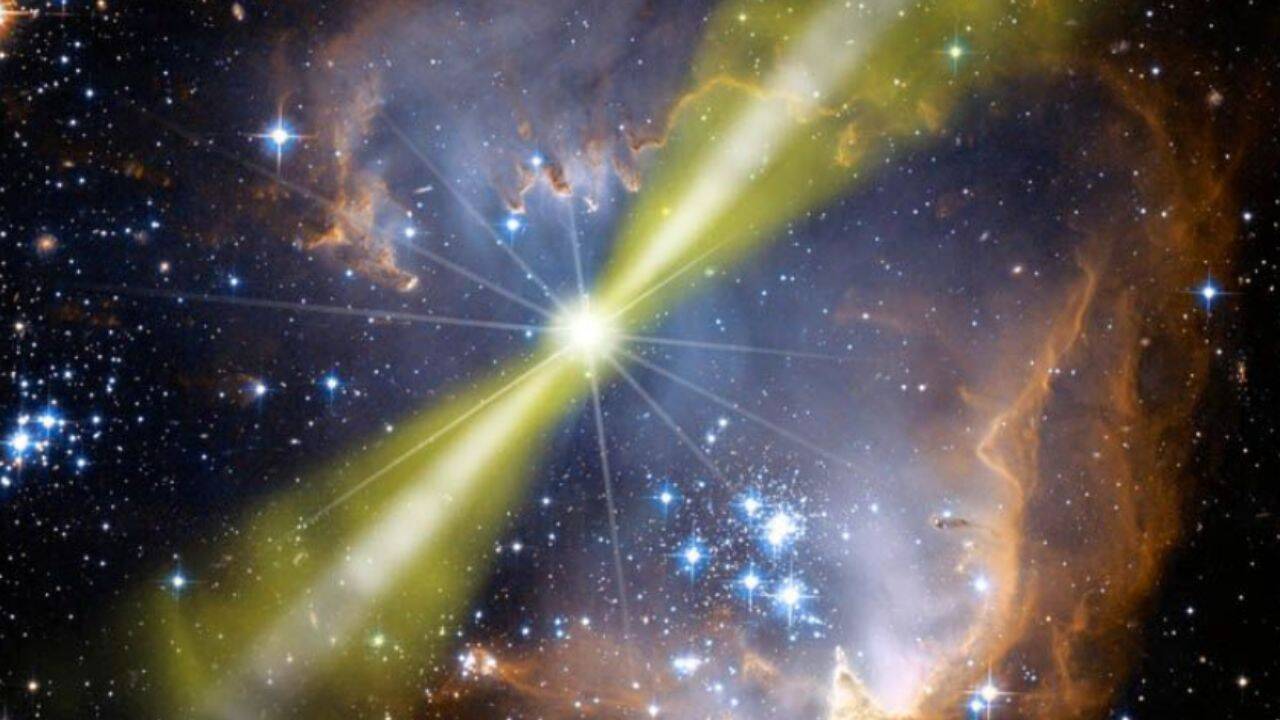
The detection of cosmic phenomena rarely follows a linear path of academic curiosity. More often, major breakthroughs emerge as operational byproducts of geopolitical surveillance. In 1967, the United States military launched the Vela satellite constellation, a network engineered with a singular, high-stakes mandate: monitor the Earth and its atmosphere for clandestine violations of the Nuclear Test Ban Treaty. These spacecraft carried scintillation detectors designed to register the sharp, distinct gamma-ray signatures characteristic of atomic detonations.
Instead of detecting unauthorized terrestrial detonations, the instrumentation recorded high-energy photon fluxes originating from deep space. These transients, subsequently classified as Gamma-Ray Bursts, revealed an entirely unknown class of astrophysical events. This historical crossover between military intelligence gathering and fundamental astrophysics demonstrates how institutional monitoring infrastructure can accidentally map the boundaries of the physical universe. If you found value in this piece, you might want to check out: this related article.
The Detection Architecture of the Vela Satellites
To understand how a nuclear-monitoring platform captured deep-space transients, one must examine the constraints of orbital reconnaissance in the late 1960s. The Vela system relied on a decentralized array of spacecraft placed in high orbits, far above the radiation belts, to maximize their field of view and minimize interference from trapped planetary particles.
The primary sensor suite utilized cesium iodide or plastic scintillators coupled with photomultiplier tubes. When high-energy gamma photons collided with the detector material, they deposited energy that was converted into flashes of light, subsequently transformed into electrical pulses. The operational logic was straightforward: For another angle on this story, check out the latest update from MIT Technology Review.
- A localized spike in photon counts across specific energy bands indicated a radiation event.
- Triangulation algorithms compared the exact arrival timestamps across multiple satellites in the constellation.
- Directional vectors were calculated to determine whether the source originated on Earth, in the atmosphere, or from exo-atmospheric vectors.
When the Vela 4 and Vela 5 satellites recorded brief, intense flashes of gamma radiation that failed to correlate with any terrestrial nuclear detonation, the telemetry data defied standard operational categorization. The time-of-arrival differentials across the constellation proved that the wavefronts were planar rather than spherical, confirming an origin point far beyond the solar system. The instrumentation built to monitor terrestrial compliance inadvertently mapped deep space.
The Mechanics of Gamma Ray Bursts
Gamma-ray bursts represent the most luminous electromagnetic events in the observable universe. Understanding why the Vela satellites registered them requires breaking down their physical drivers and emission profiles.
These events are categorized into two distinct operational windows based on duration and spectral hardness:
- Short-duration bursts: Lasting less than two seconds, these events are driven by the merger of compact binary objects, specifically neutron star pairs or a neutron star and a black hole. The gravitational collapse releases a jet of ultra-relativistic material.
- Long-duration bursts: Extending beyond two seconds, these transients are linked to the core collapse of massive, rapidly rotating stars known as collapsars. As the stellar core collapses directly into a black hole, relativistic jets punch through the dying star's outer envelope.
In both operational profiles, kinetic energy is converted into gamma radiation through internal shocks within the ultra-relativistic jet or via external shocks as the jet plows into the surrounding interstellar medium. Because the Vela detectors possessed high temporal resolution, they captured the initial prompt emission phase—the chaotic, millisecond-scale variability that encodes the geometry of the central engine.
The Institutional Classification Lag
A critical systemic failure in early space-based reconnaissance was the delay between data capture and public or scientific dissemination. Because the Vela constellation operated under strict military classification, the telemetry logs containing the first gamma-ray burst signatures remained sequestered for years.
This creates a structural bottleneck in scientific progress: when dual-use technologies are deployed, civilian research often suffers from access latency. The United States Department of Defense prioritized treaty verification over astrophysical discovery. Consequently, the data sat unanalyzed by the broader academic community until 1973, when Los Alamos scientists, led by Ray Klebesadel, Ian Strong, and Roy Olson, formally published the findings.
The operational lag exposed a vulnerability in how state-sponsored technology handles serendipitous discovery. A rigid adherence to security protocols suppresses the immediate feedback loops necessary for rapid theoretical iteration. Had the data been released to open-source channels immediately, the astrophysical community could have begun developing models for relativistic shocks decades earlier.
Methodological Parallels in Modern Sensor Networks
The accidental discovery of gamma-ray bursts establishes a historical precedent that continues to govern modern instrumentation. Today, space-based platforms designed for one objective routinely deliver foundational data for entirely unrelated domains.
Consider modern orbital architectures:
- Infrared early-warning satellites designed to track intercontinental ballistic missile launches now serve as primary inputs for wildfire detection and meteorological monitoring.
- Commercial synthetic aperture radar constellations optimized for maritime surveillance provide high-resolution crustal deformation data utilized in seismology.
- Deep-space communication arrays adapted for planetary defense track near-Earth object trajectories by repurposing radar bounce telemetry.
The underlying economic and engineering principle remains constant. Building custom sensor networks for niche scientific applications is often cost-prohibitive. By piggybacking on high-capital state security infrastructure, researchers can exploit existing surveillance grids as passive scientific instruments.
Strategic Deployment of Dual-Use Arrays
Maximizing the utility of state-backed sensor networks requires deliberate design choices during the initial engineering phase. To replicate the serendipitous success of the Vela program without relying purely on chance, modern systems architects implement specific structural adaptations.
Data pipelines must feature open-access secondary channels. While primary telemetry remains compartmentalized for security or proprietary operations, secondary diagnostic streams can be routed to academic or public repositories with minimal latency. This decoupling prevents the institutional information bottlenecks that delayed gamma-ray burst research in the 1970s.
Furthermore, sensor calibration protocols must account for out-of-band anomalies. When an instrument registers a signal that falls outside its operational parameters, standard automation often discards the data as noise. By programming anomaly-retention algorithms into the onboard processors, satellite operators ensure that unexpected phenomena—whether a terrestrial atmospheric anomaly or an extragalactic transient—are preserved for downstream analysis.
Deploy autonomous multi-messenger triggers across heterogeneous sensor networks to ensure that high-energy anomalies captured by orbital platforms immediately cue ground-based optical, radio, and gravitational-wave observatories.