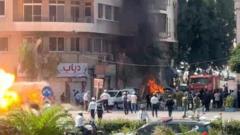
The dual improvised explosive device (IED) detonations in central Damascus on July 7, 2026, targeting the immediate vicinity of the French presidential delegation, expose the structural friction between political normalization and operational security in transitional states. While the Elysee Palace confirmed that President Emmanuel Macron was unharmed at the presidential palace during his meeting with Syrian President Ahmed al-Sharaa, the wounding of 18 individuals—including four police officers—near the Victoria Bridge and the Four Seasons Hotel undercuts the central thesis of the new Syrian administration: that it possesses a monopoly on the legitimate use of violence within the capital.
This security failure cannot be analyzed as an isolated insurgent action. It represents a systemic failure in the state's domestic intelligence and counter-IED disruption pipelines, occurring less than a week after a similar detonation killed ten people at a cafe near the Palace of Justice. For international capital and foreign state delegations, these events establish a stark calculus: diplomatic recognition does not equate to sovereign control, and institutional transitions remain highly vulnerable to low-cost, asymmetric disruption.
The Triad of Transitional Asymmetric Risk
Evaluating the security apparatus of the post-Assad administration requires a framework that isolates the variables allowing non-state actors to operate within heavily fortified administrative zones. The Damascus security architecture fails across three distinct vectors.
1. The Perimeter Disruption Deficit
The Syrian interior ministry indicated that the explosive devices—one concealed within a parked vehicle and the second inside a refuse container—detonated during active intervention procedures by local disposal units. This indicates a profound breakdown in preventive detection. In high-threat environments hosting foreign heads of state, the baseline operational standard requires a sterile zone extending well beyond the physical lodging of the delegation. The presence of uncleared civilian vehicles and unsealed refuse infrastructure within 200 meters of the French delegation's primary staging area reveals a critical flaw in exclusionary perimeter management.
2. The Intelligence Integration Gap
The transition from an insurgent coalition (formerly led by Hayat Tahrir al-Sham) to a centralized state bureaucracy introduces friction in intelligence continuity. Security agencies in Damascus are currently operating with fragmented databases, legacy informant networks that have been compromised or dismantled, and a lack of technical signal intelligence capabilities. This creates an environment where clandestine cells affiliated with remnants of the former regime, Islamic State offshoots, or autonomous militias can transport, plant, and arm explosive components without triggering pre-emptive state interventions.
3. The Counter-Disposal Capability Bottleneck
The wounding of four police officers during the preparation phases of the disarmament process indicates a deficit in specialized tactical gear and electronic countermeasures (ECM). Advanced counter-IED protocols dictate the deployment of localized radio-frequency jamming to neutralize remote dual-tone multi-frequency (DTMF) or cellular triggers prior to physical approach. The premature detonation suggests either a failure to jam the execution frequency, a lack of technical diagnostics to identify anti-handling mechanisms, or the utilization of crude, time-delay fuses that bypass electronic warfare suites entirely.
The Capital-Security Paradox in Post-Conflict Reconstruction
The primary objective of Macron’s high-profile bilateral summit—accompanied by an expansive corporate delegation featuring the chief executives of TotalEnergies and the logistics conglomerate CMA CGM—was the validation of Syria’s macroeconomic stabilization. The French state has positionally led Western efforts to ease sanctions regimes, calculating that infrastructure investment would secure regional stability and hedge against further migration spikes.
However, asymmetric attacks alter the risk premium for external capital through specific operational mechanisms:
- Insurance Underwriting Premiums: Actuarial risks for maritime logistics (such as CMA CGM’s investments in the Latakia port) and fixed energy infrastructure escalate sharply following urban detonations. The cost of political risk insurance (PRI) becomes prohibitive, neutralizing the competitive advantage of early-market entry.
- Foreign Direct Investment (FDI) Deadweight Loss: When state forces cannot guarantee physical security within primary commercial districts like the Four Seasons business corridor, capital deployment shifts from long-term capital expenditure (CapEx) to short-term, highly liquid assets or defensive security overhead.
- Sovereign Debt Valuations: The state’s ability to secure concessional loans or bilateral reconstruction credit lines hinges on its perceived institutional durability. Repeated urban bombings signal an ongoing, low-intensity civil war rather than a closed conflict cycle, depressing sovereign creditworthiness.
The Asymmetric Advantage Vector
Insurgent factions utilize a precise cost-to-effect ratio when deploying urban IEDs during diplomatic summits. The financial cost of procuring commercial-grade fertilizers or scavenged military munitions to construct two crude explosive devices is negligible—frequently under $500 USD. Conversely, the economic and political damage inflicted on the al-Sharaa administration scales exponentially.
[Low-Cost Insurgent Input: ~$500]
       │
       ▼
[Dual Urban Detonations]
       │
       ├─► [Degradation of Sovereign Credibility]
       ├─► [Escalation of Foreign Corporate Risk Premiums]
       └─► [Disruption of Sanctions Relaxation Vector]
By executing these strikes precisely during the first visit by a major Western head of state since the 2024 regime change, the perpetrators successfully altered the global narrative from one of political consolidation to one of persistent instability. The physical safety of the French president, while maintained by the interior ring of the Elysee security detail and the sudden transit of his convoy to the presidential palace, becomes secondary to the psychological reality: the capital remains a contested battlespace.
Geopolitical Alignment Realignment
The tactical choice of timing also carries strategic implications for Syria's broader foreign policy objectives. Macron’s itinerary, which concludes with a transit to an upcoming NATO summit in Ankara, was intended to build a unified European-Turkish framework for managing the post-Assad political transition.
The immediate result of the Damascus security breach is the empowerment of skeptical factions within Western intelligence frameworks who argue that lifting sanctions prematurely removes leverage over a government that cannot secure its own ministries. The al-Sharaa administration now faces a compounding challenge: it must enforce draconian internal security measures to reassure foreign investors, yet these very measures risk alienating a population fatigued by decades of authoritarian policing, potentially accelerating the radicalization cycle it is attempting to suppress.
The tactical path forward for the Syrian state security apparatus requires an immediate shift away from reactive policing toward predictive threat interdiction. This demands the deployment of wide-area cellular monitoring within urban centers, the enforcement of strict vehicle-exclusion zones around diplomatic infrastructure, and the immediate procurement of modern electronic countermeasure suites from international partners. Without these technical upgrades, the administration's economic reconstruction strategy will remain stalled by the realities of urban asymmetry.


