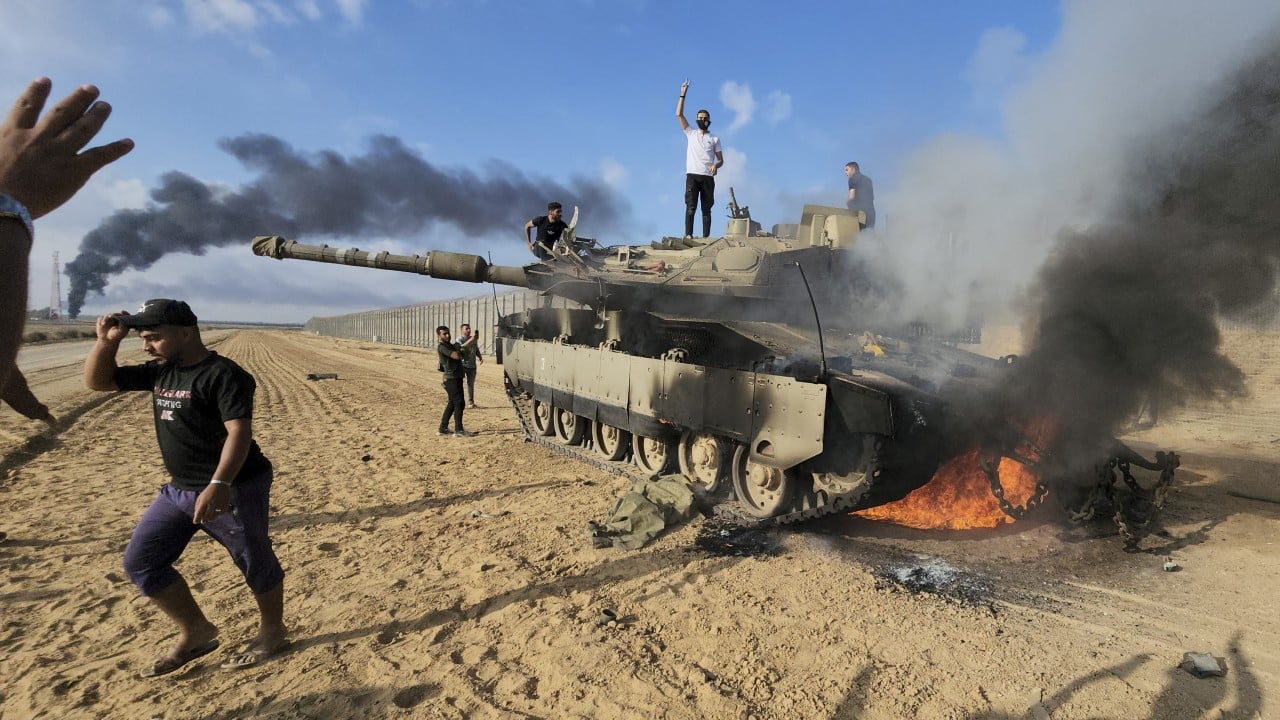
Political survival during systemic crisis requires a continuous redistribution of accountability. When national infrastructure collapses under the weight of an unpredicted intelligence failure, executive leadership faces an immediate structural threat. Prime Minister Benjamin Netanyahu’s assertion that senior military and intelligence commanders deliberately withheld operational warnings in the hours preceding the October 7, 2023 assault represents an extreme manifestation of this political calculus. By moving from a narrative of passive administrative oversight to an accusation of intentional omission, the executive apparatus attempts to decouple the political head of state from the operational machinery of the security establishment.
The Decision Architecture of Executive Shielding
To evaluate the claim that defense chiefs actively avoided waking the prime minister, one must examine the operational protocol of midnight intelligence assessments. Senior military leadership, including the Chief of Staff, the head of the Israel Security Agency, and the Directorate of Military Intelligence, operate under a continuous evaluation matrix. In moments of ambiguous indicators—such as anomalous SIM card activations or localized border drills by Hamas—these bodies routinely categorize threats based on historical probability.
The assertion that officials calculated the prime minister's response vector—believing he would mandate immediate total mobilization and preemptive kinetic strikes—reverts the logic of command responsibility. In standard bureaucratic hierarchies, subordinate agencies do not withhold critical threat indicators from executive authority to prevent specific tactical decisions. Doing so violates the core mandate of national security governance. However, framing the omission as a fear of executive over-mobilization serves a distinct rhetorical function. It shifts the primary fault from an systemic failure of the entire security conception to a localized, behavioral dysfunction among specific commanders who allegedly feared the prime minister's decisive posture.
The Mechanics of the Prewar Intelligence Conception
The systemic vulnerability that allowed the October 7 attack to succeed was rooted in a shared intellectual framework across both political and military leadership, often termed the concept. For years, the prevailing consensus held that Hamas was economically deterred, strategically contained, and fundamentally uninterested in large-scale escalation.
Both the executive branch and the defense apparatus endorsed this paradigm. Budget allocations, troop distributions along the northern and Judea and Samaria sectors, and the reduction of active-duty forces on the Gaza perimeter reflected this shared miscalculation. When early warning signs flickered in the hours before dawn, the midnight assessment team processed those anomalies through the filter of past false alarms.
The structural flaw in blaming the non-notification on individual sabotage lies in its contradiction of this shared baseline. If the military leadership genuinely believed Hamas was deterred, their failure to wake the prime minister stems from institutional blindness rather than a malicious conspiracy to subvert executive authority. Conspiratorial explanations for systemic failures bypass the more complex, uncomfortable reality of organizational groupthink.
Political Timing and the Electoral Horizon
The escalation of these accusations occurs within a compressed political timeline, marked by looming elections and intense public scrutiny regarding state accountability. In systems where executive longevity depends on maintaining a reputation for unmatched security competence, absolute liability is politically fatal.
When public opinion data indicates that a substantial portion of the electorate attributes the disaster to internal institutional failures or partisan sabotage, political messaging adapts to capture that sentiment. By claiming that the defense establishment kept him in the dark to prevent a robust counter-response, the executive achieves two distinct objectives:
- It portrays the prime minister as inherently aggressive and ready to act, neutralizing criticisms of prewar passivity.
- It localizes responsibility onto a departed or embattled military hierarchy, insulating the political office from direct legal and historical condemnation.
This division between operational execution and political governance breaks down under structural audit. The prime minister appoints intelligence heads, dictates strategic doctrine, and oversees the cabinet committees responsible for supervising security agencies. Therefore, any systemic failure in the flow of critical information during a national emergency implicates the entire governance structure, regardless of who held the phone or dialed the emergency number at 3:00 AM.
Strategic Forecast
As legal and political investigations into the October 7 intelligence failure proceed, the discourse will shift further away from objective military analysis toward institutional self-preservation. Future inquiries will likely document the precise timeline of communications between Unit 8200, the Shin Bet operations room, and the military secretary's office.
The technical logs will clarify whether the failure was an administrative breakdown in dissemination or a deliberate tactical miscalculation by mid-level commanders managing false-positive thresholds. Regardless of those forensic findings, the primary takeaway for governance models remains clear. When executive leadership relies on informal communication channels and hierarchical compliance without rigid, automated redundancy protocols during crisis windows, systemic collapse becomes an inevitability rather than a remote risk. The strategic imperative for any state apparatus is to eliminate the discretion of subordinates to filter critical threat streams, ensuring that executive notification functions as an absolute, non-negotiable mechanical mandate.