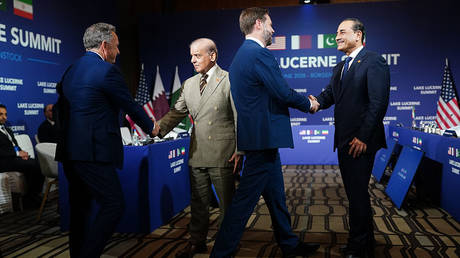
The 11-day-old Memorandum of Understanding (MoU) between Washington and Tehran is undergoing structural stress testing. The recent suspension of kinetic military operations ahead of emergency technical talks in Doha reveals a fundamental flaw in the treaty design: the absence of a shared operational definition for transit rights within the Strait of Hormuz. What the broader market reads as an unpredictable cycle of escalation and truce is an inevitable outcome of competing legal and geographic structural frameworks.
Resolving this deadlock requires moving beyond political rhetoric to analyze the exact mechanics of maritime choke points, the operational friction of unexecuted military communication channels, and the economic variables driving the price of global energy transit.
The Structural Flaw: Competing Interpretations of Transit Authority
The core vulnerability of the June 2026 interim agreement rests on an unresolved legal friction regarding the governance of the Strait of Hormuz. The text of the memorandum states that "the Islamic Republic of Iran will make arrangements using its best efforts for the safe passage of commercial vessels". This phrasing created an immediate strategic ambiguity that both state actors exploited to different ends.
The Iranian strategy relies on a framework of sovereign administration. Tehran interprets "arrangements for safe passage" as an explicit delegation of regulatory authority. Under this model, the Islamic Revolutionary Guard Corps (IRGC) demands that commercial vessels transiting the strait route themselves through lanes hugging the Iranian coastline and establish direct communication with Iranian maritime authorities. This assertion matches historical Iranian claims regarding inland waters and the right to control transit within its Exclusive Economic Zone (EEZ).
The American strategy is built on the principle of unimpeded international transit under customary international maritime law. Washington interprets the phrase "best efforts for safe passage" as a passive security guarantee rather than an active regulatory mandate. The operational bottleneck occurred when commercial ships attempted to cross the strait by hugging the coast of Oman to bypass Iranian oversight. Iran viewed this route alteration as a violation of the preliminary peace terms; the United States viewed Iran's subsequent kinetic interdiction of those vessels as an outright breach of the ceasefire.
This divergence exposes the fragility of agreements that prioritize political breakthroughs over technical alignment on physical coordinates. Without an ironclad definition of what constitutes an acceptable transit lane, the treaty creates an structural incentive for both sides to use military force to establish a baseline on the water.
The Operational Bottleneck: The Failure of the Kinetic Prevention Hotline
De-escalation mechanisms require functional communication channels to prevent local tactical maneuvers from triggers a strategic escalatory spiral. During the initial rounds of talks in Switzerland, both delegations agreed to establish a direct military hotline between US Central Command (CENTCOM) forces and the IRGC. The objective was simple: provide a real-time mechanism to de-conflict commercial shipping traffic and prevent accidental engagements.
The operational breakdown over the weekend of June 27–28 was a direct consequence of this hotline remaining non-operational. The delay in setting up this communication link left both militaries relying on radar signals and visual identification in one of the most congested waterways in the world.
The kinetic chain reaction followed a predictable escalation matrix:
- Interdiction: Iranian naval assets targeted a commercial vessel attempting to alter its route toward the Omani coast.
- Defensive Strike: Citing its commitment to protecting commercial shipping, the United States launched strikes against Iranian coastal radar installations, drone facilities, and missile infrastructure.
- Asymmetric Retaliation: The IRGC responded by launching targeted drone and ballistic missile packages against eight US military facilities across Kuwait and Bahrain.
The geographical distribution of Iran's response highlights its counter-strike doctrine. By striking infrastructure in Kuwait and Bahrain rather than engaging US naval vessels directly in the strait, Tehran demonstrated its capability to exact an operational cost on host nations throughout the Gulf Cooperation Council (GCC), raising the geopolitical stakes for Washington’s regional allies.
The temporary stand-down negotiated for the Doha talks is not a permanent solution; it is a tactical pause to build the communication infrastructure that should have preceded the implementation of the ceasefire.
The Strategic Venue Shift: Narrowing the Diplomatic Scope
The decision to abruptly move negotiations from Switzerland to Qatar represents a deliberate narrowing of the diplomatic agenda. The Swiss talks were designed as a comprehensive, multi-variable negotiation focusing on long-term nuclear enrichment limitations and structural sanctions relief. The maritime crisis forced a strategic re-prioritization.
By relocating the technical teams—led by US representative Nick Stewart—to Doha, both states partitioned the broader geopolitical disputes from the immediate crisis of shipping stability. The diplomatic calculus here is driven by asymmetric urgency. While nuclear verification mechanisms require months of drafting, the closure of the Strait of Hormuz presents immediate macroeconomic consequences that neither actor can easily absorb.
Qatar's role as a mediator provides a specific operational advantage over a European venue. Doha maintains direct economic ties with Tehran through shared natural gas fields while hosting critical US military infrastructure at Al Udeid Air Base. This physical and economic proximity allows Qatari intermediaries to relay highly technical operational trade-offs quickly, turning the Doha talks into a tactical crisis-management cell rather than a formal diplomatic summit.
The Economic Cost Function: Energy Risk Premium Elasticity
The immediate transmission mechanism of this military friction to the global economy is the maritime insurance and energy supply chain. Approximately 20% of the world's liquefied natural gas (LNG) and petroleum consumption transits the Strait of Hormuz daily.
When the ceasefire faltered, the market reaction was immediate. Brent crude futures adjusted upward by 0.69% to $72.49 a barrel, while West Texas Intermediate (WTI) climbed 1.05% to $69.96. This price movement reflects the re-introduction of a geopolitical risk premium based on three underlying operational risks:
- War Risk Insurance Premiums: Every kinetic exchange in the strait triggers a non-linear increase in hull war risk premiums for commercial vessels. Continued instability forces shipping companies to weigh the cost of these spikes against the economic alternative of rerouting vessels around the Cape of Good Hope, adding roughly 10 to 14 days to transit times.
- Operational Capacity Constrictions: The physical geometry of the strait means that even minor military operations force commercial shipping to slow down or halt transit entirely. This creates a rolling bottleneck in downstream refining capacity, as modern supply chains operate on just-in-time delivery models.
- The Symmetrical Leverage Matrix: The economic impact is not one-sided. While Washington seeks to protect global shipping lines and manage domestic inflation, Tehran relies on the removal of the US naval blockade on its ports to stabilize its internal economy. This economic interdependence creates a natural floor for the escalation: both actors understand that total closure of the strait destroys the exact economic benefits they are attempting to negotiate.
The Doha Playbook: Designing a Stable Maritime Corridor
For the Doha talks to yield more than another temporary halt in strikes, the technical teams must replace ambiguous legal prose with rigid operational protocols. The primary objective of the negotiation cannot simply be a generic agreement to stop shooting; it must establish a clear framework for maritime traffic management.
The first technical requirement is the immediate operationalization of the CENTCOM-IRGC hotline. This channel must be decoupled from broader political disputes, functioning strictly as an air and maritime traffic control link.
The second, more difficult requirement is defining the exact coordinates of acceptable transit routes. A sustainable framework must balance Iran's demands for administrative visibility with the international community's requirement for unimpeded passage. This could take the form of a jointly mapped, internationally monitored transit corridor that avoids both the extreme Omani coastline route and the immediate internal waters of the Iranian mainland.
The limitation of this strategy is its vulnerability to regional proxy dynamics. While Washington and Tehran are negotiating directly in Doha, allied actors across the region retain the capability to disrupt the process. The explicit rejection of concurrent regional frameworks—such as Hezbollah’s opposition to the recent US-Israel-Lebanon trilateral agreement—demonstrates that maritime stability in the Gulf cannot be entirely isolated from the broader security architecture of West Asia.
The technical teams in Doha are fighting to stabilize an agreement that is fundamentally exposed to outside geopolitical variables. The success of the upcoming talks will not be measured by the warmth of the diplomatic statements issued from Doha, but by whether the technical teams can establish a verifiable, coordinate-based transit protocol that removes human error and tactical interpretation from the water.

:max_bytes(150000):strip_icc()/parts-of-a-swamp-cooler-2718628-a477e6f0787b4f8bb62ddf2def31d495.png)