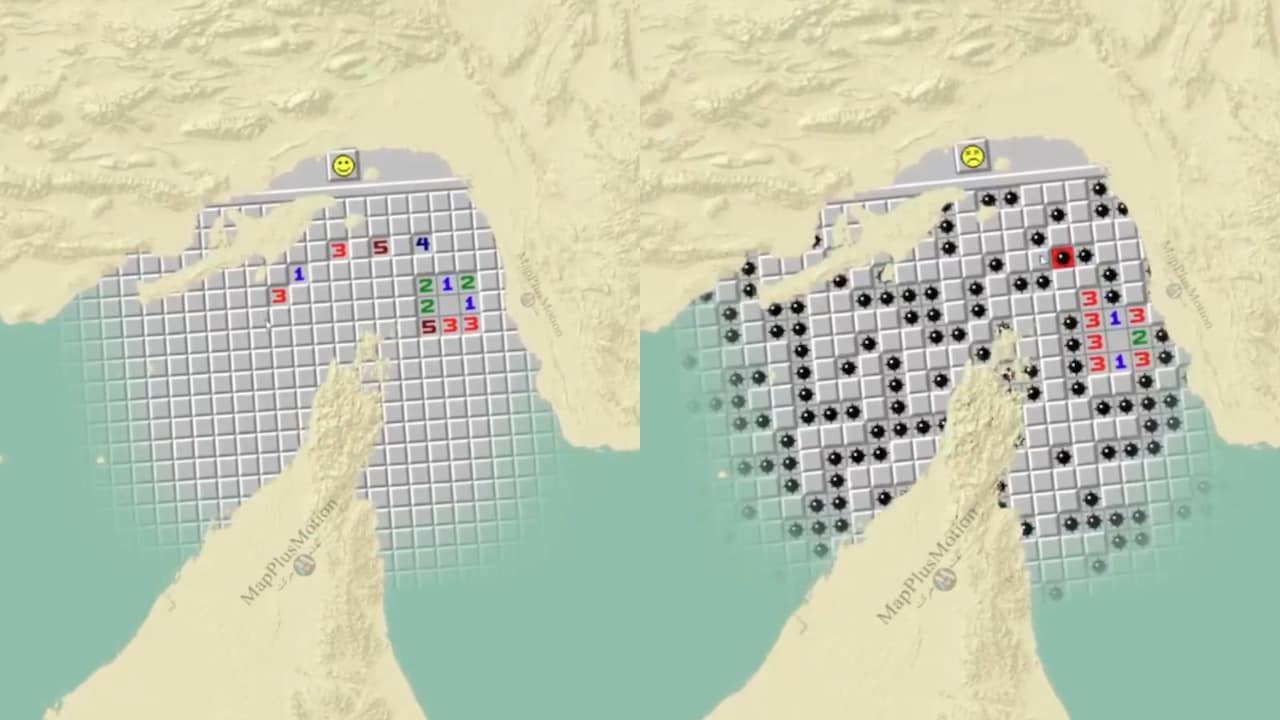
Geopolitical signaling rarely adopts the aesthetic of retro arcade software, yet recent digital messaging from Iranian state channels superimposing the vintage logic of Minesweeper onto the Strait of Hormuz encapsulates a very real strategic calculation. Beneath the viral nature of diplomatic taunts featuring animated grids and colloquial invitations lies an economic reality. Naval choke points operate on structural vulnerabilities where low-cost asymmetrical denial mechanisms impose disproportionate friction on global commerce and superpower projection. Deconstructing this standoff requires stripping away diplomatic posturing to examine the mathematical cost functions of maritime interdiction, the limits of mine-clearing operations, and the strategic calculus governing the world's most critical energy corridor.
The Cost Function of Asymmetrical Maritime Denial
Naval blockades traditionally required massive capital outlays in blue-water fleets, aircraft carriers, and heavy surface combatants. Modern asymmetrical warfare in confined corridors like the Strait of Hormuz inverted this equation. The economic efficiency of sea mines and coastal rocket launchers creates a severe asymmetry between defender expenditure and attacker mitigation costs.
A standard naval mine requires minimal capital investment to manufacture, conceal, and deploy via commercial or small craft vessels. Conversely, neutralizing these weapons demands specialized mine countermeasures vessels, nuclear-powered sonar sweeps, elite clearance divers, and persistent aerial asset deployment. When Washington executes clearance operations to reopen shipping lanes, the financial expenditure ratio heavily favors the defensive actor. Every operational hour spent sweeping international shipping routes represents a compounding cost in fuel, asset depreciation, and insurance premiums for global energy transit.
Tehran understands that actual physical closure of the strait is unnecessary to achieve its strategic objectives. The mere probabilistic threat of detonation introduces enough risk aversion into commercial shipping markets to disrupt global supply chains. Insurance underwriters respond to potential maritime hazards by spiking premiums or withholding coverage entirely. This market friction translates directly into inflated energy costs, creating macroeconomic ripple effects that serve as a force multiplier for Iranian deterrence strategy.
The Mechanics of Chokepoint Vulnerability
The Strait of Hormuz handles roughly a fifth of the world's petroleum consumption, transforming a narrow twenty-one-mile-wide waterway into a critical systemic dependency. Evaluating the mechanics of this chokepoint reveals three distinct structural vulnerabilities that inhibit rapid power projection:
- Spatial Constraint: The shipping lanes are exceptionally narrow, forcing heavy tanker traffic into predictable, delimited transit corridors that simplify targeting parameters for coastal batteries and submerged hazards.
- Sensor Obstruction: The Persian Gulf's bathymetry, salinity gradients, and high commercial vessel density create a noisy acoustic and magnetic environment, complicating the passive sonar detection of sophisticated, modern bottom mines equipped with acoustic or magnetic tripwires.
- Reconstitution Velocity: Deploying a mine takes minutes; clearing a shipping lane to certified safety standards takes days or weeks of painstaking, methodical sweeps. This temporal asymmetry gives defensive actors the ability to regenerate threat vectors faster than offensive forces can neutralize them.
Recent escalations involving United States strikes against Iranian rocket launchers intended for mine-laying operations demonstrate the tactical rhythm of this conflict. Washington seeks to neutralize the capability ex-ante, preemptively destroying launch infrastructure before deployment occurs. However, distributed and mobile launch systems make complete interdiction mathematically improbable. As long as decentralized deployment mechanisms persist, the latent threat remains active.
Strategic Interdependence and the Limits of Retaliation
Escalation dynamics in the region are governed by a fragile doctrine of calibrated thresholds. When kinetic exchanges occur—ranging from missile strikes on regional military installations to maritime asset degradation—both sides operate within bounded limits designed to prevent total systemic collapse.
Washington's primary political and military objective remains the degradation of nuclear capabilities and regional proxy networks. For Iran, maintaining control over the Hormuz escalation ladder provides a vital counter-pressure mechanism. By weaponizing maritime uncertainty, Tehran forces an operational tax on the United States and its allies, diverting military resources and diplomatic capital toward corridor security.
The integration of pop-culture motifs into state communication channels highlights a psychological dimension designed to frame superpower frustration as an exercise in grid-based guesswork. While satirical animations simplify a complex theater of war into a simple puzzle grid, they accurately reflect the operational dilemma faced by mine-clearing task forces: a single missed hazard invalidates the safety of the entire corridor.
Future stability in the waterway depends less on episodic clearance sweeps and more on establishing durable, multi-lateral de-confliction frameworks. Until the structural economic asymmetry of maritime denial is resolved through technological leaps in autonomous mine-hunting or comprehensive regional security architecture, the Strait of Hormuz will continue to function as a high-stakes game of probabilistic survival where the cost of a single miscalculation reverberates globally.


