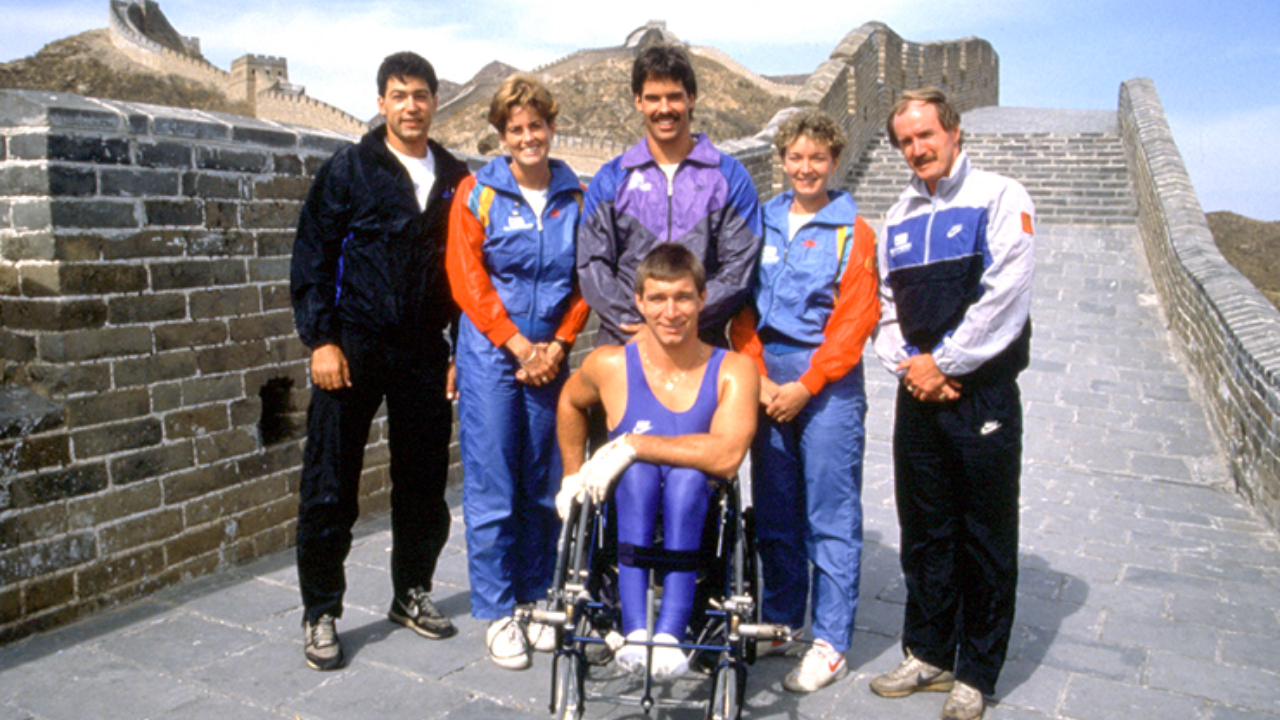
Long-distance human endurance is rarely constrained by cardiovascular capacity alone; it is bounded by the efficiency of mechanical force transfer, cumulative load management, and the architectural resilience of support logistics. Forty years after Rick Hansen initiated the Man in Motion World Tour—covering 40,075 kilometers across 34 countries between March 1985 and May 1987—the endeavor is frequently romanticized as a pure test of willpower. A rigorous examination of the expedition reveals a different reality: a masterclass in operational logistics, tactical pacing, and the systemic deconstruction of physical and societal barriers.
The Kinematics of Propulsive Efficiency
Human propulsion via a manual wheelchair across variable topography introduces distinct physiological and biomechanical bottlenecks. Unlike cyclical leg-driven motion, upper-extremity propulsion relies on smaller muscle groups—primarily the latissimus dorsi, pectoralis major, anterior deltoids, and triceps—operating under sub-optimal mechanical advantage.
Over a distance of 40,075 kilometers, structural degradation of the shoulder girdle represents the primary failure point. To sustain an average daily volume that frequently exceeded 80 kilometers, the system required rigorous torque management. The biomechanical variable determining success was not merely force output, but the minimization of frictional losses at the wheel-hub interface and the optimization of stroke frequency versus amplitude.
When confronting environmental resistance, such as the 12-percent gradients of the St. Anton Pass in the Alps or the extreme thermal loads of diverse global climates, energy expenditure spikes exponentially. The physical preservation of the athlete depended on integrated sports science protocols that were advanced for the era: constant daily micro-adjustments in seating posture, continuous monitoring of tendon strain by dedicated medical personnel, and the strategic deployment of recovery intervals to forestall catastrophic repetitive strain injuries.
The Logistics Function of Global Expeditions
An expedition of this scale functions as a mobile enterprise. The logistical cost function comprises three primary variables: route optimization, geopolitical friction, and resource supply chains.
Traversing 34 countries requires navigating disparate legal frameworks, highway infrastructures, and diplomatic barriers. The logistical apparatus must absorb high variance in road quality, traffic density, and meteorological conditions without compromising the safety tolerances of the primary operator. Support vehicles operated as mobile maintenance units, managing equipment failure, nutritional intake, and physical rehabilitation in real time.
Financially, the tour utilized a decentralized funding model anchored by service clubs, corporate sponsors, and public donations, ultimately yielding $26 million. In strategic terms, the initial phase of the tour operated with a high burn rate of early momentum relative to public awareness. The introduction of broad cultural amplifiers—such as the international dissemination of an anthem that captured global attention—altered the fundraising velocity, transforming a regional awareness campaign into an international mass-participation movement.
Systemic Barriers and the Economics of Accessibility
The legacy of the 1985–1987 tour extends beyond athletic endurance into the structural economics of urban design. Societal barriers to individuals with disabilities are traditionally categorized into three distinct vectors: architectural, attitudinal, and systemic.
[Barrier Architecture]
       │
       ├─► Physical & Spatial (Inaccessible infrastructure, transit nodes)
       ├─► Attitudinal (Implicit bias, lowered performance expectations)
       └─► Systemic & Policy (Exclusionary legislative frameworks)
Architectural impediments represent a high capital expenditure problem for municipalities, often deferred under the pretext of fiscal constraint. The intervention strategy demonstrated by the tour was to reframe accessibility not as a charitable accommodation, but as a prerequisite for economic and social participation.
The establishment of legacy funds directly redirected capital toward spinal cord injury research and the development of localized adaptive sports programs. By standardizing the physical audit of public spaces—marked visibly by infrastructure modifications—the initiative shifted the burden of proof from the marginalized individual back to the designers of the public realm.
The Scaling of Institutional Impact
The transition from a singular physical journey to a permanent institutional framework requires converting episodic attention into institutional policy. Organizations focused on barrier-free design must navigate the tension between advocacy and technical implementation.
Modern accessibility certification models rely on quantifiable metrics—measuring door clearances, slope gradients, and sensory signage—rather than qualitative intentions. This structural shift from sentiment to compliance represents the definitive evolution of the disability rights movement over the past four decades. The strategic objective is no longer merely to raise awareness of potential, but to encode universal design principles directly into municipal codes, ensuring that infrastructural inclusion functions as a default standard rather than a retroactive retrofit.
Prioritize empirical auditing over qualitative pledges in infrastructure development, ensuring that accessibility metrics are bound to measurable compliance frameworks rather than voluntary guidelines.