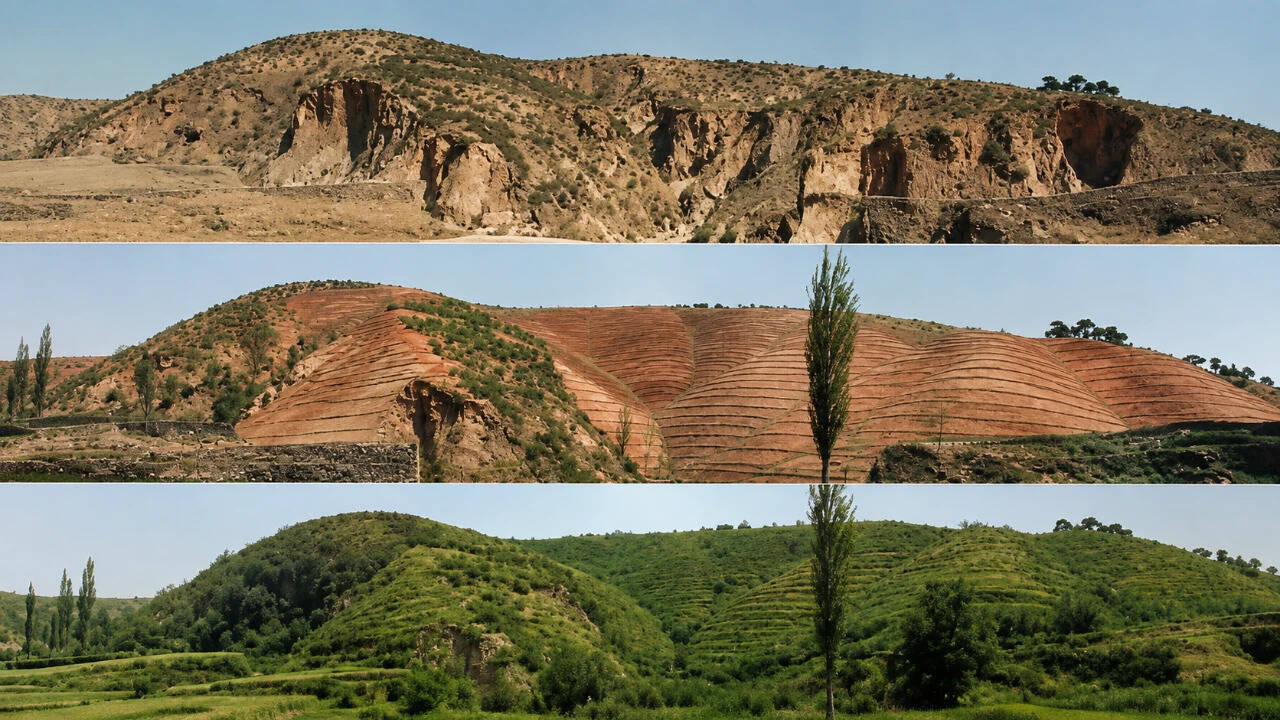
National ecological recovery is rarely driven by altruism or spontaneous civic participation; it is an exercise in resource allocation, enforcement architecture, and energy substitution.
Popular discourse frames South Korea post-war reforestation as a straightforward narrative of planting ten billion trees. This framing is analytically vacuous. Planting count is an input metric, not a performance indicator. The actual variable of interest is growing stock volume per hectare, which rose from roughly 5.7 cubic meters per hectare in 1953 to over 165 cubic meters per hectare by 2020. Understanding how a denuded landscape became dense timberland requires deconstructing the operational systems that forced survival rates to flip from below fifty percent to above ninety percent.
The Energy Substitution Constraint
The primary driver of post-war deforestation was not industrial timber harvesting, but household thermal energy demand. In the immediate aftermath of the Korean War, rural households relied entirely on forest biomass for heating and cooking, driven by the structural reliance on the traditional ondol floor-heating system.
When demand for firewood exceeds biological regeneration capacity, the resource stock collapses regardless of administrative edicts. The central government recognized that penalizing wood collection without providing an alternative energy source would trigger immediate social non-compliance.
The strategic fix was a systematic energy pivot:
- Accelerated distribution of anthracite coal briquettes for domestic heating across urban and rural settlements.
- Mandated establishment of dedicated fuelwood plantations managed by local administrative units, isolating energy harvesting from primary ecological zones.
- Legislative criminalization of unauthorized timber felling backed by national forest protection police units.
Without this parallel energy infrastructure, every planted seedling would have been harvested within months of establishment as immediate fuel stock.
Institutional Governance and Decentralized Enforcement
Early attempts at restoration during the 1950s failed due to weak administrative reach and fragmented institutional authority. The turning point arrived with the centralization of the Korea Forest Service in 1967 and the subsequent launch of the First Ten-Year Forest Rehabilitation Plan in 1973.
The state engineered a public-private governance model that aligned local economic incentives with national ecological targets. Village Forestry Associations were converted into operational instruments of the state, distributing labor requirements directly to rural communities through the Saemaul movement.
This model operated on clear operational parameters:
- Seedling production was decentralized. Village nurseries generated over thirty percent of the national seedling volume, minimizing transit friction and matching local soil variations.
- Enforcement was decentralized yet rigorously audited. Local cooperatives held collective responsibility for survival rates, shifting the monitoring cost from the central government to peer networks.
- Economic alignment tied community labor contributions directly to erosion control grants and localized agricultural support programs.
The Material Shift from Volume to Commercial Value
The mechanics of the recovery evolved through distinct administrative phases over four decades. The initial phase prioritized survival and erosion mitigation over ecological diversity, utilizing fast-growing species such as pitch pine and black locust to rapidly anchor denuded topsoil.
Once stabilization was achieved, the second and third national plans executed a tactical shift toward commercial forestry and multiple-use resource management.
The strategic progression followed strict thresholds:
- Phase One prioritized ground cover and root binding on steep slopes to halt severe topsoil erosion.
- Phase Two introduced commercial timber species like Korean white pine and Japanese larch across structured plantation blocks.
- Phase Three integrated ecological valuation, introducing recreational zoning and watershed protection metrics into national asset accounting.
The system succeeded because it treated forestry not as a static environmental project, but as an iterative industrial supply chain. Failures in early survival rates were diagnosed through systematic archival tracking, adjusting soil nutrient requirements and protection protocols before subsequent planting cycles.
Deploying large-scale environmental interventions requires solving the underlying energy and enforcement bottlenecks before capital is allocated to planting stock. Capital invested in saplings without concurrent energy substitution produces a net loss. Future ecological strategies must couple biological targets with strict demand-side resource replacement to achieve permanent landscape transformation.



/getty-brown-bear-56afcf215f9b58b7d01d5195.jpg)