Stone remembers. Long after the architects have turned to dust and the politicians who funded their ambitions have been forgotten, stone speaks in the quiet language of weight and shadow. For millennia, human societies built arches to mark transitions. An arch was a threshold. It welcomed travelers into a bustling market, celebrated a triumphant return from distant borders, or framed the horizon with a promise of safe passage. It was an invitation written in marble and granite.
Then came the announcement that rewrote the grammar of public monuments.
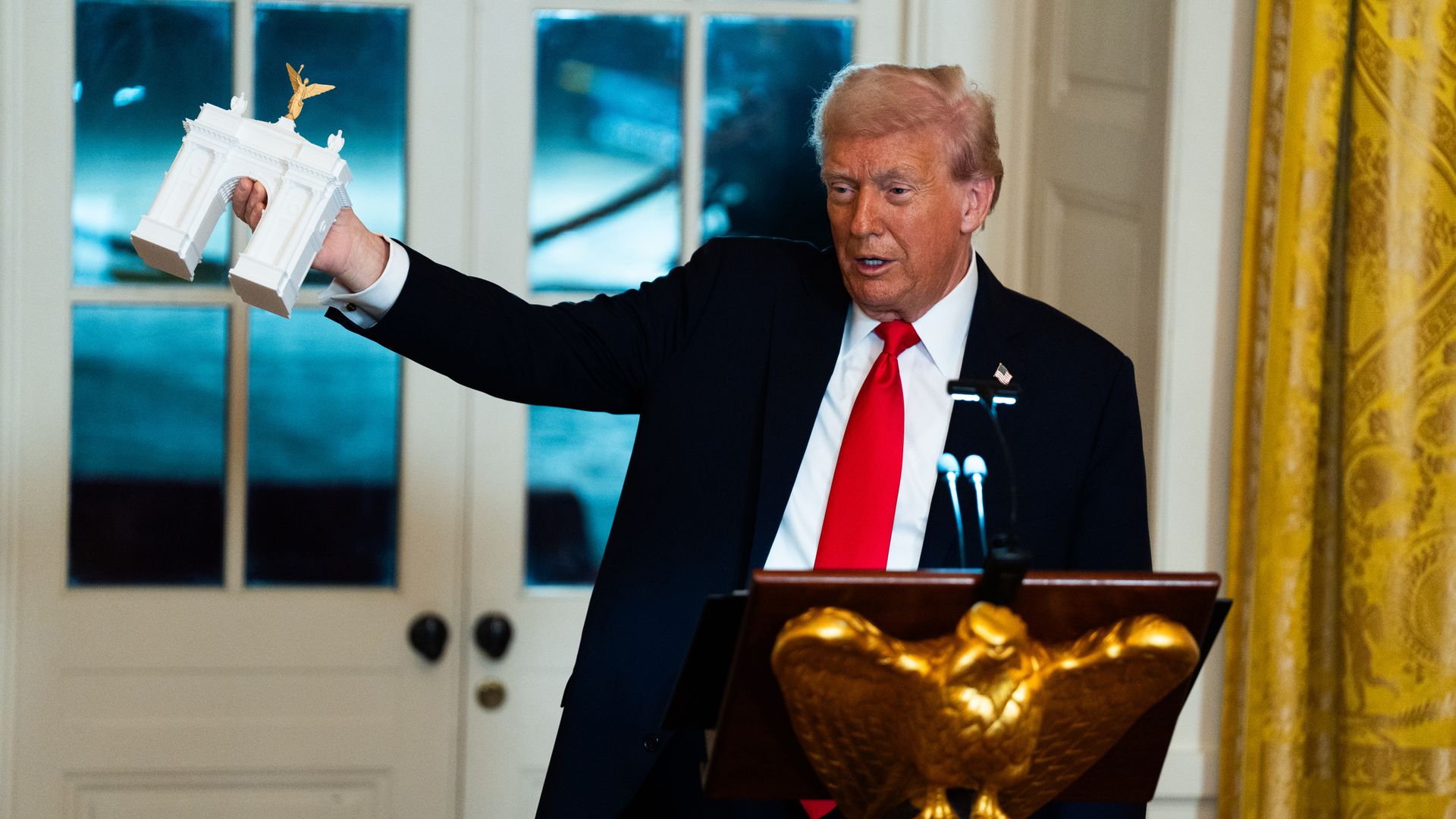
When the proposal surfaced regarding a major planned architectural arch, the conversation instantly fractured. Stripped of its romantic veneer as a classic civic tribute, the structure was described in starkly operational terms. Not a welcome gate for citizens. Not an aesthetic capstone to a grand boulevard. Instead, it was conceptualized as a militarized node, a high-security redoubt designed to house drone launch platforms and elevated sniper positions.
Silence followed. Then, a slow, uneasy realization.
Consider what happens when the monuments we build to honor our history double as defensive perimeters against our present.
To understand the weight of this shift, consider Elena. She is not a real person in the historical register, but she represents a lineage of urban designers whose drafting tables have watched the world grow paranoid. Elena spends her evenings staring at computer-aided renderings of public squares overlaid with thermal imaging grids and field-of-fire vectors. She remembers a time when urban planning was guided by an optimistic philosophy: that a city should invite movement, encourage gathering, and project an open hand.
Today, Elena draws invisible lines across blue skies. She maps where a quadcopter drone can hover undetected behind a neo-classical cornice. She calculates the ballistic arc from an elevated parapet down to a crowded plaza below.
"We are designing for fear," she murmurs to an empty room, her coffee cooling on the desk. "We are dressing it up in classical columns, but we are designing for fear."
This tension between aesthetic grandeur and defensive utility is not entirely new, yet its modern manifestation feels profoundly different. Throughout history, rulers have fortified their seats of power. Castles had drawbridges. Palaces had crenellated walls. But these were explicitly military installations, making no secret of their purpose. They stood apart from the civilian populace, warning potential invaders to stay away.
The modern paradox is far more insidious. It seeks to wrap military lethality inside the packaging of civic pride. It invites citizens to picnic beneath an arch that doubles as an overwatch station. It asks the public to admire the clean lines of a national monument while infrared cameras track their heart rates from the friezes above.
Why does this matter? Because architecture shapes consciousness. When every public gathering space is subtly reengineered to accommodate riot control, drone swarms, and counter-surveillance positions, the relationship between the state and the citizen undergoes a quiet mutation. You stop looking at the sky with wonder. You start looking at it for threats.
The integration of unmanned aerial systems into permanent physical infrastructure represents a new chapter in the securitization of public life. Drones are no longer temporary tactical tools deployed during acute crises; they are becoming fixtures of the built environment, requiring nests, charging stations, and secure communication conduits baked into the very concrete of our civic centers. An arch built to accommodate them is not just a monument. It is an airport for the invisible eye.
At the same time, the inclusion of sniper positions introduces an intimate element of lethality into civilian spaces. A sniper requires height, concealment, and a clear field of fire. Placing such a position atop a triumphal arch transforms the symbolic apex of a city into a tactical high ground. The message sent by that elevation is unambiguous: order is maintained from above, and the distance between celebration and suppression is measured only in vertical feet.
History offers uncomfortable mirrors for this evolution. Whenever empires begin to experience internal fracture lines and external anxieties, their public works undergo a functional migration. The Roman triumphal arch celebrated military conquest over foreign foes; the modern security arch contemplates control over domestic space. The enemy is no longer at the gates. The enemy is perceived to be walking among the statues.
This is where the psychological toll deepens. Trust is an invisible infrastructure. Just as a bridge requires load-bearing steel, a society requires a baseline assumption of mutual goodwill between governance and governed. When monuments are explicitly designed to withstand asymmetric threats from within—when stone arches are engineered to project force downward—that invisible steel begins to corrode.
Citizens internalize the architecture of surveillance. They adjust their posture when passing beneath reinforced lintels. They whisper in public squares, knowing that high-resolution lenses and directional microphones do not care about the poetry of the space. The monument ceases to be a shared cultural inheritance and becomes a contested zone of observation.
We stand at a crossroads where the line between a democratic public square and a garrisoned outpost is blurring into irrelevance. The technocratic impulse to secure every square inch of physical reality against every conceivable threat is an insatiable beast. Give it an arch, and it will demand a sniper nest. Give it a plaza, and it will demand a perimeter. Give it a skyline, and it will fill it with the silent, whirring hum of rotors peering down through the clouds.
We must ask ourselves what kind of future we are carving into the stone. Will our descendants look up at our monuments and see the embodiment of courage, liberty, and openness? Or will they trace the silhouettes of automated turrets and drone bays hidden behind ancient motifs, wondering how we traded our freedom for the sterile comfort of total control?
The blueprints are drawn. The calculations are complete. But the stone is not yet poured.
Look up. The sky is still yours. For now.