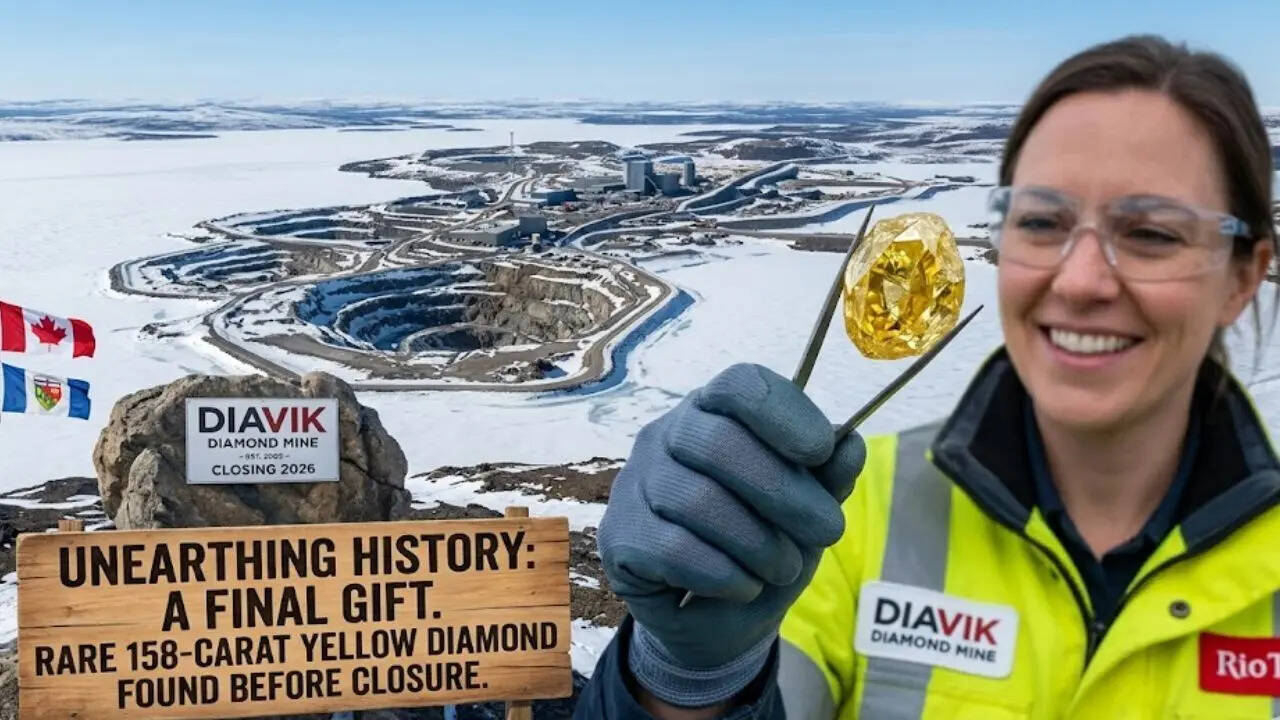
The timing is almost too perfect to be natural, yet the geology doesn't lie. As the Diavik Diamond Mine in Canada’s Northwest Territories began its final, irreversible descent into decommissioning this spring, the frozen earth surrendered one last trophy: a 158.20-carat gem-quality yellow diamond. It is a monster of a stone, a jagged, sun-colored remnant of a volcanic eruption that occurred fifty million years ago, carrying a passenger that had already waited two billion years for the light of day.
But behind the celebratory press releases and the "miracle of nature" rhetoric lies a colder industrial reality. This discovery arrives not at the height of a boom, but at the literal end of an era for North American mining. The Diavik mine officially concluded its commercial production on March 24, 2026, making this yellow titan the final exclamation point on a twenty-two-year run that reshaped the global diamond trade.
The Mechanics of a Dying Giant
To understand why a 158-carat find didn’t trigger a stay of execution for the mine, you have to look at the math of Arctic extraction. Rio Tinto, the majority owner and operator, has spent the better part of five years preparing for this shutdown. The infrastructure required to maintain a city of workers 200 kilometers south of the Arctic Circle is staggering. We are talking about a site that relies on an ice road—a seasonal lifeline over frozen lakes—to truck in millions of liters of fuel and thousands of tonnes of equipment before the spring thaw cuts them off from civilization.
The discovery occurred in the A21 pipe, an underground extension that was specifically designed to be the "bridge to closure." This wasn't a lucky stumble in a new field; it was a desperate, surgical extraction from an aging asset. By 2022, the mine’s life had already been extended by re-examining the feasibility of underground mining at A21. The 158-carat stone was recovered during the very last "ore run."
The cost of keeping the lights on at Diavik just to hunt for more "miracles" simply doesn't scale. When the fixed costs of Arctic logistics outweigh the probability of finding another "Dancing Sun"—the 158-carat stone’s famous predecessor—the machines stop. Period.
The Great Diamond Bifurcation
The 158-carat ghost is entering a market that looks nothing like the one Diavik entered in 2003. Back then, a natural stone of this magnitude was an uncontested king. In 2026, the industry is grappling with what analysts call the Great Bifurcation.
On one side, lab-grown diamonds (LGDs) have obliterated the lower and middle tiers of the market. With chemical vapor deposition (CVD) technology now capable of producing high-clarity stones at a fraction of the cost, the "utilitarian" diamond is dead. On the other side, the natural diamond sector is retreating into a fortress of rarity and provenance.
This 158-carat yellow diamond is the ultimate weapon for that narrative. It isn't just a rock; it is a finite asset from a defunct source. Collectors aren't just buying the nitrogen impurities that give the stone its golden hue; they are buying a piece of Diavik’s obituary. This scarcity is the only thing keeping natural prices afloat while synthetic production in Asia—now accounting for over 20 million carats annually—drives the price of man-made stones toward the floor.
An Island in Lac de Gras
The environmental footprint of a mine closure in the sub-Arctic is a logistical nightmare that makes the mining itself look simple. The Diavik site sits on a 20-square-kilometer island in Lac de Gras. To reach the diamonds, engineers had to build massive dikes to hold back the lake, essentially creating a dry hole in the middle of a pristine water body.
The closure plan is a three-year remediation process extending through 2029. It involves:
- Breaching the embankments: Allowing the lake water to flood the open pits, reconnecting them to the original ecosystem.
- Engineered covers: Placing rock covers over processed kimberlite to prevent environmental leaching.
- Infrastructure removal: Dismantling a site that once generated 10% of the Northwest Territories' GDP.
While Rio Tinto touts its 4.2 million kWh solar farm—the largest off-grid facility in the North—as a sign of sustainable closure, the socioeconomic void left behind is harder to fill. Diavik supported over 1,100 jobs annually. For the Indigenous communities that provided nearly half that workforce, the departure of the mine is a structural shock that a single 158-carat diamond cannot fix.
The Value of the Last Breath
What happens to the stone now? If historical precedents like the "Dancing Sun" (sold for over $5 million in 2021) are any indication, the rough stone will be cut into a primary masterpiece of roughly 35 to 45 carats.
In a world where you can grow a diamond in a basement in Shenzhen, the 158-carat find from a closed mine represents the last gasp of "precious provenance." It is the final proof of concept for an industry that must now rely on the fact that nature has stopped making them. The machines at Diavik have gone silent, the ice road is melting, and the last great Canadian yellow diamond is headed for an auction block, carrying the weight of an entire industry’s history on its jagged, unpolished shoulders.
The mine is gone. The diamond remains.