Football matches aren't supposed to feel like courtroom dramas. Yet, inside the pressure cooker of Atlanta Stadium, a single whistle turned a historic sporting upset into an all-out institutional crisis. Egypt was on the brink of pulling off the unthinkable against the reigning world champions. Instead, a multi-minute technical investigation, happening a hundred yards away from the action, completely broke the match open.
If you watched Argentina advance past Egypt in the Round of 16, you didn't just watch a thrilling 3-2 comeback. You witnessed the exact moment the video review system collapsed under the weight of its own protocol. The fallout hasn't slowed down, and the complaints coming out of the African camp go far deeper than simple post-match bitterness.
The VAR Call That Shook Atlanta Stadium
Let’s lay out what actually happened on the grass. Egypt already held a shocking 1-0 lead thanks to a first-half strike by Yasser Ibrahim. Early in the second half, midfielder Mostafa Ziko broke loose on a devastating counter-attack, slotting the ball home to give the Pharaohs a 2-0 cushion. The stadium erupted. The upset of the decade was actively materializing.
Then the text appeared on the broadcast screen: VAR Review.
French referee Francois Letexier was instructed to walk over to the pitchside monitor. What he looked at wasn’t the goal itself, nor was it the breakaway pass. He was looking at an incident that occurred more than 20 seconds prior, on the complete opposite side of the field.
While Argentina was attacking, Egyptian midfielder Marawan Attia ran into defender Lisandro Martínez, subtly catching his foot. Letexier missed it in real-time, play continued, Egypt won the ball, and they scored. Because the technical "attacking phase" never reset, the video assistants rewound the tape to find that initial foul. The goal was wiped off the board.
Though Ziko ironically scored an undisputed second goal minutes later to genuinely make it 2-0, the psychological damage of the overturned goal completely altered the tactical landscape. It kept Argentina within arm's reach. The champions eventually woke up, scoring three goals in a furious 13-minute window through Cristian Romero, Lionel Messi, and an Enzo Fernández stoppage-time header. Argentina survived, but the legitimacy of how they got there remains highly contested.
The Letter vs The Spirit of the Protocol
Technically speaking, the review followed the rulebook. The International Football Association Board guidelines clearly state that VAR can examine an attacking team offense during the immediate buildup to a goal. Because Argentina never cleanly regained possession after Attia's foul, the phase of play was legally continuous. Former FIFA official Dr. Joe Machnik defended the decision on the broadcast, pointing out that an uncalled foul that directly leads to a turnover and a goal is exactly the type of clear error the system tries to fix.
But the football community isn’t buying the technicality. Former England goalkeeper Rob Green went viral with his live assessment, pointing out that hunting for a minor toe-step a hundred yards away completely violates why the technology was introduced.
The system was marketed to fix "clear and obvious" blunders—think missed handballs on the goal line or egregious offsides. It wasn't meant to act as a microscope searching for reasons to invalidate brilliant athletic sequences. When a referee winds back the clock nearly half a minute to penalize an infraction that had zero impact on the actual defensive structure of the goal, the game loses its flow and structural integrity.
Aggressive Backlash and Claims of Favoritism
The post-match press conferences quickly turned volatile. Egypt’s manager, Hossam Hassan, didn't hold back his fury, openly suggesting that external commercial factors dictated the refereeing behavior.
"It could be a matter of marketing," Hassan told reporters. "They want a World Cup with the champion of the last World Cup. They want Messi to exist. It’s all about money."
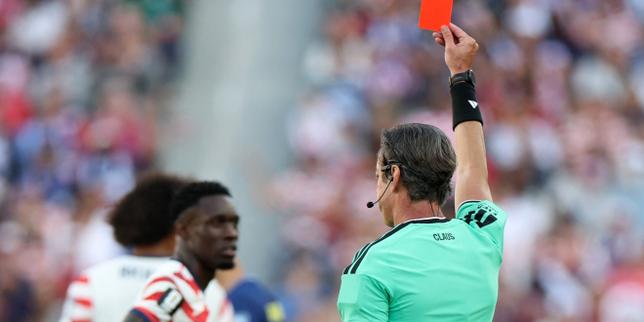
The bitterness wasn't just confined to the manager's office. Goalscorer Mostafa Ziko was visibly distraught during his media walk, bluntly calling the officiating team unjust and suggesting the tournament was structured to protect its biggest stars. The anger on the touchline boiled over so severely at the final whistle that Egypt's goalkeeping coach, Saafan El-Sagheer, was flashed a red card during a post-game confrontation with the refs.
Adding to the frustration was a massive penalty appeal late in the match. Mohamed Salah went down inside the penalty box after heavy contact from Julian Alvarez. Letexier waved it away, and crucially, the VAR room decided not to trigger an on-field review. To the Egyptian squad, this dual standard felt like absolute proof of structural bias. Why dissect a minor foul to take away an Egyptian goal, but ignore a heavy box challenge that could have rescued their tournament?
High-profile observers outside of Egypt echoed the sentiment. Even chess legend Garry Kasparov weighed in publicly, criticizing the staggering inconsistency of using video intervention to scrub a goal away over a distant foul, while refusing to look at similar physical contact inside the Argentine box minutes later.
How FIFA Fixes This Broken Process
Argentina is moving on to the quarterfinals, and no amount of online rage is going to rewrite the match reports. But if football wants to protect its competitive integrity, the governing bodies need to clean up how video reviews operate before the tournament concludes.
If you want to remove the conspiracy theories and the constant cries of favoritism, you have to limit the scope of the review window. Implementing a strict time limit—such as preventing reviews for minor fouls occurring more than 15 seconds or three passes before a goal—would instantly fix the problem. If a defending team has ample time to track back and set up their defensive shape after a turnover, the initial foul is no longer the primary cause of the goal.
Football is fundamentally a game of human error, flowing momentum, and emotional high points. When you allow technology to travel deep into the past to retroactively alter the present, you don't make the game fairer. You just make it unwatchable.
FIFA World Cup Round of 16 Match Statistics
| Metric | Argentina | Egypt |
|---|---|---|
| Final Score | 3 | 2 |
| First Half Goals | 0 | 1 |
| Second Half Goals | 3 | 1 |
| Yellow Cards | 0 | 5 |
| VAR Decisions | 1 (Foul Identified) | 0 |
The immediate focus shifts directly to the quarterfinal brackets, where Argentina's defensive vulnerabilities will face even stiffer tactical tests. For the tournament organizers, the urgent task is managing an officiating team that is rapidly losing the trust of the participating nations. Expect heavy internal reviews regarding how Letexier and his video assistants handled the phase-of-play rules before the next round kicks off in earnest.