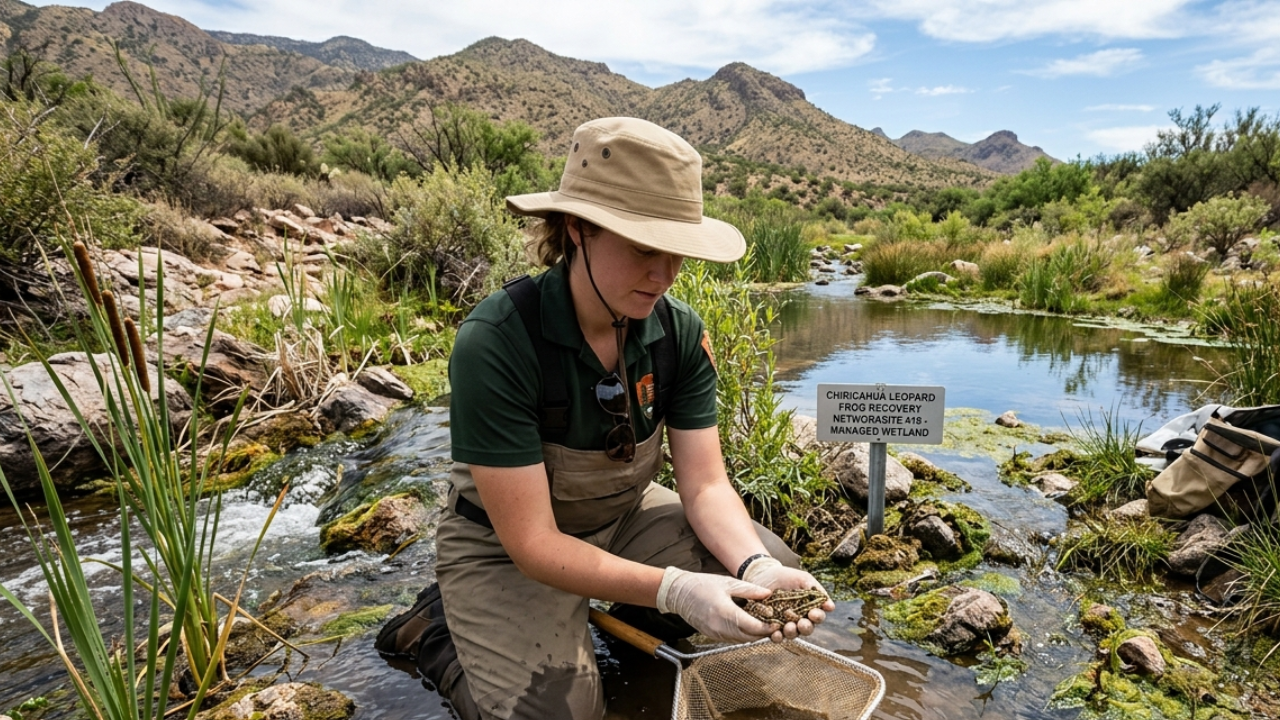
Forty years ago, the desert sounds of Arizona were missing a key voice. Along the creeks, stock tanks, and marshy cienegas of the Southwest, the Chiricahua leopard frog and its lowland cousins were vanishing into the dry dust of extinction. Biologists walked streams that had echoed with mating calls for millennia and found only silence. The culprit was a silent biological storm: habitat destruction, predatory bullfrogs, and a devastating fungal pathogen that was chewing through amphibian populations across the globe like wildfire.
Then came a quiet pivot in conservation strategy. Wildlife managers stopped writing post-mortems and started building fortresses. By the late 2010s, field data began recording leopard frogs across 19 distinct recovery sites, signaling a fragile but undeniable pulse in populations once written off as dead ends. Yet this modest rebound is not a miracle. It is the product of brutal, unglamorous field labor, concrete water management, and an aggressive campaign to purge invasive predators from fragile desert ecosystems.
Understanding how these amphibians clawed their way back requires looking past the glossy press releases and examining the mechanical realities of desert wetland restoration.
The Anatomy of a Collapse
Amphibians are living pressure gauges for environmental health. Their permeable skin makes them immediate victims of water pollution, shifting climate baselines, and chytrid fungus, a waterborne parasite that suffocates frogs by disrupting their electrolyte balance. In Arizona, the crisis was compounded by the literal drying of the landscape. Groundwater pumping drained historical springs, while cattle ranching altered the muddy margins where leopard frogs laid their eggs.
Worse still were the introduced interlopers. American bullfrogs, massive and voracious, were imported into the West for the food trade during the nineteenth and twentieth centuries. Once they escaped or were dumped into local waterways, they became apex predators of native amphibians. A bullfrog eats anything it can fit into its mouth, including smaller leopard frogs. They also carry the chytrid fungus without necessarily dying from it, acting as silent Typhoid Marys moving through the watershed.
When conservationists first stepped in to save the Chiricahua leopard frog, they faced a stark reality. You cannot simply release captive-bred frogs into a creek crawling with bullfrogs and contaminated with fungus. The animals would be devoured or diseased within a week. Recovery required a complete redesign of how desert water is managed, defended, and monitored.
Engineering the Refuges
Saving a semi-aquatic animal in a desert state means treating water as a geopolitical asset. State and federal biologists, working alongside private landowners and tribal nations, began constructing fenced livestock exclosures and artificial stock tanks designed specifically to keep bullfrogs out while holding enough water to support native species through punishing seasonal droughts.
These are not pristine wilderness preserves. Many are working cattle tanks modified with concrete aprons, solar-powered wells, and steep-sided walls that prevent invasive species from colonizing the perimeter. Biologists drained infected ponds, allowed the baking sun to sterilize the mud, and restocked them with disease-resistant lineages bred in controlled hatchery environments.
The 19 recovery sites documented in recent surveys represent these islands of intervention. Each site functions as a biological stronghold. When floods or droughts wipe out one population, biologists use neighboring strongholds as source material to reseed the watershed. It is a system of managed redundancy. If nature hits hard in one canyon, the neighboring canyon holds the genetic line.
The Human Friction Point
Conservation in the American West is rarely just about biology. It is an exercise in resource politics. Ranchers depend on stock tanks to water cattle, and any regulation restricting livestock access to natural springs creates immediate friction. For decades, environmentalists and agricultural operators viewed one another across an unbridgeable chasm.
The turnaround for Arizona's leopard frogs happened when local stakeholders realized that saving a tiny amphibian did not require shutting down rural economies. In many cases, it meant improving water infrastructure to benefit both cattle and wildlife. Fencing off a portion of a stock tank to create a predator-free nursery zone while leaving a piped trough for livestock proved that coexistence was mechanically possible.
Tribal lands have also played an unheralded role in this recovery. Several Native American reservations in Arizona maintain strict ecological stewardship policies that limit invasive species introductions and protect remote cienegas from unchecked development. Without these tribal sanctuaries, the geographic spread of leopard frog recovery sites would look significantly more fractured.
The Fragile Math of Survival
Nineteen sites sounds like a triumph until you look at a map of historical distribution. It is a microscopic fraction of what once was. The chytrid fungus has not vanished; it lives permanently in the soil and water of the Southwest, waiting for a stressed population or a wet, cool season to flare up again. Climate projections for Arizona point toward hotter summers and more erratic monsoon cycles, which will shrink the duration of seasonal wetlands and concentrate predators and prey into smaller, bloodier pools.
Furthermore, genetic stagnation remains a constant threat. When populations are reduced to isolated pockets in artificial tanks, inbreeding depression can quietly erode their resilience. Biologists now spend significant resources moving individual frogs between distant sites to mix gene pools, acting as manual pollinators for a species that can no longer migrate naturally across a fragmented landscape of highways, cities, and dry riverbeds.
The rebound of Arizona's leopard frogs proves that extinction is not always inevitable once a species enters a downward spiral. It demonstrates that intense, localized, mechanical intervention can hold the line against systemic ecological collapse. But it is a temporary holding action. Unless the larger structural pressures of water scarcity and climate stabilization are addressed, these 19 recovery sites will remain what they are today: fortified islands in a drying sea.


