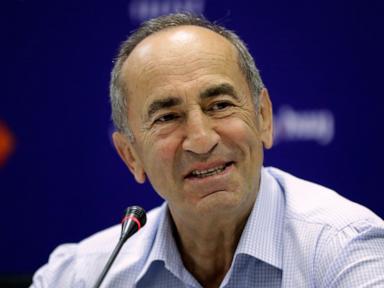
The media treats the latest detention of a former head of state as a triumph for accountability. Robert Kocharyan sits behind bars once more, caught in the gears of Armenia’s Anti-Corruption Committee alongside his kin. Headlines beam across global networks celebrating justice catching up to the old guard.
It is a comforting narrative. It is also entirely a distraction.
Focusing on the personal criminality of ousted leaders misses the structural design of post-Soviet political extraction. When a state apparatus treats the seizure of public assets as a routine perk of office for three decades, locking up the top beneficiary does nothing to fix the plumbing. It merely opens the valve for a new crew to inherit the pipes.
Let us look past the theater of the perp walk. The lazy consensus in standard journalism frames these high-profile arrests as milestones of democratic maturation. I have watched transition economies execute this script for decades. A new faction takes power on a wave of popular fury, sets up specialized anti-corruption courts, and starts parading yesterday's untouchables in front of television cameras. Meanwhile, the underlying mechanisms of patronage remain completely untouched.
The Myth of the Singular Villain
To understand why arresting Kocharyan is a geopolitical magic trick, you have to look at how power actually moves in Yerevan. The charges involve state properties sold below market value during his tenure between 1998 and 2008. No one who understands the privatization chaos of the late twentieth century doubts that state assets were looted on an industrial scale.
The analytical failure lies in treating looting as an anomaly driven by a few uniquely evil men rather than an inevitable feature of a weak state captured by competing oligarchic clans. Kocharyan did not invent systemic corruption; he optimized a system where control over the executive branch functioned as the ultimate venture capital fund.
When Prime Minister Nikol Pashinyan locks horns with opposition blocs and rounds up former leaders like Kocharyan or Serzh Sargsyan, Western outlets cheer the shift toward European-style governance. They ignore the obvious vector: this is an existential turf war disguised as a courtroom drama. Pashinyan is actively pivoting the country away from Moscow's orbit while neutering the domestic pro-Russian political opposition. When legal investigations double as instruments of geopolitical realignment, the law stops being blind. It becomes a sniper rifle.
Follow the Structural Incentive
Imagine a scenario where every single official tied to the 1998-2018 administrations is convicted, stripped of their remaining assets, and given maximum prison sentences. Does the average citizen's cost of living drop? Does the civil service suddenly become meritocratic? Does foreign direct investment flood into an insecure landlocked border state overnight?
No. Because the underlying architecture of state capture relies on discretionary authority.
When bureaucrats retain the power to grant exemptions, award no-bid licenses, and selectively enforce tax codes, corruption is inevitable regardless of who sits in the prime minister's chair. Pashinyan’s administration operates within the exact same institutional framework that birthed the oligarchies they claim to destroy. They have simply changed the beneficiaries.
The lazy narrative says that cleaning house means locking up yesterday’s thieves. Real institutional reform means making it mathematically impossible for today's officials to replicate the theft. Yet nobody builds television ratings by rewriting public procurement laws or establishing genuinely independent regulatory boards. Viewers want villains. Governments happy to oblige provide villains on demand while consolidating their own grip on the levers of state patronage.
The Geopolitical Smoke Screen
Let us address the elephant in the Caucasus room. These high-stakes arrests do not happen in a vacuum. They coincide with aggressive maneuvers to downgrade historic ties with Russia and court European integration. Kocharyan represents not just a legacy of the past, but the primary political proxy for Moscow's remaining leverage inside Armenian domestic politics.
When domestic anti-corruption crackdowns conveniently sweep up leaders of pro-Russian opposition factions while leaving allied loyalists untouched by similar scrutiny, calling it pure justice requires willful blindness. It is a calculated consolidation of power wrapped in the language of civic virtue. International monitors look away because the geopolitical direction of travel pleases them, sacrificing long-term institutional integrity for short-term alignment gains.
If Armenia wants to break the cycle of predatory governance, it must abandon the populist trap of treating politics as a morality play between good revolutionaries and bad autocrats. Every time a society relies on ad-hoc vengeance rather than cold, impersonal systemic constraints, it lays the groundwork for the next cycle of betrayal.
Stop celebrating the cage matches of elite survivors. Demand rules that render the cage irrelevant.