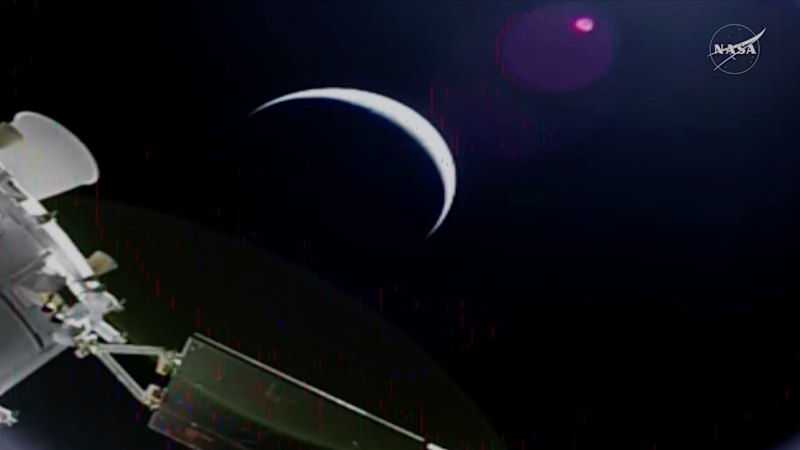
The headlines are vibrating with a desperate, nostalgic energy. They want you to believe that four astronauts circling the moon for the first time in over fifty years is a "giant leap" into the future. It isn't. It is a expensive, scripted rehearsal of a play we already performed in 1968. If you think Artemis II is about innovation, you have been sold a PR narrative designed to mask the stagnation of state-sponsored spaceflight.
NASA is currently trapped in a loop of circular logic. We are told we must return to the moon to "learn how to live on another world," yet we are doing so using an architecture that is fundamentally disposable and economically ruinous. The SLS (Space Launch System) and the Orion capsule represent the peak of "Sunk Cost Fallacy" engineering.
We aren't going to the moon because it’s the next logical step. We are going because the bureaucracy needs a reason to exist, and the contractors need the checks to clear.
The High Cost of Doing it Again
The competitor rags will tell you how "historic" this mission is. What they won't tell you is the price of admission. Each SLS launch carries a price tag of roughly $4.1 billion. That is not the development cost; that is the per-mission "rental" fee for a rocket that disappears into the ocean after one use.
For the price of one Artemis II mission, you could theoretically buy dozens of launches from private heavy-lift competitors. We are using a Ferrari to deliver a single gallon of milk, then crashing the Ferrari into a wall and asking for more tax money to build another one.
The "lazy consensus" suggests that this is the only way to ensure "astronaut safety." That is a myth. Safety is a function of flight cadence. The more you fly, the more you learn. By flying once every two years, NASA ensures that every mission is a high-stakes gamble with hardware that has never been "broken in."
The Orion Bottleneck
Let's talk about the Orion capsule. It is a masterpiece of engineering, but it is built for a world that no longer exists. It is heavy, cramped, and relies on a heat shield technology that hasn't fundamentally changed since the Nixon administration.
The Artemis II crew will spend approximately 10 days in a space roughly the size of a professional kitchen. They will perform a "figure-eight" trajectory around the moon—a "Free Return Trajectory"—which is the exact same safety-first orbital mechanic used by Apollo 13.
Where is the disruption? Where is the nuclear thermal propulsion? Where is the artificial gravity research? We are celebrating a mission that effectively proves we can still do what our grandfathers did with slide rules and cigarettes.
The Lunar Gateway is a Toll Booth
The broader Artemis plan involves the Lunar Gateway, a small space station that will orbit the moon. The industry cheerleaders call it a "hub for deep space exploration." In reality, it is a logistical nightmare.
Imagine you are driving from New York to Los Angeles. Instead of driving straight there, you stop in a tiny shack in the middle of the Nevada desert, move all your luggage into a different car, wait three days, and then finish the drive. That is the Gateway. It adds complexity, risk, and massive cost to every landing.
Why does it exist? Because the SLS isn't powerful enough to send a fully-fueled lander and a crew capsule to the lunar surface in one go. The Gateway is a workaround for a weak rocket, yet it’s being marketed as a revolutionary outpost.
The False Promise of "Living on the Moon"
Every press release mentions "sustainable lunar presence." This is the most dishonest phrase in the aerospace industry.
To be sustainable, a colony must produce more than it consumes. Currently, we cannot even recycle 100% of the water on the International Space Station without regular resupply from Earth. On the moon, there is no "living off the land" with current technology. Lunar regolith is essentially shards of glass that destroy seals and lungs. Extracting oxygen from it requires massive amounts of energy we don't have.
We are sending humans to the moon to sit in a pressurized tin can and look out the window. That is exploration, yes. But it is not a "foothold." It is a camping trip where you have to bring your own air, water, and dirt.
Why We Should Stop Fixing Artemis
The common question is: "How do we make Artemis more efficient?"
That is the wrong question. You don't make a steam engine more efficient to compete with a jet turbine. You scrap the steam engine.
The real path to the stars isn't through government-mandated "prestige missions." It's through the commoditization of low-earth orbit. We should be spending those billions on:
- Orbital Refueling: If we can gas up in space, the size of the rocket on the pad doesn't matter.
- Material Science: Developing shields that don't weigh five tons.
- In-Situ Resource Utilization (ISRU): Sending robots to actually build something before the humans arrive.
Instead, we are focused on the "Optics of the Astronaut." We want the photo of the flag and the footprints. We are prioritizing the PR moment over the structural foundation of a spacefaring civilization.
The Blind Spot: Automation vs. Ego
There is a hard truth that nobody in the Artemis program wants to admit: Robots are better at this than we are.
A rover doesn't need a pressurized cabin, a toilet, or a return ticket. It can stay on the moon for ten years, grinding through data, mapping minerals, and testing construction techniques. But robots don't get ticker-tape parades.
Artemis II is a human-centric mission in an era where humans are the most fragile and expensive part of the equation. We are risking four lives to prove a point we already proved in the Cold War.
I’ve seen this before in big tech. A legacy giant spends billions to "update" a product that is fundamentally obsolete because they are too afraid to cannibalize their own existing market. NASA is the legacy giant, and the moon is the product they’ve been trying to "relaunch" since 1972.
The Reality Check
If you want to be inspired, look at the telemetry, not the slow-motion footage of the launch. Look at the mass-to-orbit ratios. Look at the cost-per-kilogram.
When you do the math, Artemis II looks less like a bridge to Mars and more like a very expensive museum exhibit that happens to fly. We are celebrating the fact that we haven't forgotten how to do the bare minimum.
Stop asking when we’ll get to the moon. Start asking why we’re going there with technology that belongs in a history book. The moon isn't the goal; it’s the bait for a massive government spending program. If we want a future in the stars, we have to stop settling for a high-definition remake of the past.
Go back to the moon when we have a reason to stay. Until then, you're just watching the world's most expensive vacation.