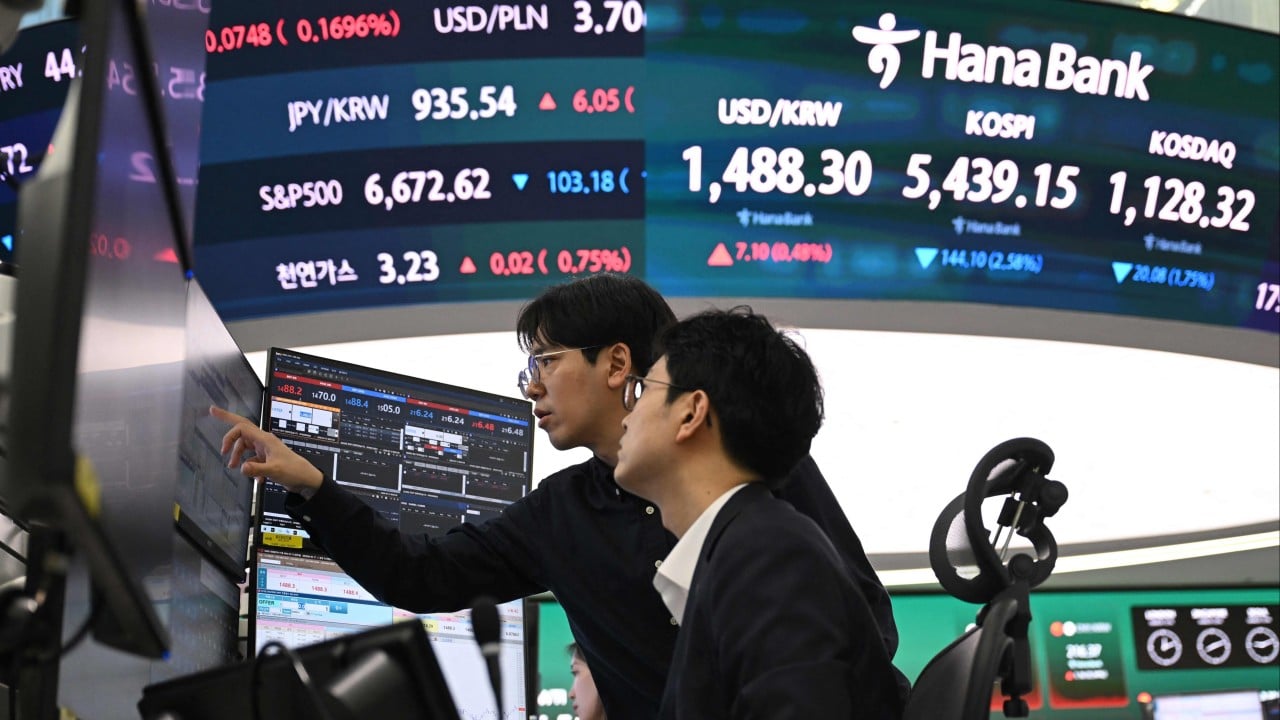
The headlines are screaming about a bloodbath in Seoul and Tokyo. They want you to believe that because Brent crude spiked and the yen did a backflip, the sky is falling on the Nikkei 225 and the KOSPI.
They are wrong.
Most financial "journalism" is just a trailing indicator masquerading as insight. When the "global stock sell-off" hits South Korea and Japan the hardest, the knee-jerk reaction is to flee toward the perceived safety of US Treasuries or overpriced Silicon Valley tech. That is the lazy consensus. It’s the move of an amateur who sees volatility as a threat rather than a repricing of reality.
The truth? This isn't a crisis of fundamentals. It’s a liquidity tantrum. If you’re selling now, you aren't "managing risk." You’re subsidizing the retirement of the institutional players who are currently waiting for your limit orders to hit the floor so they can sweep them up.
The Oil Shock Myth
The prevailing narrative is that Japan and South Korea are uniquely vulnerable because they are resource-poor energy importers. The logic goes: Oil prices go up, input costs explode, margins evaporate, and the export-driven miracle dies.
It’s a nineteenth-century view of a twenty-first-century economy.
South Korea isn't just a "manufacturer." It’s the world’s foundry for the high-end semiconductors and EV batteries that the rest of the planet literally cannot live without. When energy costs rise, companies like Samsung and SK Hynix don't just sit there and bleed. They have massive pricing power. If the cost of making a chip goes up by 5%, they pass that cost to the global consumer who has zero alternatives.
Japan is in an even more misunderstood position. For decades, the world treated the Japanese market like a stagnant pond. Now, corporate governance reforms—the kind that actually have teeth—are forcing companies to return mountains of cached yen to shareholders. An oil shock doesn't change the fact that Japanese balance sheets are cleaner than a surgical suite.
The Currency Carry Trade Trap
The real reason Tokyo and Seoul "bore the brunt" of the sell-off has nothing to do with tankers in the Strait of Hormuz. It has everything to do with the unwinding of the yen carry trade.
For years, big macro funds borrowed yen at near-zero interest rates to buy everything from Mexican pesos to Nvidia stock. When volatility spikes, these funds have to cover their tracks. They sell their winners to pay back their yen loans. This creates an artificial, technical downward pressure on Japanese equities that has nothing to do with whether Toyota is selling cars (they are) or whether Sony is dominant (they are).
You’re seeing a margin call on a global scale, and the media is calling it an "economic downturn."
Stop Asking if the Bottom is In
"People Also Ask" columns are currently littered with queries like "Is it safe to invest in Japan right now?" or "Will the KOSPI recover?"
These are the wrong questions. "Safe" is a word used by people who lose money slowly over thirty years to inflation. The right question is: "Is the current price of these assets lower than their replacement cost?"
In many cases in South Korea, the answer is a resounding yes. We are seeing companies trading at Price-to-Book (P/B) ratios below 1.0. That means the stock market is essentially saying that these global titans are worth less than the physical land, buildings, and equipment they own.
Imagine a scenario where you could buy a dollar for eighty cents, but the catch is that the person selling it to you is panicking because they heard gas prices went up. You’d take that deal every time. That is the South Korean market right now.
The Cowardice of Diversification
Financial advisors love to talk about "geopolitical risk" as a reason to underweight Asia during an energy crisis. They’ll tell you to stick to the S&P 500 because it’s "stable."
I’ve watched investors blow millions trying to play it safe. Stability is a lagging metric. By the time a market feels "safe," the gains are already gone. The volatility in Tokyo and Seoul is a feature, not a bug. It provides the entry points that the efficient market hypothesis says shouldn't exist.
The "brunt" of the sell-off isn't a badge of failure; it’s a reflection of liquidity. These are deep, sophisticated markets where you can move billions of dollars in an afternoon. When global funds need cash, they sell what they can, not what they want. They are selling Japan and Korea because they can, not because those economies are failing.
The Nuance of the Supply Chain
While the "experts" are staring at oil charts, they are missing the strategic shift in global trade. The "China Plus One" strategy makes Japan and South Korea the primary beneficiaries of the West’s desire to de-risk from Beijing.
An oil shock is a temporary inflationary spike. The structural relocation of high-tech manufacturing to the democratic hubs of North Asia is a multi-decade secular trend. If you think a $20 movement in a barrel of crude outweighs the total reconfiguration of the global tech supply chain, you shouldn't be managing your own money.
How to Actually Play This
Most people will wait for the "all-clear" signal. They’ll wait for oil to stabilize and for the headlines to turn green. By then, the Nikkei will have already rallied 15% and the opportunity will have vanished.
- Ignore the Macro Noise: Stop tracking the daily fluctuations of Brent crude as if it’s a direct proxy for the health of a robotics firm in Kyoto. It isn't.
- Focus on the Yield: Look at the dividend hikes coming out of Japan. They are hitting record levels because these companies are finally being forced to care about their owners.
- Bet on the Foundry: South Korea is the backbone of the AI revolution. You cannot have a "landscape" (to use a word I hate) of generative AI without the HBM (High Bandwidth Memory) that SK Hynix produces.
The downside to this approach? You will look wrong for a few weeks. You will have to stomach red numbers while the rest of the world congratulates themselves on holding "safe" assets. But when the liquidity cycle turns—and it always turns—the rebound in these "bruised" markets will be violent and swift.
The "brunt" of the sell-off is just a discount for those brave enough to read a balance sheet instead of a headline.
Quit waiting for the storm to pass. Buy the rain.