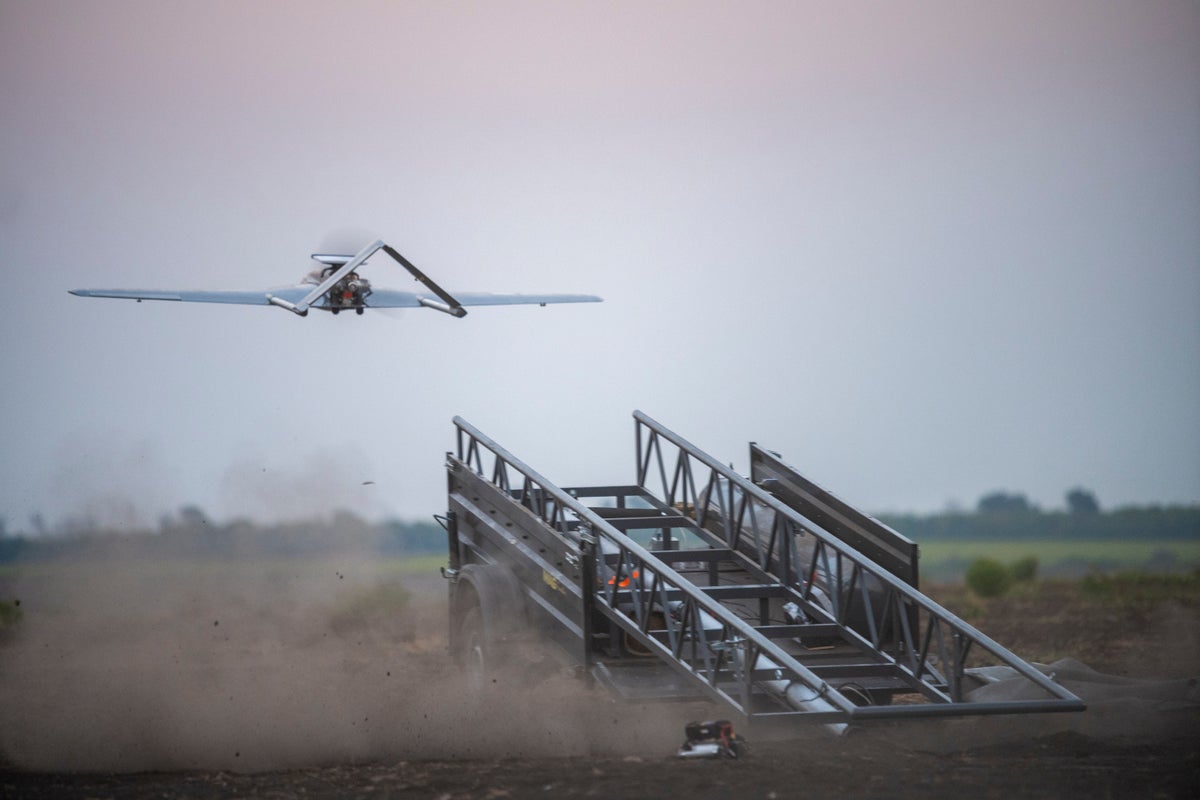
The strategic calculus of modern territorial defense has undergone a structural inversion. When a state defending a massive geographic perimeter faces an adversary with vastly superior industrial capacity and raw mass, conventional military parity is economically impossible. The traditional response involves symmetrical escalation, matching missile for missile and platform for platform. That path guarantees financial exhaustion. The alternative requires exploiting the asymmetry of production costs, supply chain vulnerabilities, and target sensitivity.
Ukraine's campaign of deep-strike uncrewed aerial vehicles against Russian energy infrastructure represents a textbook case of economic arbitrage in military operations. Rather than seeking tactical wins on the frontline, this strategy targets the liquidity and refining margins of a state actor's primary revenue engine. By analyzing the structural mechanics of this campaign, we can deconstruct how low-cost attritional systems disrupt high-value fixed assets, mapping out the precise cost functions, supply chain dependencies, and logistical bottlenecks that dictate modern strategic attrition.
The Cost Function of Long Range Attrition
To understand why low-cost aerial vectors inflict disproportionate strategic pain, we must evaluate the economics of production and interception. A long-range strike drone utilizing commercial-grade composite airframes, off-the-shelf microprocessors, and hobbyist-class combustion engines can be manufactured for a fraction of the cost required to build or maintain the target it attacks.
The financial asymmetry reveals the core mechanism of the campaign. A refinery fractional distillation column, secondary processing unit, or catalytic cracker represents hundreds of millions of dollars in capital expenditure, requiring specialized Western-manufactured catalysts, proprietary software, and years of engineering lead time to construct or repair. When a low-cost vector disables that asset, the replacement cost disparity creates an unsustainable budgetary drain on the defending economy.
Compounding this imbalance is the interception economics borne by the target state. Deploying a sophisticated surface-to-air missile interceptor to neutralize an incoming platform that costs less than a luxury automobile guarantees a negative return on investment for the defender's treasury. Over time, forcing an adversary to expend high-tier interceptors on low-tier targets depletes strategic stockpiles of precision munitions that cannot be replenished at scale due to international sanctions and microelectronic export controls.
The strategy relies on a simple mathematical reality. If the defender must maintain a continuous, multi-layered air defense shield over thousands of square miles of industrial territory, the cumulative operational expenditure of the defense mechanism eventually outpaces the capital cost of the offensive campaign.
Structural Bottlenecks in Energy Infrastructure
Energy infrastructure is uniquely vulnerable to targeted disruption because of its geographic centralization and specialized engineering requirements. Unlike decentralized manufacturing, petroleum refining depends on continuous-flow processing facilities where a single point of failure can halt an entire plant's output.
Refineries are optimized for throughput, not resilience against kinetic impact. The primary targets of long-range strikes are rarely the crude oil storage tanks, which are structurally resilient and relatively easy to patch. Instead, operations focus on primary distillation units and alkylation units. These sections require heavy-wall alloy steel vessels operating under extreme temperatures and pressures.
When these specialized components are ruptured or thermally shocked by fire, standard industrial welding fixes are insufficient. The metallurgical integrity of the units demands certified replacement parts sourced from global industrial suppliers. Because primary processing technology in the target state has historically relied on foreign engineering firms, sanctions create a severe friction coefficient. The lead time for acquiring replacement compressors, pumps, and control systems stretches from months to years.
This creates a secondary economic shock: domestic supply contraction. When primary refining capacity drops, the state faces a stark trade-off between supplying domestic fuel markets—crucial for civilian stability and logistics—and fulfilling export contracts that generate foreign currency reserves. Curtailing exports damages fiscal revenue, while rationing domestic fuel triggers inflationary pressures and localized shortages. The campaign thus bypasses tactical frontline engagements to strike directly at the macroeconomic stability of the aggressor.
Supply Chain Realities and Scaling Limits
The viability of a massive drone strike campaign depends entirely on industrial scalability and supply chain autonomy. Scaling production from experimental prototypes to hundreds of units per month requires bypassing traditional defense-procurement bloat and integrating directly with commercial manufacturing ecosystems.
The supply chain for long-range strike platforms relies heavily on dual-use commercial components. Inertial measurement units, global navigation satellite system modules, carbon fiber sheets, and brushless electric motors are freely traded global commodities. This modularity allows operators to diversify sourcing, preventing supply chain chokepoints from halting production. If a specific microchip or sensor from one jurisdiction becomes unavailable, engineering teams can substitute alternative components with minimal software adjustments.
However, scaling introduces distinct operational limitations. As production volume increases, quality control variance rises. Long-range autonomous navigation requires robust resistance to electronic warfare countermeasures, including spoofing and jamming. Commercial-grade guidance systems are inherently vulnerable to electromagnetic interference. To maintain strike accuracy over hundreds of kilometers without relying exclusively on vulnerable satellite links, systems must incorporate redundant onboard navigation aids, such as terrain-contour matching or optical terminal guidance.
Integrating these advanced vision-based or autonomous correction systems increases unit costs and manufacturing complexity. The central engineering challenge shifts from maximizing sheer production volume to optimizing the trade-off between unit survivability against electronic countermeasures and cost efficiency. If a platform becomes too expensive through the addition of hardened military-grade components, it loses the economic advantage of the asymmetric cost function.
Strategic Operational Constraints
Despite the disruptive potential of low-cost long-range strike campaigns, significant operational limitations prevent them from serving as a standalone path to total victory. Recognizing these boundaries is essential for an objective evaluation of the strategy.
First, kinetic disruption of infrastructure does not equal permanent destruction. Industrial facilities can be repaired, albeit slowly under sanctions. The campaign creates systemic friction, delays, and financial drains, but it operates as a campaign of attrition rather than a decisive knockout blow. The target state retains the capacity to reallocate capital from other sectors to prioritize industrial reconstruction, absorbing economic shocks through sovereign wealth reserves or debt restructuring.
Second, geographical distance introduces severe physical constraints. As operational range increases, payload capacity decreases proportionally due to fuel weight requirements. A heavier warhead reduces the operational radius, while an extended range necessitates smaller explosive payloads. Consequently, strikes against deep interior targets often rely on precision placement rather than brute-force explosive mass, requiring advanced terminal guidance capabilities that increase technical failure rates.
Third, the political and diplomatic costs of deep-range infrastructure campaigns carry inherent risks. Strategic partners and international stakeholders monitor energy market stability closely. Disrupting major global energy flows can trigger volatility in international commodity prices, complicating diplomatic relations with neutral third-party states that rely on stable energy supplies. Operational planners must carefully calibrate the intensity and frequency of strikes to achieve domestic economic disruption without provoking severe retaliatory escalation or alienating vital diplomatic allies.
The Long-Term Equilibrium of Asymmetric Air Campaigns
The evolution of long-range drone warfare signals a permanent shift in the economics of state conflict. By transforming commercial off-the-shelf technology into strategic power projection tools, resource-constrained actors can neutralize the advantages of traditional mass and industrial scale.
The campaign against deep-seated energy infrastructure demonstrates that conventional military power is no longer insulated from economic arbitrage. When the cost of offense remains structurally lower than the cost of comprehensive defense, prolonged campaigns create cumulative systemic drag on the aggressor state's financial architecture.
Future developments in this domain will hinge on the integration of autonomous swarming algorithms and machine-learning terminal guidance, which will reduce reliance on external communication links and bypass advanced electronic defense shields. As these technologies mature, the financial burden on defenders will escalate, forcing a fundamental reassessment of how modern states protect critical national assets against scalable, low-cost threats. The defining metric of future strategic stability will not be the size of an army or the count of heavy armored divisions, but the agility and resilience of a nation's supply chains in the face of persistent, asymmetric disruption.