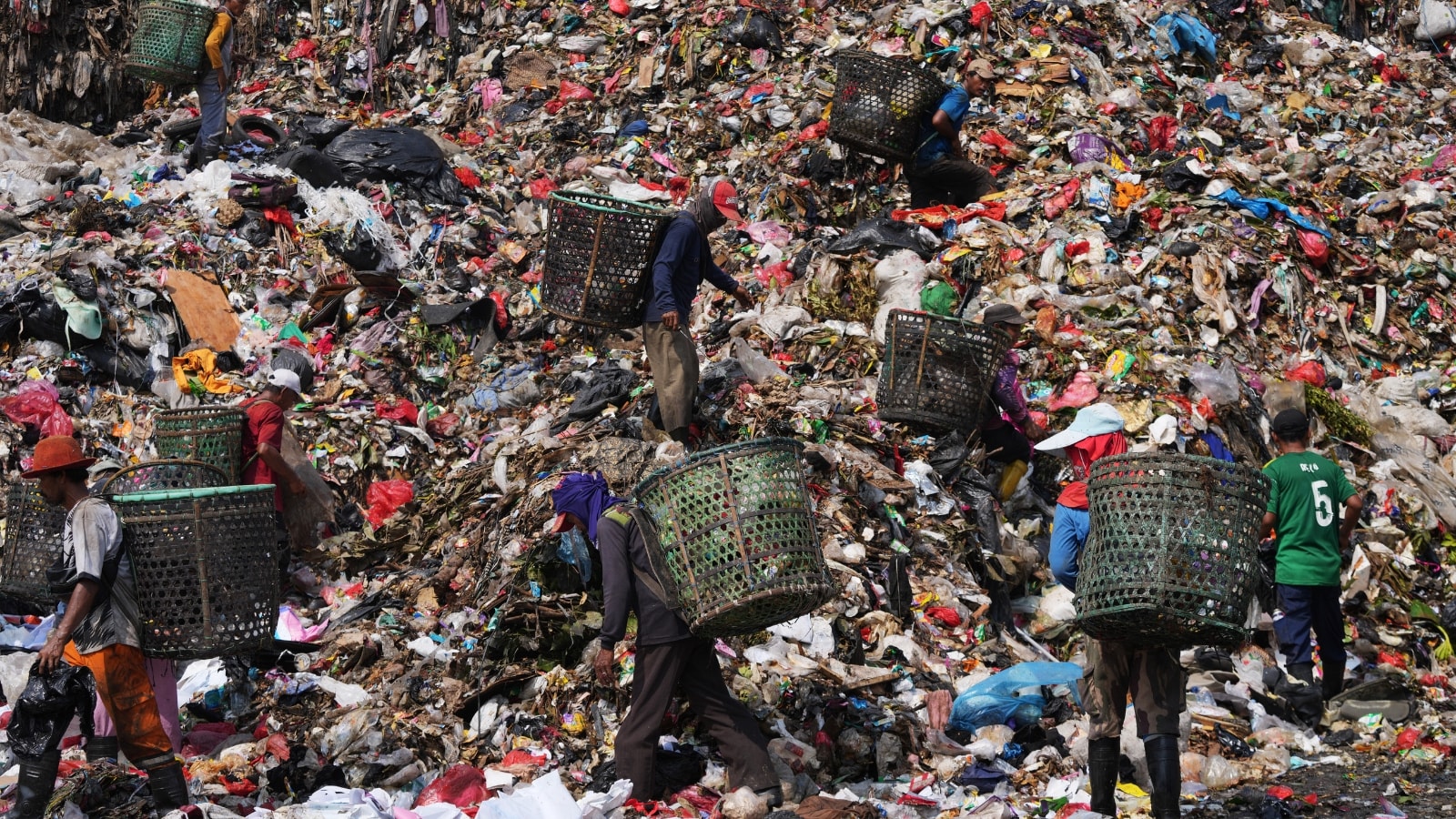
Jakarta generates nearly eight thousand tons of waste every single day, and an overwhelming majority of that refuse ends up piled high at the Bantar Gebang Integrated Waste Management Facility. Located in the Bekasi region of West Java, this colossal dump stands as the second-largest municipal solid waste methane emitter on the entire planet. Indonesia has finally rolled out an ambitious overhaul plan to tackle the monumental environmental crisis brewing at this site, but deep structural hurdles threaten to derail the entire intervention before it ever gains momentum.
For decades, the mechanics of garbage disposal in Southeast Asia's largest economy relied on a simple out-of-sight, out-of-mind philosophy. Trucks haul municipal waste away from the capital's gleaming skyscrapers and middle-class suburbs, dumping it into an unlined, open-air mega-site that now towers over surrounding neighborhoods like a synthetic mountain. Organic waste makes up more than half of everything trucked into the facility. As food scraps and yard trimmings decompose under the intense tropical sun without oxygen, they release massive plumes of methane gas into the atmosphere.
Methane operates as a greenhouse gas with a warming potential dozens of times more potent than carbon dioxide over a twenty-year timeframe. Left uncaptured, the invisible clouds rising from Bantar Gebang act as an accelerated furnace for global temperatures.
The Anatomy of a Mega Dump
Understanding how Bantar Gebang reached this critical threshold requires looking past the political announcements and examining the ground-level economics of municipal sanitation. Bekasi accepts Jakarta's garbage under a multi-million-dollar tipping fee arrangement, functioning as an economic safety valve for the capital. Jakarta gets to keep its streets clean, while Bekasi absorbs the ecological fallout.
The physical scale defies easy management. Mountains of garbage stretch across over one hundred hectares, routinely triggering mini-landslides that threaten informal waste pickers scavenging for plastic bottles and aluminum cans. These scavengers, locally known as pemulung, form an informal recycling backbone that corporate waste management plans routinely ignore. Any serious overhaul must account for the thousands of people whose survival depends on picking through the exact waste stream the government wants to industrialize or seal away.
[Municipal Waste Generation] ──> [Bantar Gebang Open Dumping] ──> [Anaerobic Decomposition] ──> [Massive Methane Emissions]
The New Overhaul Strategy
The Indonesian government's latest intervention relies heavily on transitioning from open dumping to controlled sanitary landfill methods, alongside waste-to-energy incineration projects known locally as Pembangkit Listrik Tenaga Sampah (PLTSa). The core objective is capturing the runaway methane, burning it or filtering it to generate electricity, and reducing the sheer volume of organic matter rotting openly in the elements.
Yet, translating these blueprints into physical reality has historically proven remarkably difficult. Waste-to-energy plants require a high-heat threshold to burn garbage efficiently. Because tropical municipal waste contains high moisture content from rain and food waste, it does not burn easily without expensive pre-drying or supplementary fossil fuels.
Financial Realities and Municipal Budgets
Building and operating a high-tech waste processing facility demands capital that municipal budgets simply do not possess without heavy foreign investment or national subsidies. Electricity tariffs paid by state utility companies for power generated from trash often fail to match the operational costs incurred by private plant operators. When the math does not close, private partners pull out, and governments are left holding half-finished facilities that rust in the monsoon rains.
+---------------------------+--------------------------------------------------+
| Challenge                 | Underlying Cause                                 |
+---------------------------+--------------------------------------------------+
| High Moisture Content     | Tropical climate and high proportion of food waste |
| Capital Shortfall         | Insufficient local municipal budgets             |
| Informal Economy Conflict | Livelihoods of thousands of local waste pickers  |
+---------------------------+--------------------------------------------------+
The Human Factor in the Rubbish Mountain
Any analysis that focuses solely on carbon metrics misses the social friction driving the Bantar Gebang ecosystem. Thousands of families live directly adjacent to the towering trash slopes. Schools, small shops, and makeshift homes sit in the shadow of toxic leachate runoff pools.
When authorities introduce new sorting mandates or centralized processing plants, they frequently disrupt the informal supply chains that feed local scrap dealers. If a waste-to-energy incinerator starves local pickers of recyclable plastics, entire communities lose their primary source of income overnight. A sustainable transition cannot succeed by displacing poverty; it must integrate the informal workforce into the formal processing chain, providing fair wages, safety equipment, and legal protections.
Beyond the Official Roadmap
The government's new plan features impressive architectural renderings and ambitious carbon reduction targets. The atmosphere in Bekasi, however, smells of hydrogen sulfide and decomposing organic sludge, a reality untouched by PowerPoint presentations.
Capping a landfill the size of Bantar Gebang requires continuous maintenance for decades after the gates close. Gas extraction wells must be constantly monitored, leachate treatment plants must operate at peak efficiency during torrential monsoon downpours, and structural slopes must be anchored against internal combustion fires that smolder underground for weeks at a time.
Indonesia has signaled a willingness to confront its trash crisis head-on, moving away from quiet complacency toward active intervention. The true test will not be found in the launch ceremonies or the signing of foreign partnership agreements. It will be measured in the daily volume of gas safely flared or captured, the chemical purity of the water running off into local streams, and whether the mountain stops growing before it collapses under its own weight.