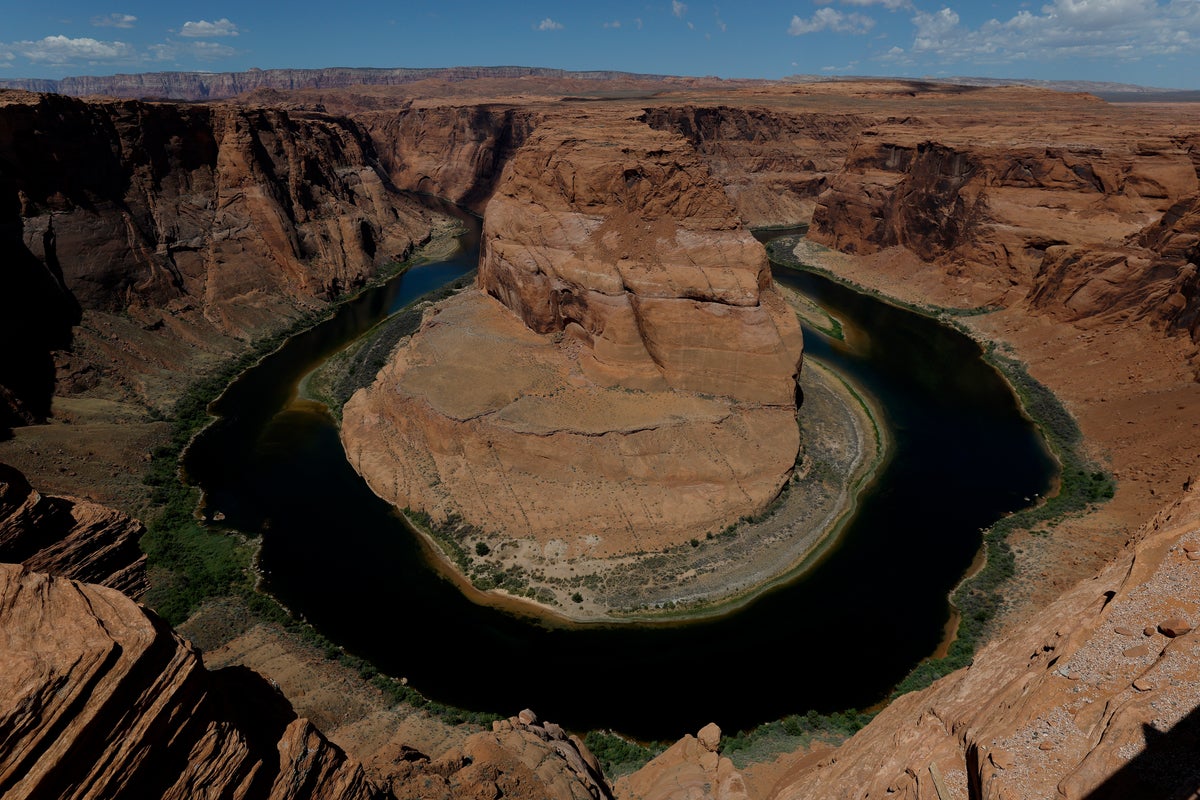
The water remembers where it used to be.
Drive down the winding desert roads toward the edge of Lake Powell, and you will see it carved into the sheer sandstone walls like a pale, ghostly scar. White rock. Hundreds of feet of it. For centuries, the Colorado River stained these canyon walls a rich, reddish-brown hue, brushed by silt and iron oxide. But over the last two decades, that deep stain has been bleached clean by air and sun, leaving behind a stark, blinding ribbon of calcium carbonate. A bathtub ring for giants.
I stood there last summer, listening to the absolute silence of the desert floor where a hundred feet of cold, churning water used to rush toward the turbine intakes. It sounds like absence.
We call it a drought, but that is a comforting lie. A drought implies an end. It suggests that the clouds will eventually remember their job, that the snowpack in the Rockies will rebound next winter, and that the dial will reset. This is not a drought. This is a relocation. We have simply asked a thirsty desert to support a sprawling, humid illusion, and the math has finally caught up to our ambition.
Lake Powell sits behind the monumental curve of Glen Canyon Dam, a concrete wedge holding back the lifeblood of the American Southwest. When full, it is a sapphire abyss, drowning ancient canyons in millions of acre-feet of liquid security. It feeds hydroelectric generators that hum with the electricity powering millions of homes across Arizona, Nevada, and California. Or at least, it used to.
Today, those turbines are gasping.
Consider what happens when a glass is nearly empty, but you keep tipping it further and further, desperate for one last drop. The water level at the second-largest reservoir in the United States has plummeted to historic lows, hovering dangerously close to minimum power pool status. That is a clinical, bureaucratic term for a terrifying cliff. If the water drops below that threshold, the penstocks stop spinning. The lights flicker out in Las Vegas. The air conditioning units stutter in Phoenix. The farms in the Imperial Valley turn to dust.
(As a hypothetical scenario to understand the scale, imagine every swimming pool in a hundred-mile radius draining simultaneously into dry earth, and you still wouldn't match the daily deficit of what is evaporating and draining out of this basin faster than the snowmelt can replace it.)
The trouble began decades ago with a stroke of a pen on a humid day in 1922.
The Colorado River Compact divided the river's bounty between seven states, based on data collected during one of the wettest centuries in the region's historical timeline. They divided water that didn't exist. They allocated gallons based on a statistical outlier, promising the moon to politicians who wanted to turn arid sand into lush lawns and sprawling suburbs. We built cities where cactus belongs, and we built them with the arrogant assumption that the sky would always pay our debts.
Now, the bill is due.
Talk to the marina owners near Page, Arizona, and you will hear a different kind of heartbreak. They are playing a grueling game of leapfrog with the shoreline, moving multi-million dollar docks hundreds of yards outward every single season as the water recedes further into the main channel. Ramps that once plunged steeply into deep water now end in muddy flats, jagged rocks, and submerged stumps of trees that were drowned fifty years ago and are now seeing the sun for the first time since the Eisenhower administration.
It is eerie. It is apocalyptic without the fire. It is just a slow, quiet vanishing act.
We comfort ourselves with numbers. We talk about acre-feet and cubic measurements as if they protect us. But numbers don't sweat. Numbers don't watch their alfalfa fields crack open like dry skin.
Out on the mesa, rancher Marcus Vance looks out over pastures that his grandfather cleared by hand. He is seventy-two years old, with skin the color of tanned leather and eyes that squint constantly against a glare that has only grown harsher with every passing decade.
"My granddad told me this river was an endless snake," Marcus told me, shaking his head as he kicked a clump of dead sagebrush. "He said it would always find a way through. But snakes die, too. When you bleed them dry, there ain't nothing left to wiggle."
Marcus has already sold off half his herd. The cost of hauled water skyrocketed last summer, and the federal cuts to Colorado River allocations forced his irrigation district to ration every drop. He doesn't blame the politicians, exactly. He blames the hubris. The stubborn human belief that we can bend geography to our whims forever.
The irony is that we are drowning in our own ingenuity. We engineered the dams. We carved the tunnels through mountains. We diverted the course of nature so that air conditioners could hum in the middle of the Mojave Desert in July. We are brilliant at building the machine, but utterly incapable of turning it off.
When the water level drops near dead pool, the structural integrity of the entire grid wobbles. Power generation at Glen Canyon Dam has already slumped significantly, forcing utility operators to purchase expensive, dirtier energy from elsewhere to make up the shortfall. That cost trickles down to rate-payers, turning an environmental crisis into a monthly utility bill shock for families who have never even seen the color of the Colorado River.
The ripple effect spreads outward, touching ecosystems that most people will never lay eyes on. Endangered native fish, like the humpback chub, find their warm, shallow spawning grounds swallowed by narrowing channels or dried up entirely. Cottonwood trees along the banks, desperate for a water table that keeps sinking deeper into the earth, wither from the top down, turning into skeletal grey fingers against the blue sky.
We are watching a landscape rewrite itself in real time.
There are solutions, of course, though none of them are painless. Desalination plants on the coast, aggressive municipal recycling programs, and hard caps on agricultural water use in the desert are no longer optional policy debates. They are survival parameters. Cities like Las Vegas have shown the way, ripping up decorative grass and paying residents to replace lawns with xeriscaping, slashing their water consumption even as their population grows.
Yet, conservation alone feels like bringing a bucket to a house fire when you look at the sheer scale of the depletion at Lake Powell and Lake Mead downstream.
The basin states are locked in an endless, bitter poker game, each one refusing to fold first, each one holding onto historic legal rights that were written when the world was wetter and simpler. California points to its senior water rights. Arizona points to its explosive growth. The federal government threatens mandatory cuts, and the states threaten lawsuits. Meanwhile, the white ring on the canyon walls creeps higher.
The water does not care about our legal briefs.
It obeys gravity. It follows the path of least resistance, and right now, that path leads down, down, down into the dwindling heart of the dam.
If you walk out to the edge of the overlook just as the sun dips below the horizon, turning the desert into a bruised canvas of purple and gold, you can hear the wind whistling through the empty canyons. It sounds like a warning. Or perhaps, simply, an eviction notice.
The white stone stands silent, glowing in the dusk, a monument to everything we thought we could tame.