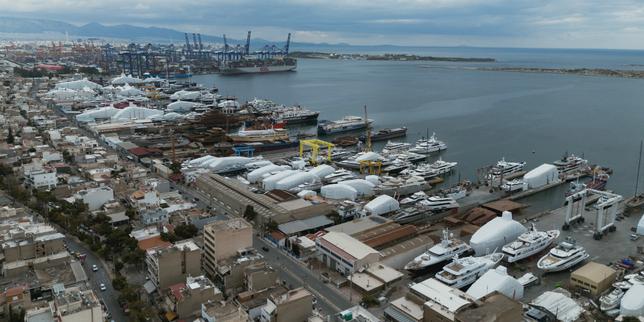
The air in Piraeus smells of salt, thick diesel exhaust, and the kind of heavy, metallic tension that precedes a storm. On the surface, it looks like any other industrial hub. Giant cranes, painted a sharp, clinical blue, reach toward the Mediterranean sky like the fingers of a titan. They move with a rhythmic, automated grace, hoisting containers that hold the world’s desires—electronics from Shenzhen, textiles from Vietnam, car parts from Germany. But look closer at the concrete docks, and you will see the invisible fault lines of a new kind of war.
This isn't a war fought with hulls or gunpowder. It is a war of balance sheets, logistics, and quiet influence.
To understand why a single Greek harbor has become the most contested piece of real estate in the Western world, you have to stand where the water meets the stone. For decades, Piraeus was a sleepy, somewhat gritty gateway to the Aegean. It was the place where you grabbed a coffee and a ferry ticket to Mykonos. Then, the money arrived. Not just any money, but a specific, state-backed capital from the East that saw what others ignored.
The Ghost in the Harbor
When the Greek debt crisis hit like a sledgehammer in 2008, the country was gasping for air. Factories closed. Youth unemployment soared. The cradle of democracy was being told to sell its silver to pay its debts. While European neighbors offered austerity and lectures, China offered a checkbook.
COSCO, the Chinese shipping giant, didn't just buy a stake in the port; they bought a vision. They saw Piraeus not as a decaying Mediterranean dock, but as the "Dragon’s Head"—the primary entry point for the Belt and Road Initiative into the heart of Europe. They poured billions into modernization. They turned a stagnant harbor into the fastest-growing port in the world.
Walking through the COSCO-controlled Pier II today feels like stepping into a different century. The efficiency is chilling. Here, the "human element" has been squeezed into high-tech control rooms. You see fewer grizzled dockworkers shouting over the wind and more screens tracking GPS coordinates in real-time. It is a triumph of engineering and capital.
But growth has a shadow.
Consider the local shopkeeper in the nearby neighborhood of Perama. For generations, his family repaired ships. Now, he watches the massive Chinese-owned vessels slide past his window, often heading to dedicated Chinese-run repair yards. The wealth is there, flowing through the water, but it doesn't always wash up on the shore for the locals. The "Dragon’s Head" is attached to a body that breathes in Beijing, and that makes people nervous.
The Eagle Returns to the Coast
For years, Washington watched this transformation with a mix of distraction and growing unease. While the U.S. was focused on the Middle East and domestic pivots, a strategic adversary was quietly securing the keys to the European front door.
Now, the Americans are back, and they aren't hiding their intentions.
The shift started subtly. Diplomatic visits increased. Warnings about "debt-trap diplomacy" and security risks began to echo through the halls of the Hellenic Parliament. The Americans realized that if they lost the ports of Greece, they lost the ability to monitor the eastern flank of NATO effectively.
But you can’t beat a checkbook with a speech.
The U.S. response has been to pivot toward the northern Greek port of Alexandroupoli and to funnel private American investment into shipyards like Elefsina. If Piraeus is the Chinese gateway for goods, Alexandroupoli has become the American gateway for energy and military hardware. It is a classic pincer movement. The Greeks find themselves in the enviable, yet terrifying, position of being the most popular date at the dance, with two suitors who despise each other.
The Invisible Stakes of a Container
Why does a container of plastic toys or microchips matter to a general in the Pentagon or a strategist in the Forbidden City? Because logistics is the modern equivalent of territory.
If you control the port, you control the data. You know what is moving, where it is going, and how fast it can get there. In a world where "just-in-time" delivery governs the global economy, the entity that owns the terminal owns the clock.
There is a technical concept often missed in the headlines: "Dual-use" infrastructure. A dock that can unload a million iPhones today can unload a division of tanks tomorrow. A sensor system meant to track a commercial freighter can, with a software tweak, track a destroyer. This is the anxiety that keeps Western planners awake at night. They look at the blue cranes of Piraeus and they don't see commerce; they see a potential listening post deep inside the house.
The Greek Tightrope
Spare a thought for the Greek government. They are the protagonists in a tragedy they didn't write. On one hand, they need the Chinese investment. It kept the lights on when no one else would. It created jobs. It turned Piraeus into a global heavyweight. On the other hand, Greece is a core member of the EU and NATO. Their security is tied to the West.
They are performing a high-stakes balancing act on a wire that is fraying.
I spoke with a retired Greek naval officer who spent his life navigating these waters. He described the situation as a "maritime chess match."
"We used to fear the sea," he told me, gesturing toward the horizon. "Now, we fear the contracts. When you sign a deal for ninety-nine years, you aren't just making a business decision. You are deciding what language your grandchildren will need to speak to get a job."
That is the emotional core of the Piraeus story. It isn't about shipping tonnages or GDP percentages. It’s about sovereignty. It’s about the feeling of a nation that survived thousands of years of empires, only to find itself at the center of a new, corporate-led imperialism.
The Sound of the Future
If you go to the port at night, the sound is constant. A low, vibrating hum that never stops. It is the sound of globalism.
The rivalry between the U.S. and China in Greece is often framed as a clash of ideologies—democracy versus autocracy. But on the docks of Piraeus, it feels more like a clash of gravity. Two massive bodies are pulling on a smaller one, and the tension is visible in every new fence, every diplomatic protest, and every new investment project.
The Americans are pushing for "trusted vendors" and secure supply chains. They want to ensure that the digital nervous system of the port isn't built by Huawei. The Chinese are doubling down, emphasizing their role as the reliable partner who stayed when the West turned its back.
Where does it end?
It doesn't. Not anytime soon. Piraeus is no longer just a port. It is a laboratory for the 21st century. It is where we are discovering if two superpowers can occupy the same narrow strip of land without colliding. It is where we see if commerce can truly be separated from conflict.
As the sun sets over the Saronic Gulf, the blue cranes are still moving. They don't care about the flags flying on the ships or the frantic cables being sent between embassies. They just keep lifting, moving the world’s weight from the water to the land.
The Greeks sit in the cafes nearby, drinking their ouzo, watching the giants play. They know better than anyone that when titans fight, it’s the ground they stand on that suffers the most. And right now, the ground is vibrating.
The next time you see a shipping container on the back of a truck, don't just see a box. See it as a piece of a puzzle that is being put together in a small harbor in Greece—a puzzle that, once finished, will show us exactly who owns the future.
The wind is picking up in Piraeus. The storm isn't here yet, but the air is electric with the arrival of something much bigger than a boat.