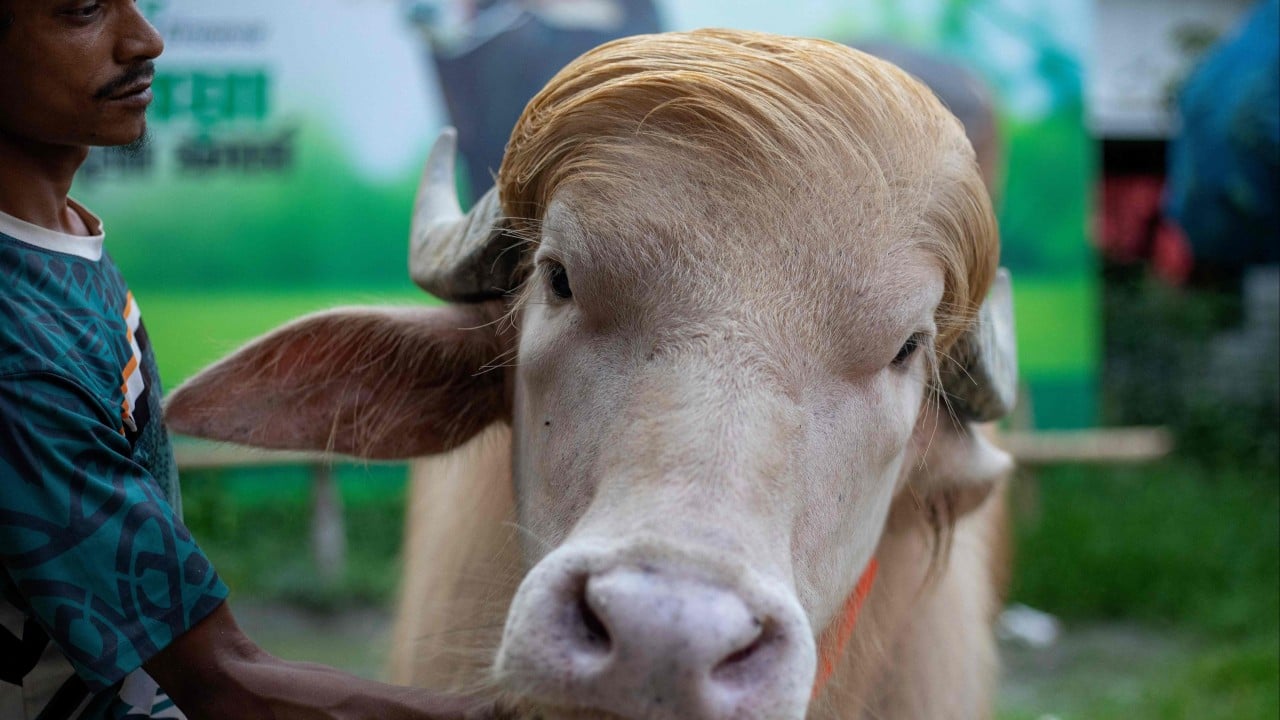
The air in the Kalapara sub-district of Bangladesh usually smells of salt and drying fish, but for months, it carried the electric charge of a countdown. In the village of Tiakhali, a massive water buffalo stood tethered, unaware that his name and his weight had turned him into a living symbol of both political fervor and impending sacrifice. He was called "Trump."
He was a titan of a creature, weighing nearly 800 kilograms. His skin was the color of wet slate, stretched tight over muscles that rippled like the Bay of Bengal during a storm. His owner, a local man named Joynal Abedin, had raised him with a specific, grisly purpose. This was not a farm animal meant for the plow; this was a political statement waiting for a blade. Abedin had pledged that if his chosen political party won the national elections, Trump would be slaughtered in a grand celebratory feast.
Then, the world shifted.
Politics is a fickle master, but the fate of a thousand-pound animal shouldn’t necessarily hinge on the ballot box. Yet, in the rural stretches of Bangladesh, the line between devotion and spectacle is often drawn in blood. Trump became a local celebrity. Crowds gathered to see the buffalo named after a foreign leader, a name chosen to reflect power, bulk, and perhaps a touch of the unpredictable. People touched his flanks and took photos, all while knowing that his life was effectively a ticking clock synchronized with the counting of votes.
The Weight of a Promise
Consider the pressure on Abedin. In a community where a man’s word is his currency, a public vow to sacrifice a prized animal is a heavy burden. To back down is to lose face. To follow through is to lose a fortune. A buffalo of that size is a massive financial asset, representing years of feed, labor, and care.
But as the election results solidified, something unexpected happened. The "sacrifice" began to feel less like a celebration and more like a tragedy. The buffalo wasn't just meat. He had become a neighbor. He had a temperament. He had eyes that watched the village children play. The local community, once excited for a feast, began to feel the tug of a different emotion: empathy.
The story began to leak beyond the borders of Tiakhali. It reached the ears of animal rights activists and government officials who saw a different path for the beast. They didn't see a political offering. They saw a magnificent specimen of livestock that deserved a fate better than a butcher’s hook.
A Different Kind of Victory
The intervention was quiet at first, a series of negotiations between local authorities and the owner. They had to navigate the delicate ego of a man who had made a public promise. How do you save an animal without making the owner look like he’s breaking a sacred vow?
The solution was a stroke of diplomatic genius. Instead of a slaughter, the buffalo would be "sacrificed" to the public good. He would be donated. This transformed the act from a private feast into a national gift. Abedin could still claim the merit of his generosity, but the buffalo would keep his life.
The logistics of moving an 800-kilogram celebrity are not for the faint of heart. It required a crane, a reinforced truck, and a convoy that looked more like a moving state funeral than a livestock transfer. As Trump was hoisted into the air, the village watched in silence. The heavy chains clanked against the metal frame of the truck, and for a moment, the buffalo hung suspended between his old life of certain death and a new, uncertain future.
The Road to the Capital
The journey from the muddy fields of Kalapara to the bustling heart of Dhaka is a long one. It is a path through narrow roads choked with rickshaws, over crumbling bridges, and past endless stretches of emerald-green rice paddies. Throughout the trip, Trump remained the center of gravity. People peered into the back of the truck at the beast who had cheated the knife.
He arrived at the Bangladesh National Zoo in Mirpur not as a prisoner, but as a guest of honor.
The zoo is a place of noise—the scream of peacocks, the chatter of families, the distant roar of traffic. It was a far cry from the salt air of the coast. For Trump, the transition was jarring. He was moved into a spacious enclosure, a place where his only job was to exist. No plows. No blades. Just the slow, rhythmic chewing of cud under the shade of a rain tree.
The Ghost of the Blade
If you visit him today, you won't see the politics. You won't see the election results or the heated arguments of the village elders. You see a mountain of muscle and horn, a creature that represents a rare moment where mercy overrode tradition.
There is a specific kind of silence that surrounds an animal that was supposed to be dead. It’s a quietude that commands respect. The zookeepers treat him with a certain level of awe, perhaps recognizing that he is a survivor of a human whim that usually ends in bone and gristle.
His name remains. It is a strange, jarring moniker to hear in the heart of Dhaka, a reminder of the bizarre ways our global culture trickles down into the most remote corners of the earth. But to the children who press their faces against the enclosure fence, he isn't a political statement. He is simply the biggest buffalo they have ever seen.
The Unseen Stake
We often talk about "human-centric" stories as if they only involve people. But the story of the Trump buffalo is about the human capacity to change our minds. It is about the moment we decide that a living soul—even one with four legs and a tail—is worth more than the satisfaction of a grim tradition.
Abedin, the owner, walked away with his pride intact and his pockets empty of the profit the meat would have brought. The village walked away with a story instead of a meal. And the buffalo? He walked away with everything.
He stands now in the dust of his enclosure, flicking his tail at the flies of the capital. He is a living monument to the idea that even when the path is set toward the dark, we can choose to turn toward the light.
The truck that brought him to the zoo is long gone, the echoes of the election have faded into the background noise of history, and the salt air of Kalapara is a distant memory for the beast. He is safe. He is fed. He is a king in a kingdom of dirt and hay, a survivor of a promise that was, thankfully, broken.
The sun sets over the Mirpur zoo, casting long, distorted shadows of the buffalo against the concrete walls. He lowers his massive head to the water trough, the ripples distorting his reflection until he is nothing but a blur of gray and light. He is no longer a sacrifice. He is just a buffalo. And in that simple reality lies the greatest victory of all.


