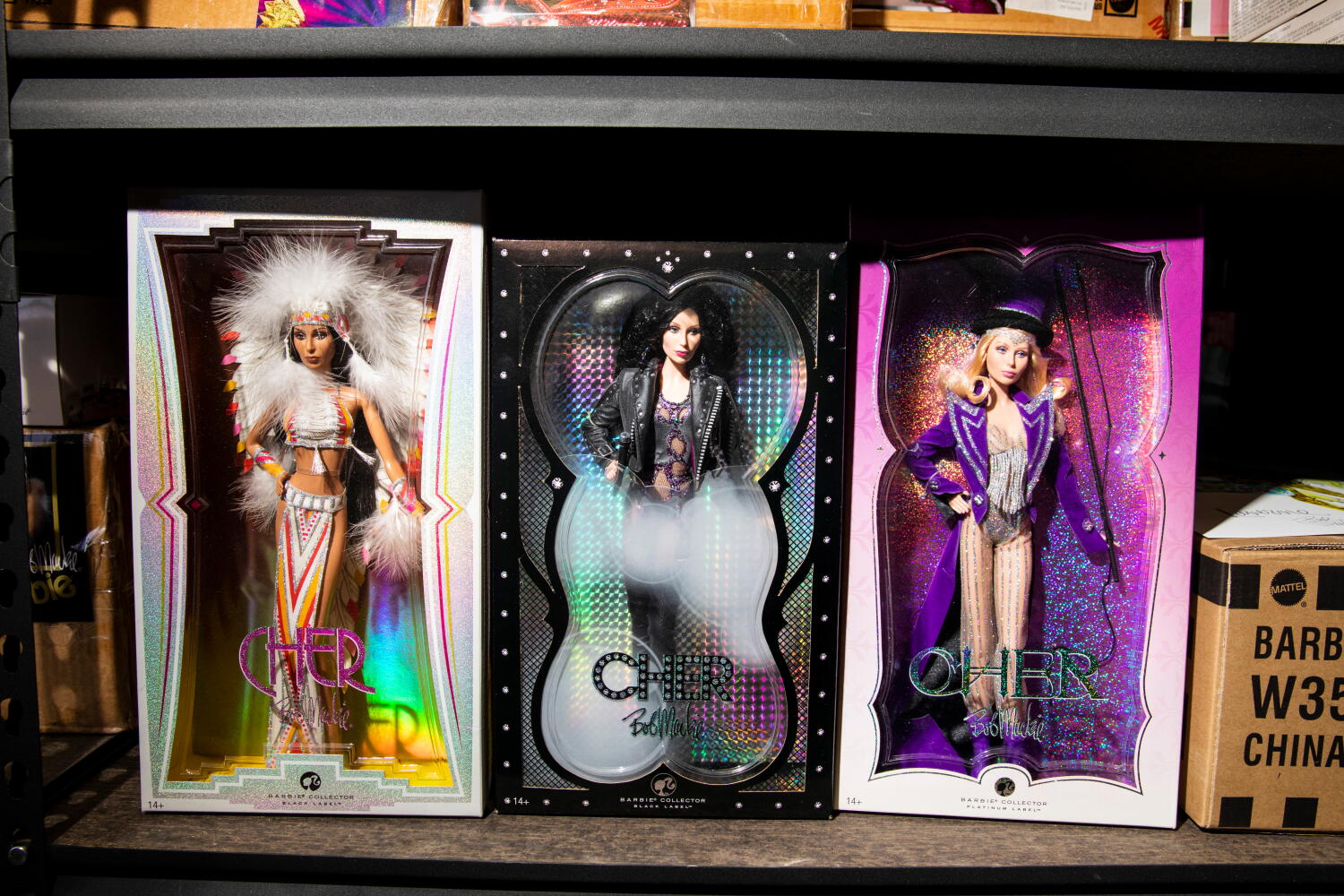
The fashion establishment loves a cute narrative. They look at Bob Mackie’s glittering, hyper-intricate miniature gowns crafted for an eleven-and-a-half-inch piece of plastic and call them whimsical. They treat them as adorable novelty side-projects, tiny echoes of the grand sequined armors he built for Cher, Diana Ross, and 1970s television royalty. That narrative is lazy, intellectually dishonest, and backwards.
Bob Mackie did not scale down his red-carpet aesthetic for Barbie. He used Barbie as a high-risk laboratory to solve structural design problems he could never get away with on a human body.
When you shrink a garment down to eleven and a half inches, you do not simply reduce the pattern by ninety percent. The laws of physics do not care about your nostalgic childhood memories. Surface tension changes. Fabric weight ratios multiply exponentially relative to the underlying surface. A standard micro-sequin that looks delicate on a human shoulder acts like chain mail armor when draped over a rigid PVC clavicle. If Mackie had sewn human-scale construction techniques onto a Mattel doll, the clothing would have slid off, buckled, or warped the doll's molded plastic torso within seconds.
Instead, he invented an entirely separate discipline of micro-engineering.
The Physics Nobody Wants to Talk About
Look closer at the 1990 Mackie Barbie or the legendary 1988 Golden Legacy edition. The mainstream fashion commentary always raves about the dazzle, the drama, and the rhinestones. Nobody talks about the tension mechanics.
Human bodies breathe. They sweat, shift, slouch, and complain when a boned bodice restricts their ribcage. A human model provides kinetic energy that helps a dress move; she fills out the negative space. Barbie does none of that. She is a static, impossibly proportioned pillar with a waist circumference that would induce organ failure in any living mammal. Her ankles are permanently pitched for high heels. Her neck is fixed. Her shoulder articulation has zero give.
Designing clothing for a stationary, hyper-exaggerated mannequin means the designer must compensate for every single dead zone in the silhouette. Mackie realized early on that traditional tailoring was useless here. You cannot put a functional zipper on a dress meant for an eleven-inch doll without it looking like a logging chain. You cannot rely on gravity to pull a hemline straight when the fabric's own weight is negligible compared to static electricity.
So, what did he do? He abandoned traditional sewing entirely. He used custom-dyed netting as a invisible structural foundation, gluing and hand-tacking thousands of micro-components directly onto the chassis of the doll. He treated the garment as an architectural skin graft rather than a stitched textile.
When people praise those tiny dresses for being "scaled-down masterpieces," they reveal that they have never touched a sewing machine or studied textile physics. You cannot scale down a feather boa. A real ostrich feather on a miniature doll looks like a damp broom. Mackie had to invent synthetic mimicry, using specialized trims, shaved threads, and metallic foils that did not exist in the human couture houses of Seventh Avenue. He was not scaling down; he was inventing a new material science from scratch.
The Laboratory of Excess
In the 1970s and 1980s, Mackie’s human clients had budgets running into the tens of thousands of dollars per gown, backed by entire workrooms of skilled hands. Yet, those human designs were constrained by a frustrating variable: the client's vanity and physical comfort. Cher might demand a daring cutout, but she still needed to walk down a flight of stairs on live television without suffering a wardrobe malfunction or passing out from lack of oxygen.
Barbie had no vanity. Barbie had no safety regulations, no union breaks, and no lung capacity.
This made the doll the ultimate conceptual proving ground. If Mackie wanted to test a wildly aggressive asymmetric neckline that defied structural support, he could not risk testing it live on television with Cher's career on the line. He tested it on the doll first. He pushed beaded fringe weights to their absolute breaking point on miniature frames to see how much optical motion he could generate before the garment looked cluttered.
The glittering fringes, the cascading rhinestones, the gravity-defying feathered headpieces—these were not cute adaptations of human fashion. They were the raw prototypes of high-impact showmanship. The doll was the draft sheet for the superstar stage.
Yet, the fashion historians love to flip the script. They frame the toy collaborations as a lucrative commercial retirement home for a master designer—a fun little gig after the real work was done. That is an insult to the rigor of the craft. Mackie’s work with Barbie was sharper, tighter, and structurally more demanding than half the lazy ready-to-wear collections rolling out of Milan and Paris during the same decades.
The Hypocrisy of the Runway
Consider the historical snobbery of the fashion elite toward toys. For decades, high-end design houses treated dolls and children's playthings as a vulgar commercial distraction. Real fashion lived in silk faille, heavy wool gabardine, and hand-woven organza worn by breathing breathing women on elevated wooden runways.
At the exact same time, those exact same design houses were quietly sending their junior assistants to toy stores and collector conventions to study how Mackie and Mattel achieved such clean lines at a micro-scale.
The secret that the high-fashion old guard refused to admit was that micro-couture forces a designer to edit out all the lazy fat. On a human runway, a designer can hide sloppy construction behind yards of expensive fabric or rely on the sheer charisma of a supermodel to sell a mediocre silhouette. You cannot hide behind charisma on a shelf. An eleven-inch doll does not have a personality; she is entirely at the mercy of the stitching. If the proportion of a sequin is half a millimeter too large, the entire garment instantly transforms into a cheap, tacky piece of plastic junk.
Mackie understood scale distortion better than any couturier of his era. He knew that the human eye reads detail differently at a distance versus up close, and he adjusted his micro-patterns to create exaggerated optical illusions that read as full-scale opulence. When you look at a Mackie Barbie photograph, your brain fills in the missing human scale because the density of the embellishment tricks your visual cortex into seeing a six-foot woman standing under studio lights.
That is not nostalgia. That is master-level visual manipulation.
The Uncomfortable Downside of Miniature Perfection
Every radical innovation carries a cost, and Mackie’s miniature mastery inadvertently set a toxic trap for the collectibles market and modern fashion culture.
By proving that a piece of plastic could wear couture more flawlessly than a human being, he helped birth an era of impossible aesthetic tyranny. The collector community stopped looking at toys as objects of imaginative play and turned them into hyper-precious, untouchable museum pieces locked behind glass cases. The focus shifted away from what a child could invent with a doll and toward how many millions of micro-beads could be glued onto a static collector edition sold at a massive markup.
Furthermore, it warped public perception of tailoring. When people consume decades of hyper-detailed miniature art, their expectations of real-world clothing become distorted. They demand structural impossibilities from everyday garments—gowns that defy gravity, fabrics that never wrinkle, silhouettes that maintain razor-sharp geometry while a human body sits, eats, and breathes.
Mackie’s work with Barbie created a standard of pristine, unblemished glamour that cannot exist in organic human reality. We are left chasing an illusion born on a toy factory floor, trying to bend our messy, fleshy lives into the rigid geometry of a plastic icon.
Dismantling the Myth
Stop calling these dresses cute. Stop reducing a masterclass in spatial engineering to a nostalgic footnote about a children's toy.
When Bob Mackie dressed Barbie, he was not playing dress-up. He was conducting a masterclass in material economy, optical trickery, and structural defiance. He proved that high fashion is not defined by the size of the body it covers, but by the rigor of the mind that constructs it.
The next time someone dismisses miniature design as trivial, remember that the smallest garments often require the largest intellects to keep them from collapsing under their own microscopic weight. The splash wasn't made because the dresses were tiny. The splash was made because they held together when they had no business surviving at all.