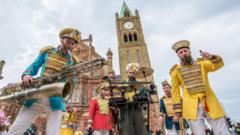
When the idea of a jazz festival in Derry was first floated over two decades ago, the local reaction wasn't just skeptical—it was derisive. "Are you off your head?" became the unofficial slogan for a city that, at the time, was still shaking off the grey dust of the Troubles and a reputation for grit that didn't exactly scream "smooth syncopation." Yet, what started as a seemingly delusional ambition has transformed into the City of Derry Jazz and Big Band Festival, the largest event of its kind in Northern Ireland. It succeeds not because Derry suddenly became a global hub for avant-garde bebop, but because the city mastered the art of high-volume, low-barrier cultural tourism that keeps the local economy breathing during the leanest months of the year.
The festival works by subverting the traditional jazz model. While prestigious festivals in Montreux or Newport bank on high-priced tickets and elite lineups, Derry’s model is built on accessibility and alcohol. It is a pub-crawl masquerading as a high-art gathering, and that is precisely why it remains solvent. By saturating the city’s bars, hotels, and public squares with over 400 performances—many of them free—the event drives a massive spike in footfall that benefits the hospitality sector far more than a niche, ticketed concert series ever could. Also making headlines in related news: Nine Hours and Two Hundred Feet from Home.
The Myth of the Jazz Purist
If you walk through the Diamond or down Shipquay Street during the May Bank Holiday weekend, you won’t just hear the complex modal shifts of Miles Davis. You are more likely to hear boogie-woogie, blues, rockabilly, and brass bands playing pop hits. This stylistic drift is the festival’s dirty little secret. Purists might scoff, but the "jazz" label serves as a broad umbrella for any music that encourages people to buy a pint and stay for a second set.
From an industry perspective, this is a masterclass in brand positioning. By calling it a "Jazz Festival," the city council and local organizers provide a veneer of sophistication that attracts an older, more affluent demographic from across the border and overseas. These are visitors who stay in hotels and eat three-course meals. However, by filling the schedule with high-energy big bands and jump-jive acts, the festival retains the local youth and the "weekend warrior" crowd. It is a dual-track economic engine. More information on this are covered by Condé Nast Traveler.
Why May Matters
The timing of the festival is a calculated strike against the seasonal nature of Northern Irish tourism. May in the North is notoriously fickle. It’s too early for the summer rush and too late for the Easter bump. By anchoring a massive international event in this window, Derry creates an artificial peak season.
Hotel occupancy rates in the city frequently hit 95% to 100% during the festival weekend. For a regional city, this isn't just "good business"—it’s a lifeline. The influx of roughly 70,000 visitors over five days injects millions into the local till. Investigative looks at the balance sheets show that the return on investment for the local council is significant; every pound of public money spent on artist fees and infrastructure is returned several times over through VAT, employment hours, and secondary spending in shops and transport.
The Invisible Logistics of a Citywide Stage
Turning an entire city into a venue presents a logistical nightmare that most analysts overlook. Unlike a greenfield festival like Glastonbury, where you can fence off the chaos, Derry’s festival is woven into the existing urban fabric. This creates a unique set of pressures on local infrastructure.
- Public Order and Policing: Maintaining a "festival atmosphere" while thousands of people move between licensed premises requires a light-touch but expensive security presence.
- The Artist Circuit: Because the festival relies on hundreds of gigs, it creates a temporary labor market for musicians. Many bands play three or four different venues in a single day, hauling gear through narrow, crowded streets.
- Acoustic Pollution: Managing the sound bleed between neighboring pubs in the city center is a constant battle of decibels that requires cooperation between rival business owners who are otherwise competing for the same customers.
This cooperation is the real reason the festival hasn't collapsed under its own weight. The "Derry Jazz" brand has become a collective asset. If one pub fails to provide a good experience, it tarnishes the reputation of the whole weekend. Consequently, there is an unspoken agreement among publicans to keep standards high and the music constant.
The Gentrification of the Troubles Narrative
There is a deeper, more cynical layer to the festival’s success. For decades, Derry was defined by the walls and the conflict that happened within them. The Jazz Festival was one of the first successful attempts to rebrand the city as a destination for pleasure rather than a site for pilgrimage to past trauma.
This shift is essential for long-term economic growth. You cannot build a sustainable tourism industry solely on "Dark Tourism" or political murals. You need joy. You need a reason for people to come back annually. The Jazz Festival provides a neutral ground. It is an event where the politics of the region are drowned out by a saxophone solo, providing a "safe" cultural product for international tourists who might still be wary of the city’s history.
However, this rebranding comes with a cost. As the festival grows, the local "maverick" spirit that birthed it is being replaced by more corporate, sanitized management. The spontaneous jam sessions in smoky back rooms are increasingly replaced by scheduled, sponsored performances. While this ensures the bins are emptied and the stages are safe, it risks alienating the very artists who gave the festival its soul.
The Problem with Success
The biggest threat to the Derry Jazz Festival is, ironically, its own scale. The city is small. Its hotel capacity is finite. When an event reaches a certain saturation point, the "Experience Economy" begins to suffer.
Prices for accommodation during the festival weekend have skyrocketed, sometimes tripling the standard rate. This risks turning the event into an exclusionary experience, moving away from the "jazz for the people" ethos that made it a success. If the average local can no longer afford to participate in the hospitality side of the festival, the social contract that sustains the event begins to fray.
Furthermore, the reliance on the "Big Band" sound is a double-edged sword. While it’s a crowd-pleaser, it is an aging genre. The festival’s organizers are now faced with a generational cliff. To survive the next twenty years, they must figure out how to integrate contemporary sounds—neo-soul, acid jazz, and electronic crossovers—without terrifying the loyal retirees who have funded the festival’s growth since the early 2000s.
The Hidden Cost of "Free"
Most attendees view the festival as a series of free concerts. In reality, the cost is simply shifted. The "free" gigs in pubs are paid for by the patrons through the price of their drinks. The "free" outdoor stages are paid for by the taxpayer.
This model is increasingly under pressure due to the rising costs of international travel and artist visas. In the post-Brexit landscape, bringing in a band from New Orleans or even Paris involves a bureaucratic gauntlet that didn't exist a decade ago. This has forced a pivot toward more local and national acts. While great for the Irish music scene, it challenges the "International" tag that the festival uses to market itself globally.
To maintain its status, Derry must prove it can still attract global talent despite the logistical hurdles. This requires more than just a "can-do" attitude; it requires a sophisticated talent-buying strategy that can navigate the new realities of the UK border.
Hard Truths for the Hospitality Sector
Local businesses that treat the festival as a "smash and grab" opportunity are the greatest internal threat. We have seen it in other cities: a festival becomes popular, the local businesses get greedy, the quality drops, and the crowds move on to the next "undiscovered" gem.
Derry’s strength has always been its warmth and the sense that you are part of a citywide party. If the festival becomes a sterile, over-policed, and over-priced corporate venture, it will die. The magic of a trumpet player performing in a tiny, packed bar on Waterloo Street cannot be manufactured by a marketing agency. It is a fragile ecosystem that requires constant protection.
The festival’s survival depends on maintaining that precarious balance between being a professional, world-class event and a chaotic, soulful street party. It requires the city council to stay out of the way just enough to let the music happen, while providing enough support to keep the lights on.
Derry proved the doubters wrong in 2002. The city wasn't "off its head"—it was ahead of the curve, recognizing that in a post-industrial world, culture is the only currency that doesn't devalue when you share it. But as the competition for the "festival pound" intensifies across Europe, Derry cannot afford to coast on its reputation. The music has to stay as sharp as the business plan.
Demand more from the venues, support the fringe performers who don't get the mainstage billing, and recognize that the moment this festival feels like a chore rather than a riot, the party is over.
Stop looking for a summary and start looking for a flight.