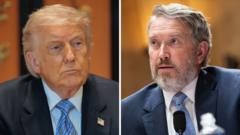
The defeat of Representative Thomas Massie in Kentucky’s Republican primary signals the near-total elimination of internal dissent within the GOP, illustrating how Donald Trump has systematically dismantled the party's libertarian-leaning faction. Massie, a seven-term incumbent known for his stubborn independence, fell to Trump-backed challenger Ed Gallrein on Tuesday. The 55% to 45% margin ended a multi-million-dollar war of attrition. This race was not a standard intra-party disagreement over policy details. It was a well-funded execution of a political rebel.
For over a decade, Massie operated under the assumption that an ideological purist could survive in a populist era by voting with his conscience. He was wrong. The primary became the most expensive House intra-party contest in American history, drawing more than $32 million in ad spending. It proved that in the current iteration of the Republican Party, adherence to a specific economic or constitutional philosophy means nothing if it conflicts with absolute personal loyalty to the president.
The Anatomy of an Execution
Political executions of this scale require immense coordination and deep pockets. The primary mechanism used to unseat Massie was a massive influx of outside capital. Outside groups aligned with the president and pro-Israel political action committees flooded Kentucky’s fourth congressional district with negative advertising. The sheer volume of spending overwhelmed the incumbent's grassroots fundraising apparatus.
Massie had long irritated the White House by carving out a position as an anti-interventionist and a fiscal hawk. He regularly voted against foreign aid packages, opposed military action in Iran, and challenged the administration’s domestic spending bills, including Trump's signature "One Big Beautiful Bill." In a previous political era, such positions would be framed as principled constitutional conservatism. Today, they are labeled as treason.
Massie's Key Points of Friction with the Executive Branch:
1. Foreign Policy: Consistent opposition to U.S. funding for foreign militaries and interventions.
2. Fiscal Discipline: Votes against massive federal spending packages backed by the administration.
3. Transgressions: Active push for the unredacted release of the Jeffrey Epstein government files.
The administration did not rely solely on television commercials to do the heavy lifting. In a rare and highly unusual deployment of executive branch authority for a domestic political campaign, Defense Secretary Pete Hegseth was dispatched to the district to campaign directly for Gallrein. A retired Navy SEAL and farmer, Gallrein was positioned as a perfect vessel for executive branch priorities. He openly skipped debates with Massie, choosing instead to replicate Trump's direct-to-voter communications strategy.
The Disloyalty Trap
The underlying mechanics of Massie’s defeat reveal a shift in how political capital is measured. Massie actually voted with Trump roughly 90% of the time during the president's second term. In any traditional political framework, a 90% voting alignment makes a lawmaker a reliable ally. In the modern GOP, that remaining 10% represents a dangerous vulnerability.
Trump’s public rhetoric leading up to the vote laid bare this reality. Speaking at a warehouse in Hebron, Kentucky, the president declared Massie "disloyal to the Republican Party" and a "major sleazebag." The focus on loyalty over voting record indicates that the administration views the legislature not as a co-equal branch of government meant to deliberate, but as a rubber stamp for executive actions.
The strategy works because the primary electorate has changed its expectations. Voters are no longer looking for constitutional scholars who read every page of a bill; they are looking for reliable soldiers to fight a broader cultural and political war. Gallrein understood this perfectly, framing his candidacy around advancing the executive agenda without friction. Massie's defense—that he was protecting the taxpayer and the Constitution—sounded outdated to an electorate conditioned on conflict.
A Pattern of Purges
Massie's loss cannot be viewed in isolation. It occurred just days after Senator Bill Cassidy of Louisiana lost his primary to a Trump-backed challenger. Cassidy had committed the ultimate infraction of voting to convict Trump during his second impeachment trial. Earlier in the month, independent-minded Republican state lawmakers in Indiana faced similar fates.
What we are witnessing is a systematic purge of the party's institutional memory and ideological diversity. The libertarian wing, once a powerful force driven by the Tea Party movement and figures like Ron and Rand Paul, has been effectively hollowed out. The remaining members of Congress who share Massie’s skepticism of executive power are now facing an existential choice: fall in line or face a well-funded execution in their next primary cycle.
The financial reality of these races means that defiance is a luxury few can afford. When outside groups can drop $32 million into a single congressional district, they can warp the political reality on the ground. They can turn a popular, independent incumbent into an apparent enemy of the state in the span of a few months.
The Defiant Exit
Massie did not go quietly, using his concession speech to highlight the forces that brought him down. He told his supporters that he would have conceded earlier, but "it took a while to find Ed Gallrein in Tel Aviv"—a direct shot at the millions of dollars in pro-Israel PAC money that flooded the race after Massie criticized foreign aid packages.
The congressman noted that he still won among younger voters, suggesting that his brand of constitutional libertarianism has a future. That may be true in theory, but the immediate reality is bleak for his faction. The machinery of the Republican Party is now entirely synchronized with the desires of the executive branch.
By removing lawmakers who ask difficult questions about spending, executive overreach, and foreign entanglements, the party has streamlined its governance model. It has traded the messy, unpredictable nature of ideological debate for the cold efficiency of top-down command. The defeat of Thomas Massie confirms that the modern GOP no longer has room for mavericks, only followers.
/cdn.vox-cdn.com/uploads/chorus_asset/file/12849563/penthouses.0.1510182761.jpg)