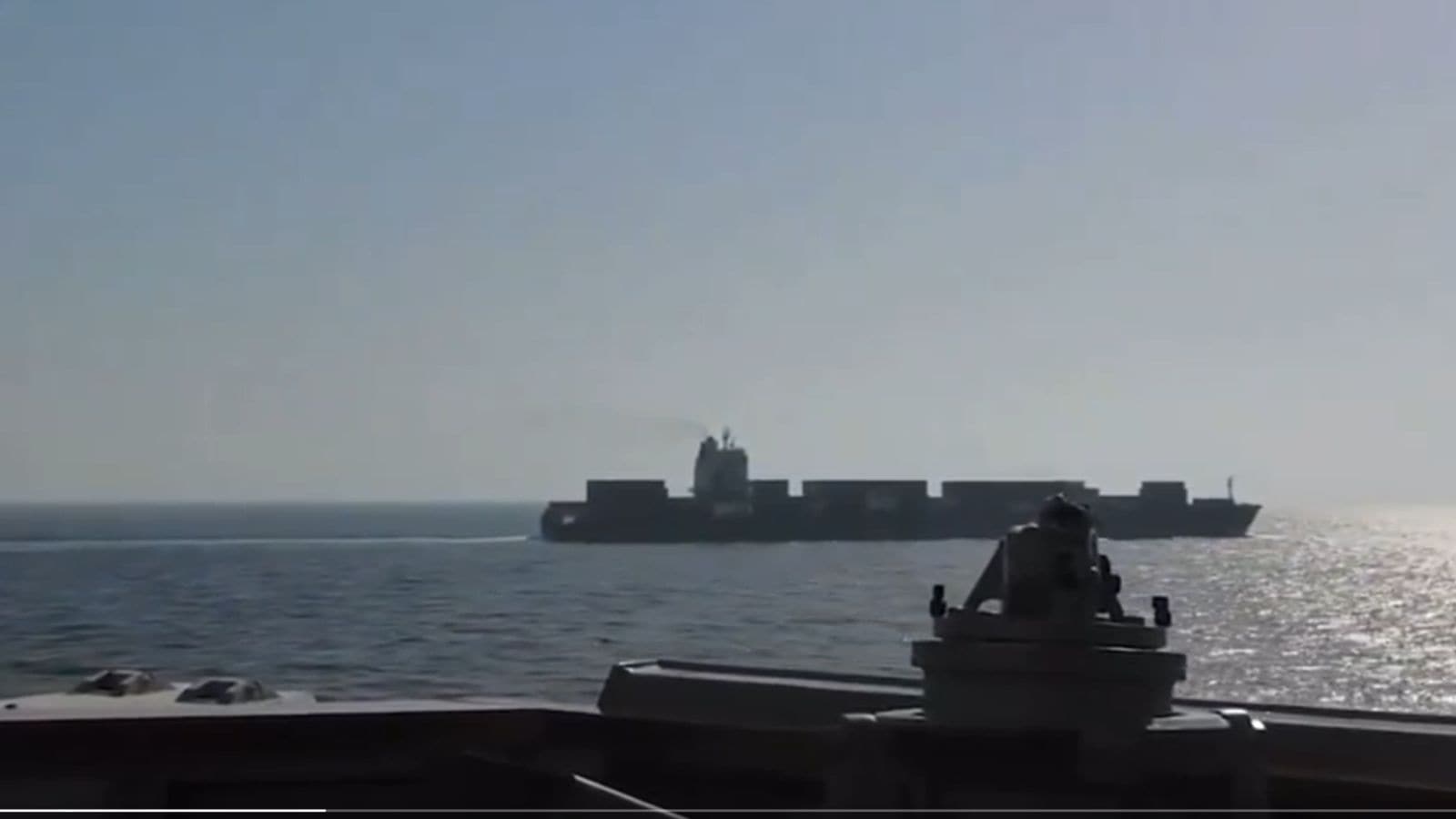
The seizure of the Iranian-flagged vessel Touska by U.S. Marines represents more than a standard maritime interdiction. It is a calculated display of Visit, Board, Search, and Seizure (VBSS) proficiency designed to send a clear message to Tehran regarding the sanctity of international shipping lanes. When the fast-roping teams hit the deck of the Touska, they weren't just looking for illicit cargo; they were executing a high-stakes geopolitical maneuver that relies on split-second timing and overwhelming technological superiority. This operation highlights the increasing friction in the Gulf of Oman and the specific tactical evolution of the Marine Expeditionary Units (MEU) operating in the region.
The Calculus of a High Seas Interception
Naval boardings are rarely about the ship itself. They are about the control of flow. In the case of the Touska, the decision to board was rooted in intelligence suggesting the vessel was participating in activities that circumvented international sanctions or facilitated the transfer of restricted materials.
Standard procedure for these operations begins long before a boot touches wood or steel. It starts with persistent surveillance. MQ-4C Triton drones and P-8A Poseidon aircraft maintain a "unblinking eye" over the target, mapping the deck layout and monitoring the patterns of the crew. By the time the order is given to "go kinetic," the boarding team already knows the location of every hatch, every camera, and most likely, the mood of the captain.
The Touska was targeted because it occupied a grey zone. Iranian shipping often utilizes a web of shell companies and frequent name changes to mask the origin of its cargo. To stop a ship like this, the U.S. Navy and Marine Corps must prove a "probable cause" that satisfies international maritime law, or act under specific UN mandates. The boarding of the Touska suggests that the intelligence was not just good—it was actionable and verified.
Engineering the Vertical Assault
The most striking aspect of the footage released from the Touska operation is the Fast-Rope Insertion. This is the most vulnerable moment for any boarding team. As the MH-60S Seahawk hovers mere feet above the moving deck, Marines slide down thick nylon ropes, carrying upwards of 80 pounds of gear.
The Physics of the Hover
Maintaining a stable hover over a moving vessel is a feat of engineering and pilot skill. The ship is pitching, rolling, and heaving in the swells. Meanwhile, the helicopter is dealing with "ground effect" over the deck and the turbulent air kicked up by the ship's own superstructure.
- Relative Motion: The pilot must match the ship's speed and heading perfectly. If the ship turns, the helicopter must pivot in sync or risk snapping the rope or dumping the Marines into the sea.
- The Rope: Fast-ropes are not climbing ropes. They are thick, braided bundles designed for friction. Marines use their gloved hands and boots to control their descent. Too fast, and they break their legs on the deck. Too slow, and they become a static target for anyone on the ship with a rifle.
Once on deck, the team moves in a "stack." They don't linger. The goal is to secure the bridge and the engine room simultaneously. If you control the steering and the power, you control the ship.
Beyond the Video Footage
What the public sees is the cinematic descent. What they don't see is the Electronic Warfare (EW) blanket thrown over the area. During the Touska boarding, U.S. assets likely jammed local communications to prevent the crew from calling for Iranian Revolutionary Guard Corps (IRGC) backup.
This invisible shield is critical. The Gulf of Oman is a crowded neighborhood. Iranian fast boats are often lurking just over the horizon, ready to harass U.S. operations. By severing the Touska’s ability to transmit data or distress signals, the Marines created a "tactical vacuum" where they held all the cards.
The Equipment Reality
The gear worn by these Marines is a far cry from the heavy, cumbersome plates of the early 2000s. They utilize Maritime Integrated Navigation Systems and lightweight, buoyant body armor. If a Marine goes overboard during the boarding, their gear is designed to keep their head above water while they await recovery.
Furthermore, the weapons used—typically the Mk18 Close Quarters Battle Receiver—are optimized for the tight confines of a ship's interior. In the narrow, dark corridors of a freighter like the Touska, a full-length rifle is a liability. The Mk18 allows for rapid movement around corners and through "fatal funnels" like doorways and companionways.
The Iranian Counter-Strategy
Tehran is not a passive observer in these encounters. The IRGC has spent decades refining "asymmetric naval warfare." They know they cannot win a head-to-head fight with a U.S. Carrier Strike Group. Instead, they use ships like the Touska as pawns.
Sometimes, these vessels are bait. They are meant to be boarded to see how the U.S. reacts, what frequencies they use for jamming, and how long it takes for support to arrive. Every time the U.S. boards a ship, Iran collects data. They are looking for a gap in the armor—a moment of hesitation or a procedural flaw they can exploit later with a swarm of suicide drones or limpet mines.
The Touska was a "clean" boarding, but it happened against a backdrop of "shadow war" tactics. For every ship boarded successfully, dozens of others slip through the cracks using "dark' AIS (Automatic Identification System) transponders. They turn off their tracking, hug the coastline of friendly nations, and disappear into the noise of global trade.
The Legal Tightrope
Critics often point to these boardings as "piracy" under a different name. However, the U.S. justifies these actions under the Right of Visit codified in Article 110 of the United Nations Convention on the Law of the Sea (UNCLOS).
While the U.S. is not a formal signatory to UNCLOS, it recognizes the treaty as customary international law. The Right of Visit allows a warship to board a foreign vessel if there are reasonable grounds to suspect the ship is engaged in piracy, slave trade, or is without nationality. When it comes to Iranian ships, the "without nationality" or "fraudulent registration" angle is frequently used, as many Iranian vessels fly "flags of convenience" from countries like Panama or Liberia that have revoked their registration.
The Logistics of Detention
Once the ship is secure, the real work begins. This is the part that doesn't make the highlight reel. The Marines must account for every crew member. These sailors are often third-party nationals—Filipinos, Indians, or Eastern Europeans—who are caught in the middle of a conflict they have no stake in.
The boarding team must balance the need for security with the requirement to treat the crew humanely. This involves:
- Biometric Enrollment: Scanning eyes and fingerprints to check against terror watchlists.
- Cargo Verification: Opening containers that may be booby-trapped or contain hazardous chemicals.
- Site Exploitation: Searching for logbooks, hard drives, and "pocket litter" that reveal the ship’s true destination and handlers.
The Touska operation yielded more than just the ship; it provided a snapshot of the current Iranian logistics network. Every document seized is a piece of a larger puzzle that analysts in Arlington and Tampa will spend months putting together.
Tactical Superiority is Not a Permanent State
The boarding of the Touska was a success, but it should not lead to complacency. The environment in the Middle East is shifting. The introduction of low-cost, high-impact technologies like Loitering Munitions (suicide drones) means that a Seahawk hovering over a deck is more vulnerable today than it was five years ago.
If the IRGC decided to escalate, they wouldn't send a frigate. They would send twenty drones. The U.S. Navy’s ability to protect its boarding teams during that thirty-second window of fast-roping is the next great technical challenge. We are seeing the beginning of a move toward unmanned boarding support, where autonomous surface vessels or drone swarms provide the "cover fire" and jamming currently handled by manned aircraft.
The Touska is a case study in execution. It showed that despite the political noise in Washington, the "tip of the spear" remains sharp. But as the shadow war in the Gulf continues, the methods of the Touska boarding will become the baseline, forcing the Marines to innovate once again to stay ahead of an adversary that is learning from every video the Pentagon releases.
The ocean remains the world's largest lawless space, and ships like the Touska are the frontline. The Marines didn't just board a boat; they occupied a piece of contested territory, proving that in the modern age, sovereignty is only as strong as your ability to defend it from a rope dropped from the sky.
The next time a Seahawk hovers over a suspicious deck, the stakes will be higher, the drones will be thicker in the air, and the margin for error will be nonexistent.