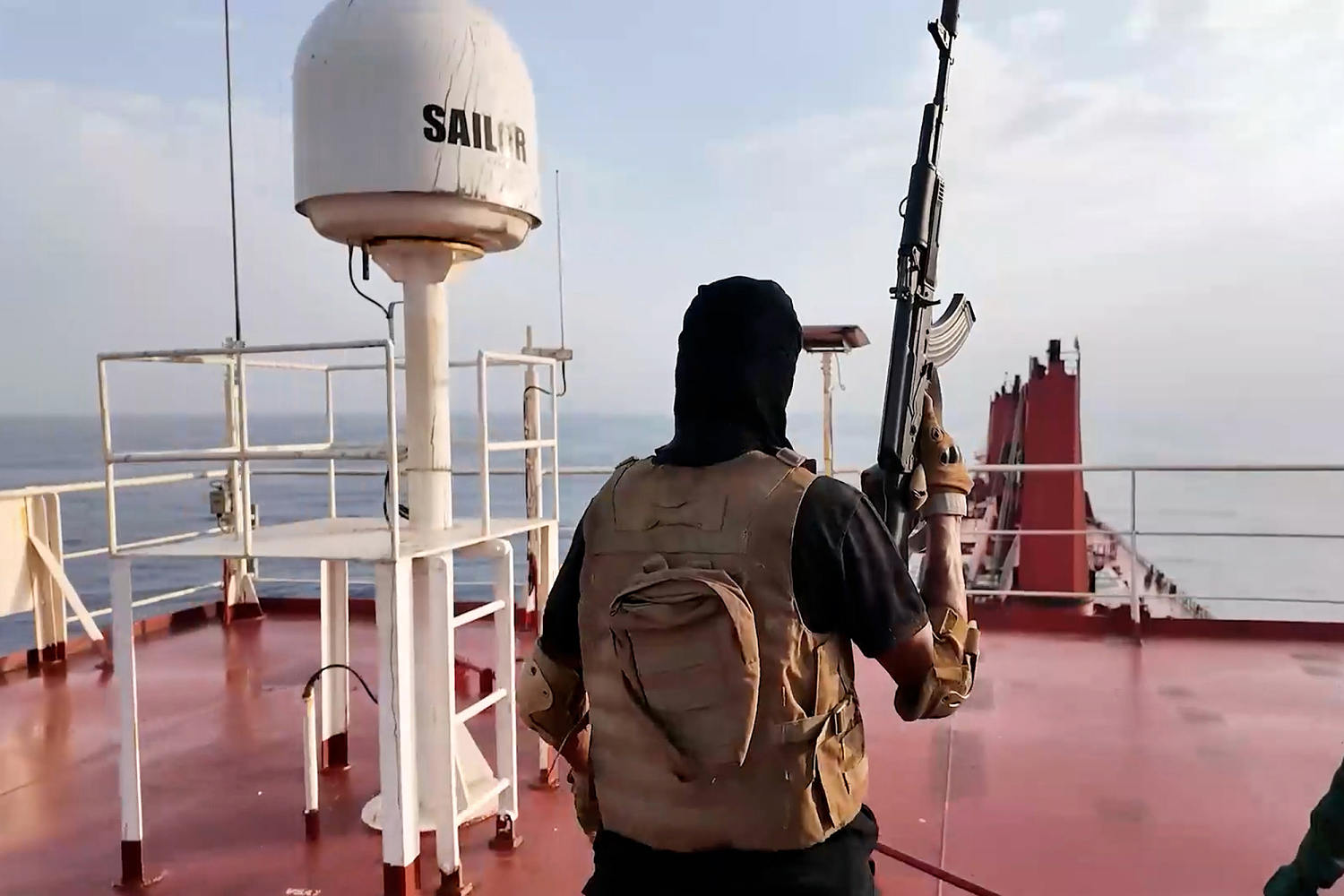
The global economy is currently relearning a lesson it had spent thirty years trying to forget. Geography matters. For decades, the Bab al-Mandab Strait—the "Gate of Tears"—was a mere line on a map that logistics software treated as a constant. Now, that narrow passage between Yemen and the Horn of Africa has become a graveyard for the "just-in-time" supply chain model. When container ships avoid this route to bypass missile fire, they aren't just taking a detour. They are fundamentally altering the cost of everything from European car parts to Asian grain. This isn't a temporary glitch in the system. It is a structural shift in how the world moves goods, proving that the era of cheap, predictable ocean freight is over.
The Red Sea handles roughly 12% of global trade and nearly one-third of all container traffic. When this artery is constricted, the blood pressure of the entire global market rises. Ships are forced to round the Cape of Good Hope, adding approximately 3,500 nautical miles and ten to fourteen days to a standard journey between Asia and Northern Europe. That delay is expensive. It consumes more fuel, ties up vessel capacity, and triggers a cascade of port congestion that ripples across the planet. Also making news lately: The Cuban Oil Gambit Why Trump’s Private Sector Green Light is a Death Sentence for Havana’s Old Guard.
The Mathematical Collapse of the Suez Shortcut
The crisis is rooted in a simple, cold calculation of risk versus reward. For a standard ultra-large container vessel, the decision to avoid the Suez Canal isn't just about safety; it is about the soaring cost of insurance and the physical limitations of the global fleet. War risk insurance premiums for Red Sea transits have spiked from near-zero to upwards of 1% of the hull value. On a ship worth $200 million, that is $2 million per transit just for the "privilege" of entering a danger zone.
When carriers choose the longer route around Africa, they effectively remove supply from the market. If a round trip takes two weeks longer, you need more ships to maintain the same weekly schedule. This creates an artificial shortage of containers. Freight rates don't just climb; they explode. We saw spot rates from Shanghai to Genoa triple in a matter of months. This isn't price gouging in the traditional sense. It is the market reacting to a sudden, violent reduction in efficiency. More details on this are detailed by The Wall Street Journal.
The Carbon Penalty Nobody Discusses
There is a hidden cost to this detour that goes beyond the balance sheet. Modern shipping was under intense pressure to decarbonize. The industry had been slowly implementing "slow steaming" to reduce emissions. The Red Sea crisis has shattered those goals. To make up for the lost time on the Cape route, vessels are burning fuel at significantly higher rates to maintain speeds.
A ship traveling at 20 knots burns substantially more fuel than one at 14 knots. The physics are unforgiving. By forcing the global fleet to take the long way around and go faster to stay on schedule, the crisis has effectively erased years of marginal gains in maritime fuel efficiency. Carbon taxes in regions like the European Union mean these increased emissions will eventually be paid for by the end consumer.
The Fragility of the Land Bridge Illusion
In the wake of the maritime shutdown, much has been made of rail and road alternatives. The idea of a "Middle Corridor" through Central Asia or a "Land Bridge" across Saudi Arabia sounds enticing in a boardroom. The reality on the ground is different. Rail can move thousands of tons, but a single Triple-E class container ship carries over 20,000 TEU (twenty-foot equivalent units). You would need dozens of trains to replace the capacity of one ship.
Furthermore, the infrastructure for these land routes is nowhere near ready for prime time. Border crossings, different rail gauges, and geopolitical instabilities in transit countries create a different set of headaches. While rail is faster than the Cape route, it is significantly more expensive and lacks the scale to save the global economy from a maritime blockade.
The Component Crisis in Manufacturing
The pain is most acute in high-value manufacturing. Take the automotive industry. Modern cars are built using parts sourced from dozens of countries, arriving at the assembly line just hours before they are needed. When the Red Sea closed to many major carriers, factories in Germany and Belgium were forced to pause production.
They ran out of components. This "stockout" risk is forcing a massive rethink of inventory management. Companies are moving from "just-in-time" to "just-in-case," which means holding more inventory. Holding inventory requires warehouse space and ties up capital. It is an insurance policy against geography, and like all insurance, it has a premium that gets baked into the sticker price of the product.
Why the Naval Presence Cannot Fix the Problem
There is a common misconception that a sufficiently large naval task force can "solve" the Red Sea problem. This ignores the asymmetric nature of modern coastal warfare. It costs a navy millions of dollars to fire an interceptor missile to take out a drone that costs twenty thousand dollars. This is an economic war of attrition that the defenders are currently losing.
Even if the hit rate for interceptions is high, the risk of a single "leaker"—a missile or drone that gets through—is enough to keep commercial insurers from lowering their rates. Commercial shipping is risk-averse by design. A captain will not gamble a billion dollars worth of cargo and the lives of twenty sailors on the hope that a naval destroyer is in the right place at the right time. The sea is too big, and the "sensor-to-shooter" timeline is too short.
The Shift Toward Regionalization
We are witnessing the end of the hyper-globalized era where it didn't matter where something was made. The Red Sea crisis is the loudest signal yet that proximity is the new gold standard. "Near-shoring" and "friend-shoring" are no longer just buzzwords; they are survival strategies.
Companies are looking at Mexico to serve the U.S. market and Eastern Europe or North Africa to serve the EU. If you don't have to cross a maritime choke point to get your goods to market, you have a massive competitive advantage. This shift will lead to a more fragmented global economy, where trade blocs become more insular and self-reliant. It may increase stability, but it will undoubtedly increase costs. The days of getting a cheap plastic product shipped across the world for pennies are gone.
The Data Gap in Maritime Intelligence
One of the most startling revelations of this crisis is how little the average business knows about its own supply chain. Most companies know who their direct suppliers are, but they have no idea which ships their sub-components are on. When the Bab al-Mandab became a no-go zone, thousands of firms were blindsided because they didn't realize their "local" European supplier was waiting on raw materials stuck on a vessel idling off the coast of Djibouti.
The demand for real-time maritime tracking and predictive analytics has skyrocketed. We are seeing a surge in investment in AI-driven logistics platforms that attempt to model these disruptions. However, data cannot create more ocean or faster ships. It can only tell you sooner that you are going to be late.
The Permanent Premium
Even if a ceasefire were signed tomorrow and the missiles stopped flying, the Red Sea "premium" would not vanish overnight. It takes months to reposition empty containers that are currently scattered in the wrong ports. It takes weeks for insurance markets to recalibrate. More importantly, the psychological barrier has been broken. The Red Sea is now officially a "volatile" zone in the eyes of every risk officer in the world.
The security architecture that allowed for decades of safe passage has been exposed as fragile. This realization will stay priced into shipping contracts for years to come. We are moving into a period where the "geopolitical risk" line item on a corporate P&L is no longer a rounding error. It is a defining feature of the balance sheet.
Investigate your tier-two and tier-three suppliers today to identify which components are currently transiting the Cape of Good Hope, because the delay you see in the news today is the factory shutdown you will face next month.