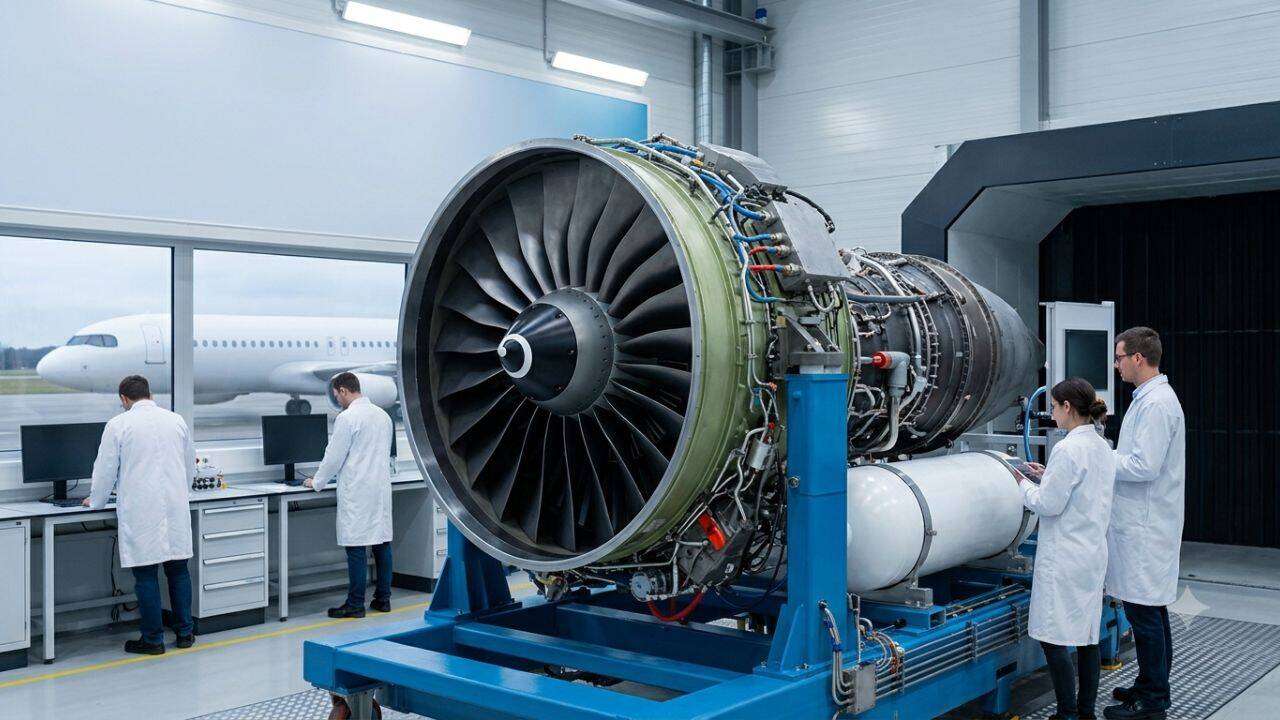
Airbus and MTU Aero Engines have officially launched a joint development program to build the world’s first hydrogen-powered aircraft engine, aiming to completely eliminate inflight carbon dioxide emissions. The partnership relies on a modified gas turbine paired with a liquid hydrogen fuel system. However, the aviation industry faces an brutal reality. Replacing kerosene with hydrogen requires entirely new aircraft architectures, an unprecedented overhaul of airport fueling infrastructure, and solving massive thermodynamic hurdles that the industry is currently underestimating.
This is not a simple engine swap. It is a fundamental rewrite of commercial aviation.
The Engineering Mirage of Clean Skies
Aviation accounts for roughly 2.5% of global carbon emissions. Decarbonizing the skies is non-negotiable if the industry wants to survive tightening regulatory chokeholds. The partnership between European aerospace giant Airbus and German engine manufacturer MTU aims to address this by burning liquid hydrogen directly in a modified gas turbine.
On paper, the chemistry is beautiful. Burning hydrogen produces water vapor and a small amount of nitrogen oxides. No carbon dioxide. None.
But chemistry in a laboratory is a far cry from a commercial flight at 35,000 feet. Hydrogen possesses nearly three times the energy density of jet fuel by weight, which sounds like an engineer's dream. The nightmare lies in its volume. Liquid hydrogen requires four times the storage space of conventional kerosene.
Fuel Volumetric Energy Density Comparison:
| Fuel Type       | Energy Density by Weight | Volume Required for Same Energy |
|-----------------|--------------------------|----------------------------------|
| Conventional Jet| 43 MJ/kg                 | 1x (Baseline)                    |
| Liquid Hydrogen | 120 MJ/kg                | 4x Space Needed                  |
This volume issue shatters the foundational design of modern airplanes. For decades, commercial airliners have stored fuel in the wings. This keeps the fuselage free for passengers and cargo while balancing the aircraft weight perfectly. You cannot fit liquid hydrogen into a wet wing. The cryogenic tanks are simply too bulky.
To use hydrogen, aerospace engineers must stretch the fuselage, placing massive, heavily insulated cylindrical tanks inside the main body of the aircraft. This shrinks passenger capacity, increases aerodynamic drag, and completely alters the center of gravity as fuel burns off during flight.
The Cryogenic Cry for New Infrastructure
The engine itself is only half the battle. MTU is focusing on the power plant mechanics, adapting the combustor and turbine blades to handle the unique properties of a hydrogen flame, which burns hotter and faster than jet fuel. Yet, the real bottleneck lies on the tarmac.
Liquid hydrogen must be stored at a chilling -253 degrees Celsius. Maintaining this temperature requires cryogenic storage facilities, vacuum-insulated piping, and specialized fueling vehicles at every commercial airport worldwide.
Consider the logistical chaos of a standard airport turnaround. Today, a ground crew plugs a hose into a wing panel, pumps thousands of gallons of kerosene, and the plane departs in forty-five minutes. With liquid hydrogen, a single microscopic leak in a refueling line can freeze air solid, causing blockages, or worse, creating a highly explosive fuel-air mixture.
The capital expenditure required to convert just the top one hundred global airports into hydrogen hubs runs into the hundreds of billions of dollars. Airlines already operate on razor-thin margins. They cannot absorb these infrastructure costs alone, and cash-strapped municipal airports are in no position to fund the transition.
The Green Hydrogen Illusion
Even if Airbus and MTU perfect the engine, and even if airports build the cryogenic networks, the environmental benefits remain a mirage without a massive shift in global energy production.
Over 95% of the hydrogen produced today is "grey hydrogen." It is derived from natural gas through steam methane reforming, a process that releases massive amounts of carbon dioxide. Flying a hydrogen plane using grey hydrogen actually increases the total carbon footprint compared to standard jet fuel.
The aviation industry requires "green hydrogen," which is produced via electrolysis powered entirely by renewable energy.
The scale of renewable energy needed to support hydrogen aviation is staggering. To supply enough green hydrogen for just the European short-haul flight market would require a massive expansion of regional wind and solar grids. Aviation will be competing for that same clean electricity with the maritime shipping industry, heavy manufacturing, and national power grids trying to decarbonize homes and cars.
The Overlooked Threat of High Altitude Water
Environmental advocates often look at hydrogen as a silver bullet because it eliminates carbon dioxide. This view ignores high-altitude atmospheric science.
When a hydrogen engine burns its fuel, it emits roughly 2.6 times more water vapor than a kerosene engine. At cruise altitudes, this water vapor immediately freezes, forming contrails.
Atmospheric scientists have repeatedly warned that contrails trap thermal radiation escaping the Earth, contributing significantly to global warming. In some atmospheric conditions, the warming effect of contrails is actually worse than the warming caused by the carbon dioxide emissions of the engine.
Airbus and MTU will have to develop precise flight path management systems to avoid atmospheric zones prone to contrail formation. This means planes will have to fly lower or divert around specific weather patterns, burning more fuel and driving up operational costs.
The Financial Gamble of the Century
Airbus has committed to bringing a zero-emission commercial aircraft to market by 2035 under its ZEROe initiative. The partnership with MTU on the engine architecture is the first real mechanical milestone toward that goal.
But the economic risks are unprecedented. If Airbus builds a hydrogen airliner and governments fail to mandate green hydrogen production, the aircraft will be an expensive, un-flyable white elephant. Conversely, if Boeing or Chinese competitors focus their billions on drop-in Sustainable Aviation Fuels that work in existing aircraft and airport tanks, Airbus could find itself holding a technologically brilliant product that the market cannot afford to support.
The joint venture between Airbus and MTU is a bold, necessary experiment in engineering boundaries. It proves that the technical know-how to burn hydrogen in a jet engine exists. But do not mistake an engine test cell success for a revolution in commercial flight. The path to clean aviation is blocked not by the limits of propulsion engineering, but by the stubborn realities of physics, infrastructure finance, and global energy production.