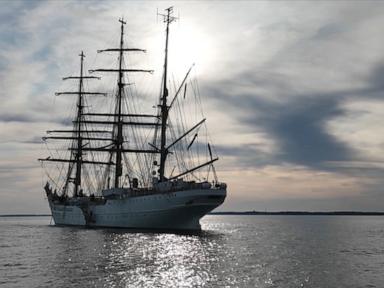
The Sail4th 250 Parade of Sail entering New York Harbor for America’s semiquincentennial represents the largest peacetime maritime gathering in American history, expected to draw eight million spectators and generate an estimated $2.85 billion in economic activity. On July 4, 2026, a fleet of 48 majestic Class A tall ships from 20 foreign nations will glide under the Verrazzano-Narrows Bridge, past the Statue of Liberty, and up the Hudson River alongside 42 allied naval warships. While promotional broadcasts present this as a seamless display of international goodwill, the true story of this historic operation reveals an unprecedented logistical battle, hidden geopolitical maneuvering, and a strained municipal infrastructure trying to absorb millions of visitors while simultaneously hosting the FIFA World Cup.
Behind the majestic sight of white canvas and gray steel lies a multi-billion-dollar maritime jigsaw puzzle that has taken years to assemble.
The Logistical Nightmare Under the Surface
Spectators watching from Lower Manhattan or Brooklyn Bridge Park see a synchronized ballet of historic vessels. The reality is a high-stakes traffic management operation that forces the U.S. Coast Guard to shut down one of the busiest commercial shipping channels on earth.
For the event to function without catastrophe, all non-participating vessels must be locked into designated spectator anchorages by 6:00 a.m. on the morning of July 4th. They are legally barred from moving until federal authorities clear the waters late in the afternoon. Managing this floating perimeter requires hundreds of law enforcement assets from local, state, and federal agencies.
The congestion is not confined to the water.
New York City and northern New Jersey are currently facing an unprecedented convergence of mass public gatherings. The region is simultaneously hosting matches for the FIFA World Cup 2026, meaning international tourists have completely saturated the local hospitality supply. Hotel occupancy across the five boroughs has reached practical capacity, driving average daily room rates to historic highs. Security forces, already stretched thin by soccer matches at MetLife Stadium, are being deployed in 12-hour shifts to manage the six million people expected to pack the 15 miles of available waterfront.
Geopolitical Soft Power on the Hudson
Every ship participating in the International Naval Review serves as a floating embassy, making the lineup a direct reflection of current global alliances. When a nation sends its premier naval vessel or national sail-training ship to New York Harbor, it is an exercise in public diplomacy and strategic alignment.
The presence of heavy allied naval assets underscores a deeper objective.
Among the 42 allied warships anchored in the Hudson River are high-profile vessels like the Spanish strategic projection ship Juan Carlos and the Canadian frigate HMCS St. John's, alongside major U.S. Navy platforms like the USS Kearsarge and USS Iwo Jima. Hosting over 130 invited navies and coast guards under the umbrella of the International Naval Review is a deliberate projection of Western maritime cooperation. At a time of heightened global tensions and shifting oceanic trade security, this massive assembly of gray hulls is as much a deterrent as it is a birthday party.
For smaller nations, sending a Class A tall ship is a massive financial commitment.
Maintaining a historical vessel like Colombia’s ARC Gloria, Peru’s BAP Unión, or Ecuador's Guayas, and sailing them across oceans with hundreds of crew members costs millions of dollars. Governments justify these budgets because these ships offer unmatched soft-power access. For the week of July 3 to July 9, these decks will host exclusive bilateral meetings between corporate executives, diplomats, and military chiefs, far away from public scrutiny.
The Legacy of Operation Sail
The organizing body behind this year's event, Sail4th 250, is the direct non-profit successor to Operation Sail, Inc. That organization was originally championed by President John F. Kennedy in 1961 as a method to preserve maritime heritage and build international ties during the height of the Cold War. The initial 1964 gathering, timed with the New York World's Fair, set a precedent that was repeated during the 1976 Bicentennial, the 1986 Liberty Centennial, and the 2000 Millennium.
This year's event represents a significant escalation in scale compared to those past milestones.
The historical weight of the event is crystallized in the race for the Five Sisters Cup, scheduled for July 9th as the fleet departs New York for Boston. Four identical historic sister ships still in active service will compete: the USCG Barque Eagle representing the United States, Portugal’s Sagres, Romania’s Mircea, and Germany’s Gorch Fock. The Tiffany-designed trophy has been held by Germany since the 1976 Bicentennial, making this year’s race a highly competitive matter of national maritime pride among the participating crews.
The Financial Reality for the City
While the projected $2.85 billion total economic impact makes for an impressive headline, local business owners and city planners are grappling with the immediate friction of the celebration. The New York Economic Development Corporation notes that the net new economic impact specifically to New York City sits closer to $730 million. The remaining billions are absorbed by corporate sponsorships, international transport costs, and regional maritime supply chains that do not directly touch the local economy.
For small businesses along the immediate waterfront, the event brings mixed fortunes.
Strict security cordons block vehicle access to key piers in Manhattan, Brooklyn, and Staten Island, disrupting regular commercial operations. Public transit systems, particularly the MTA subways and the NY Waterway ferries, are operating under emergency capacity protocols to prevent dangerous overcrowding at key transit hubs like South Street Seaport and Fulton Street.
Municipal services are bearing the brunt of the immediate overhead costs.
Sanitation departments, emergency medical services, and local police departments are incurring massive overtime expenses that must be paid upfront out of municipal budgets, with the hope of eventual reimbursement through tax revenues generated by tourist spending. The logistical friction of managing millions of people along a narrow waterfront means that for the average resident, the week is defined by street closures, transit delays, and heavy security checkpoints.
The spectacle in the harbor is undeniable, a visual masterpiece that honors two and a half centuries of American history. But as the sails catch the wind and the Blue Angels streak across the sky above the Hudson River, the true achievement is the sheer endurance of the municipal, federal, and military infrastructure holding this massive operation together under the weight of the global spotlight.