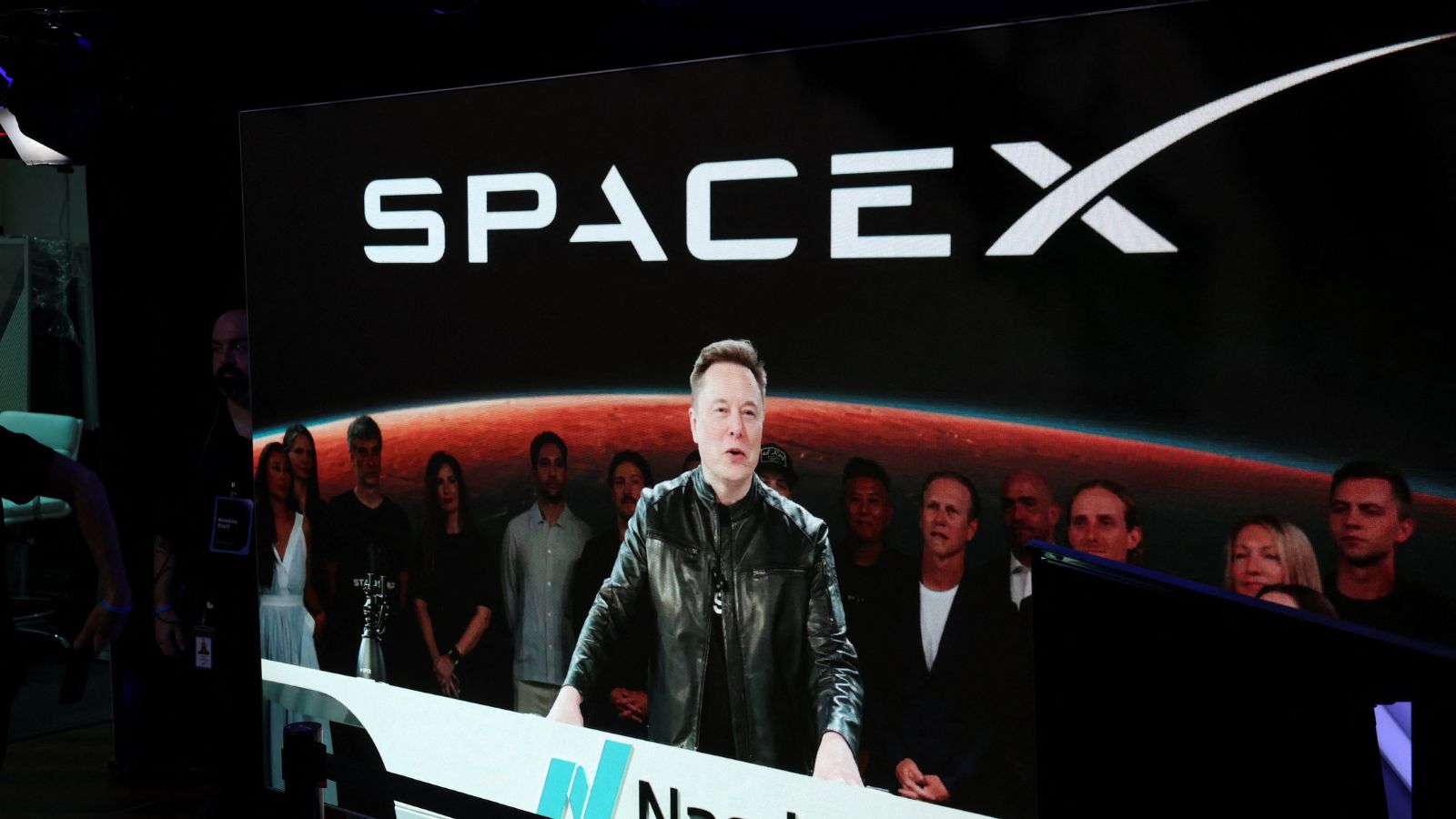
On July 15, 2026, the financial universe witnessed something once deemed impossible. Shares of SpaceX, trading under the ticker SPCX, tumbled past their initial public offering price of $135 to close at $133.34. In just over a month, a staggering trillion dollars in paper wealth evaporated from its post-listing peak. The crash has left retail buyers holding the bag, but the underlying reason for this descent is not a sudden failure of rocket engines or satellite deployments. Rather, it is a toxic mix of an illiquid public float, a highly controversial AI merger, and a fundamental misunderstanding of space economics by public markets.
For two decades, Elon Musk ran SpaceX as a private fiefdom, shielded from the short-term pressures of Wall Street. The June 2026 IPO was supposed to be his crowning achievement, raising $75 billion in the largest public offering in history. Instead, the market has quickly exposed the structural cracks in the aerospace giant's financial architecture.
The Illusion of a Two Trillion Dollar Valuation
To understand why the stock collapsed, one must first dismantle the mechanics of the listing itself. When SpaceX went public on June 12, 2026, the underwriters priced the IPO at $135 per share, valuing the company at roughly $1.75 trillion. Within days, retail euphoria pushed the price to an intraday high of $225.64, briefly lifting the market capitalization toward the $3 trillion mark.
The run-up was artificial. It was a classic squeeze.
Only a tiny fraction of SpaceX’s shares—less than 5%—were actually floated on the Nasdaq. For comparison, the historical average public float for a major IPO is closer to 30%. When a company of this scale has such a minuscule public float, standard supply and demand dynamics break down. A relatively small influx of buy orders from retail investors, who were allocated an unprecedented 30% of the IPO shares via platforms like Robinhood and Fidelity, easily overwhelmed the scarce supply. The stock rocketed on pure air.
But illiquidity cut both ways. When early momentum buyers began taking profits in late June, there were no deep institutional bids to absorb the selling pressure. A minor shift in sentiment triggered an immediate, cascading downdraft. Because there is so little float, the market-clearing price of SPCX has become wildly volatile, bearing little resemblance to the actual day-to-day operations of the rocket factory in Boca Chica.
The Trillion Dollar Albatross of xAI
The structural instability of the stock is only half the story. The fundamental driver of the current market skepticism is SpaceX's corporate structure, specifically its February 2026 merger with xAI.
Before the public filing, SpaceX was a highly capital-efficient machine. Starlink was generating predictable, high-margin cash flow. In 2025, Starlink accounted for 61% of SpaceX’s $18.7 billion in revenue, functioning as a global internet utility. The rocket launch business, dominated by the reusable Falcon 9, held a virtual monopoly on global commercial payloads.
The xAI merger changed everything.
Under pressure to find massive compute capital for his artificial intelligence venture, Musk engineered an all-stock merger that folded xAI into SpaceX, valuing the combined entity at $1.25 trillion before the IPO. This maneuver was pitched to investors as a masterstroke. The narrative claimed that Starlink’s global data stream would feed xAI’s models, while xAI’s intelligence would optimize autonomous operations for Mars-bound Starships.
The public market has looked at the numbers and rejected this thesis.
By absorbing xAI, SpaceX transitioned from a cash-generating aerospace and telecom business into a cash-guzzling AI infrastructure play. Training frontier AI models requires billions of dollars in silicon chips, specialized data centers, and massive electricity contracts. Unlike Starlink, which has physical satellites in orbit yielding immediate monthly subscription revenue, xAI is a speculative, long-term bet with massive, recurring capital expenditures.
Conservative institutional investors realized they were being asked to fund a hyper-expensive AI arms race using the balance sheet of a space exploration company. The high margin profile of Starlink’s consumer internet business is now being actively diluted by the astronomical operational losses of xAI.
The Looming Wall of Lockup Expirations
The descent below the $135 IPO price is causing panic because of what lies on the horizon.
For years, SpaceX employees and early venture capital backers were kept liquid through biannual insider tender offers managed by CFO Bret Johnsen. These private transactions saw the company's valuation climb from $350 billion in late 2024 to $800 billion by the end of 2025.
Those private valuations, however, did not have to survive the scrutiny of a public order book. They were negotiated, insular deals. Now that the stock is public, early venture capital funds and corporate insiders are locked into their positions.
The standard 180-day lock-up period will expire in December 2026.
With the stock now trading below the IPO price, early backers who watched their paper wealth explode during the private tender offer era are growing anxious. If the stock does not recover, the opening of the lock-up window could trigger an unprecedented wave of institutional selling. Venture funds that have held SpaceX shares for nearly a decade have a fiduciary duty to return capital to their limited partners. They will sell, regardless of whether they still believe in the multi-planetary mission.
The threat of this future supply overhang is actively depressing the stock today. Sophisticated market makers are refusing to establish large long positions, knowing that millions of insider shares will hit the market in less than five months.
The Reality Check on Starlink and Starship Economics
Underlying all these market dynamics is a cold, hard operational truth. The economics of space are brutal.
Starlink has been a phenomenal success, but it is reaching the limits of its addressable market in high-average-revenue-per-user (ARPU) nations. To continue growing at its historical pace, Starlink must expand into developing markets. In these regions, subscribers cannot afford the $120 monthly fee or the hardware costs of the receiver terminal. Consequently, the average revenue per user is declining.
Simultaneously, the development of Starship—the massive rocket central to SpaceX's deep-space plans—remains an incredibly expensive endeavor. NASA’s Artemis program relies on Starship to land astronauts on the Moon, but the technical milestones are lagging behind schedule. Each test launch, even when partially successful, consumes hundreds of millions of dollars in capital.
In the private markets, these expenses were easily brushed aside under the banner of revolutionary progress. In the public markets, every nickel is counted. Analysts are calculating the depreciation of the Starlink constellation, which requires constant replacement as older satellites deorbit after five years of service. This is not a software business with zero marginal cost; it is a heavy industrial enterprise with perpetual, multi-billion-dollar capital replacement cycles.
The market has finally realized that SpaceX is a brilliant engineering firm shackled to a speculative AI venture, operating with a capital structure that was designed to maximize hype rather than public liquidity. The dip below the IPO price is not a temporary hiccup. It is a structural re-rating. Wall Street is forcing Elon Musk to play by the same financial rules as everyone else, and the initial scorecard is written in red.