Donald Trump recently hijacked what was supposed to be a wholesome children's literacy initiative, turning Second Lady Usha Vance's new podcast into an unvarnished window into his own psyche. Reading a simple picture book titled Presidents Play!, Trump completely veered off script to deliver a rambling monologue covering everything from his anxieties about overtaking William Howard Taft's weight record to grading John F. Kennedy's physical appearance. It was a stark reminder of his singular obsession with self-image and personal narrative, subverting an innocent platform into a highly strategic piece of political theater.
The public often views these unscripted moments as mere eccentricities or gaffes. That interpretation misses the entire point of how modern political communication operates under his brand. What occurred in the Oval Office during that taping was a masterful masterclass in counter-programming, proving that no venue is too small, and no audience too young, to be exempted from the relentless engine of his personal brand management.
A Wholesome Initiative Transformed into Raw Political Theater
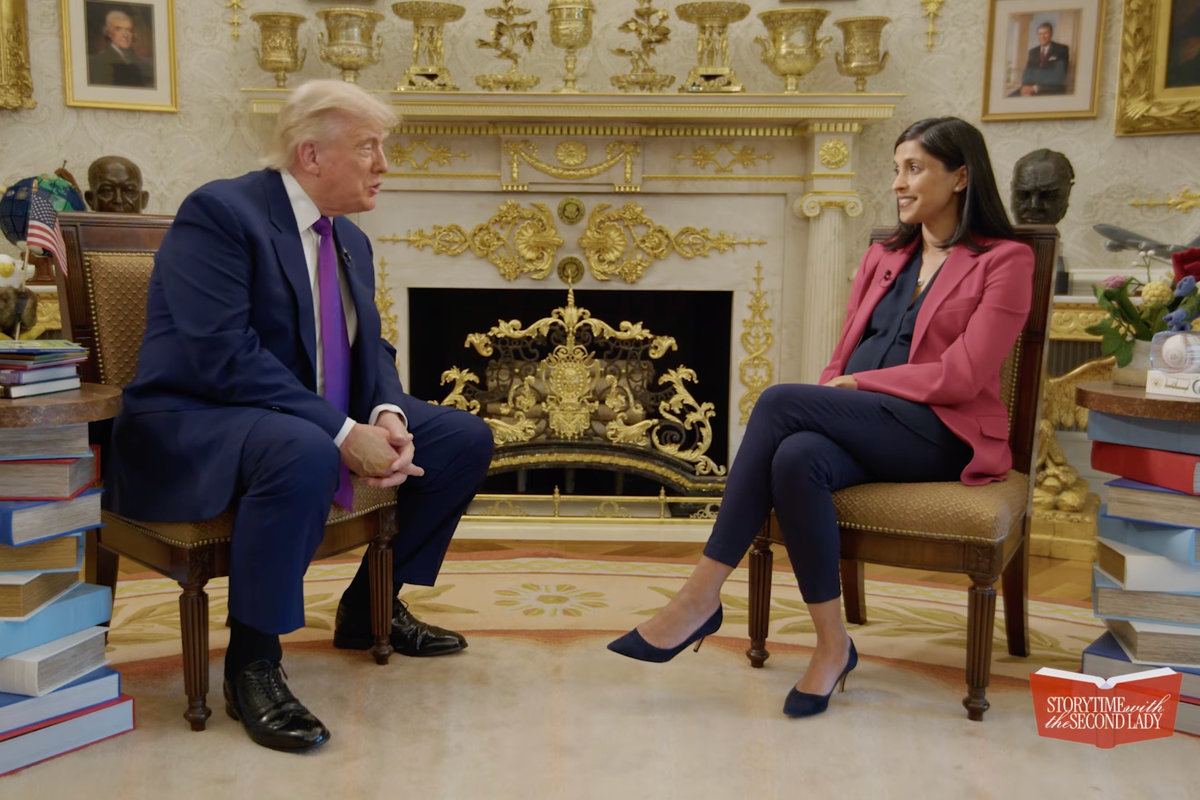
The setting was meticulously arranged for a children's show. Stacks of oversized books, a Lego globe, and a stuffed bald eagle decorated the Oval Office, providing a playful backdrop meant to highlight a benign message about literacy. Second Lady Usha Vance sat down to host an episode of Storytime with the Second Lady, an initiative designed to showcase historical anecdotes and foster a love for reading among American youth. Instead, she became the captive audience for a classic, unfiltered stream-of-consciousness performance that completely sidelined the text of the book.
When asked a direct, gentle question about whether he finds time to read for pleasure while managing the duties of the presidency, Trump did not offer the standard boilerplate response about inspiring biographies or historical texts. He admitted plainly that he mostly reads newspapers, adding with characteristic bluntness that he usually just reads stories about himself.
This level of total self-absorption would sink any traditional politician. For Trump, it acts as a badge of authenticity that his base rewards with fanatical devotion. By turning the focus instantly back to his own press coverage, he signaled to his audience that the entire apparatus of the mainstream media remains fixed on him, validating his central role in the national conversation. The children's book itself, meant to document the recreational habits of historical leaders, quickly became nothing more than a prop for his own running commentary.
The Subconscious Obsession with Legacy and Physical Appearance
As Trump turned the pages of the picture book, the text faded into the background, replaced by an evaluation of his predecessors based almost entirely on physical fitness, aesthetic appeal, and personal style. The commentary revealed a deep-seated preoccupation with how he measures up to the ghosts of the past, quite literally.
Upon seeing an illustration of William Howard Taft, the nation's heaviest chief executive, Trump paused to reflect on his own frame. He noted that Taft was a very large man and remarked that he had to be careful because he did not want to supersede Taft's historic record. He told the young audience that such a feat would be entirely possible if he allowed it to happen, before abruptly pivoting to instruct the children watching to keep themselves in good shape.
The moment was bizarre, yet entirely tracking with his long history of public obsession over weight, stamina, and physical dominance. By bringing his own weight into a discussion aimed at children, he laid bare the constant pressure he feels regarding his public image.
This anxiety over physical perception extended immediately to the aesthetic realm when the book reached John F. Kennedy. Rather than commenting on the New Frontier or the Cuban Missile Crisis, Trump focused entirely on Kennedy's famed charisma, branding JFK the second-most good-looking president in American history.
Characteristically, he left the top spot open, leaving no doubt in the minds of anyone listening as to who he believes holds the title of the most handsome man to ever occupy the office. The evaluation reduces complex historical legacies down to a simple beauty pageant, a format where he feels entirely comfortable operating as both the judge and the ultimate prize winner.
Weaponizing the Unfiltered Commentary Track
The critique did not stop at physical appearance. Trump used the opportunity to settle old political scores and pass definitive judgment on his modern rivals, demonstrating that the campaign trail never truly ends, even during a White House story hour.
- Barack Obama: When confronted with an illustration of Obama playing basketball, Trump openly doubted his predecessor's athletic prowess. He insisted he doubted Obama was a good basketball player, before taking a swipe at Obama's preferred pastime by noting that while his favorite sport might be golf, he would not be appearing in the Masters tournament anytime soon.
- Bill Clinton: An image of Clinton jogging on the track he installed around the White House lawn brought a different reaction. Trump flatly stated that he would never engage in such an activity, though he took care to mention that he liked Clinton a lot personally.
- Richard Nixon and Herbert Hoover: Nixon was dismissed with a casual remark that he simply got himself into trouble, while Hoover's economic failures were mocked through a joke about his invented sport, Hoover Ball, working out better for him than the nation's financial system.
These are not the polished, focus-grouped statements of a standard administration. They are raw, visceral assessments designed to diminish his predecessors while elevating his own choices. When looking at an illustration of John Quincy Adams swimming in the Tiber Creek that once flowed past the South Lawn, Trump bypassed the history entirely to brag about his own real estate ambitions, noting that he was currently building a beautiful ballroom right on top of that historic site. Every piece of history is immediately contextualized through what he is actively building, changing, or dominating in the present moment.
The Friction in the Modern White House Image Machine
This podcast appearance highlights a growing tension within the current executive branch. On one side stands Usha Vance, representing the traditional, polished approach to secondary White House messaging. Her initiative was structured, educational, and safe. On the other side is Trump, a political force who refuses to be managed by any script or pre-planned public relations framework.
The contrast between the host's structured questions and the guest's freewheeling digressions created a fascinating, uncomfortable friction. When she asked why children should celebrate the country on the Fourth of July, hoping for an inspiring civics lesson, Trump gave a dark, ambiguous warning. He declared that the country is currently standing on a ledge, warning that it could easily go one way or another before promising that he would steer it back toward greatness.
It was a stark, partisan message delivered directly to an audience of children, shattering the conventional boundaries of soft-power diplomatic messaging usually reserved for spouses and second families.
This is exactly why the conventional political analysis of his behavior fails so spectacularly. Critics look at this performance and see an undisciplined leader incapable of focusing on a children's book for twenty minutes. His supporters, however, see a authentic leader who refuses to speak down to children with hollow platitudes, offering instead the same raw, unvarnished thoughts he shares with stadiums full of voters. By refusing to play the traditional role of the standard storyteller, he turned a minor digital broadcast into a viral news event, ensuring that his personal anxieties, architectural projects, and historical rankings dominated the news cycle yet again.