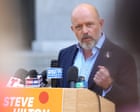
Don't trust early election night returns in California. If you went to sleep thinking the state's gubernatorial primary was settled, you haven't been paying attention to how West Coast politics actually works. Millions of ballots are still sitting in county election offices, waiting to be processed. This isn't a glitch. It's exactly how the system is designed, and it's why the race to succeed Gavin Newsom remains a total wildcard.
With roughly 60% of the votes counted, the top of the ticket is incredibly tight. Republican Steve Hilton, a former Fox News host and British political operative, holds a slim lead with 27.6% of the vote. Democrat Xavier Becerra, the former Health and Human Services Secretary, sits right behind him at 25.6%. Trailing in third is billionaire progressive Tom Steyer at 19.8%.
Because of California's unique jungle primary rules, only the top two finishers move on to November, regardless of their party. That means Steyer still has a mathematical path to push past Becerra, creating an all-Democrat general election. Or Hilton could hold his lead, setting up a brutal partisan showdown in the fall. The stakes couldn't be higher, and the waiting game is driving everyone crazy.
The Mirage of the Early Lead
Every election cycle, the same thing happens. Early numbers drop, Republicans celebrate, and then a slow, steady shift occurs over the next two weeks. It's called the "blue shift," and it's a direct result of California's voting laws.
The state mails a ballot to every single registered voter. You can drop it in a mailbox on election day, and as long as it's postmarked by June 2, election officials have to count it. Democrats overwhelmingly tend to vote late. They hold onto their ballots, debating between a crowded field of candidates, and drop them off at the last possible second. Republicans, by contrast, generally vote early or show up in person.
Look at the numbers right now. Hilton is up by about 100,000 votes over Becerra. In a state with 23 million registered voters, that's nothing. County registrars have up to 30 days to finalize the count. As mail-in ballots from heavily Democratic hubs like Los Angeles County and the San Francisco Bay Area get scanned, expect the margins to shift. It's why major networks refuse to call the second spot. It's just too early.
Three Bitter Paths for Sacramento
The three candidates remaining have completely different ideas about how to fix a state facing massive economic anxiety. The campaign hasn't been about abstract culture wars. It's about the brutal reality of living here.
- Steve Hilton (GOP): Backed by Donald Trump, Hilton built his platform on outright economic relief. He wants to make the first $100,000 of personal income completely tax-free for Californians. He's also pushing to freeze tuition at public universities and aggressively boost in-state oil production to lower gas prices. It's an aggressive populism that resonated deeply with working-class voters tired of stretching every dollar.
- Xavier Becerra (Dem): The establishment favorite. Becerra is leaning hard into his resume as former state attorney general and federal cabinet secretary. He represents continuity and institutional competence. He filed over 120 lawsuits against the first Trump administration, a fact he reminds liberal voters of constantly. If he wins, he'll be California's first Latino governor in modern history.
- Tom Steyer (Dem): The billionaire progressive activist who isn't pulling punches. Steyer is running an anti-corporate campaign, blaming major utilities and fossil fuel companies for the state's sky-high cost of living. He wants to eliminate private health insurance for a state-run system and break up companies like Pacific Gas & Electric.
The fact that three candidates with such wildly divergent platforms are locked in a dead heat shows how fractured the California electorate feels right now.
What the Pundits Missed About Affordability
National media loves to paint California as a progressive paradise or a dystopian wasteland. The truth is much more boring and much more painful. It's simply too expensive to live here.
The through line of this entire election cycle is affordability. By the end of May, California drivers were staring at $6.08 per gallon at the pump. That's $1.65 higher than the national average. According to the nonpartisan Legislative Analyst's Office, the typical home price has hit a staggering $775,000. That's more than double the national average. Combine that with the second-highest electricity rates in the country, and you get a population that is deeply stressed.
That economic pain explains why Steve Hilton is performing so well in a state where Democrats outnumber Republicans two to one. Voters are willing to look past party lines when they can't pay their electric bills. Moderate and conservative voters consolidated behind Hilton, while the progressive vote split between Becerra, Steyer, and several lower-tier candidates like Katie Porter and Matt Mahan, both of whom already conceded.
What to Do While the Ballots Realize
We won't have a final, certified answer on who makes the November ballot for days, possibly weeks. If you're tracking the race, stop refreshing the state's main portal every ten minutes. It won't help. Instead, keep these practical steps in mind to understand what's actually happening.
Track individual county updates rather than the state total. Watch Los Angeles County and Santa Clara County specifically. Those are the voter goldmines for Democrats. If Becerra and Steyer start pulling massive margins in the late-arriving mail blocks there, Hilton's lead will shrink fast.
Understand that the "top-two" system means the primary isn't the real battle; it's just the elimination round. If Steyer somehow edges out Becerra for the second spot, November becomes a civil war within the Democratic party. If Hilton holds, it becomes a traditional left-versus-right referendum on the state's direction. Keep your eyes on the outstanding ballot estimates published by local registrars every afternoon. That's where the real story hides.