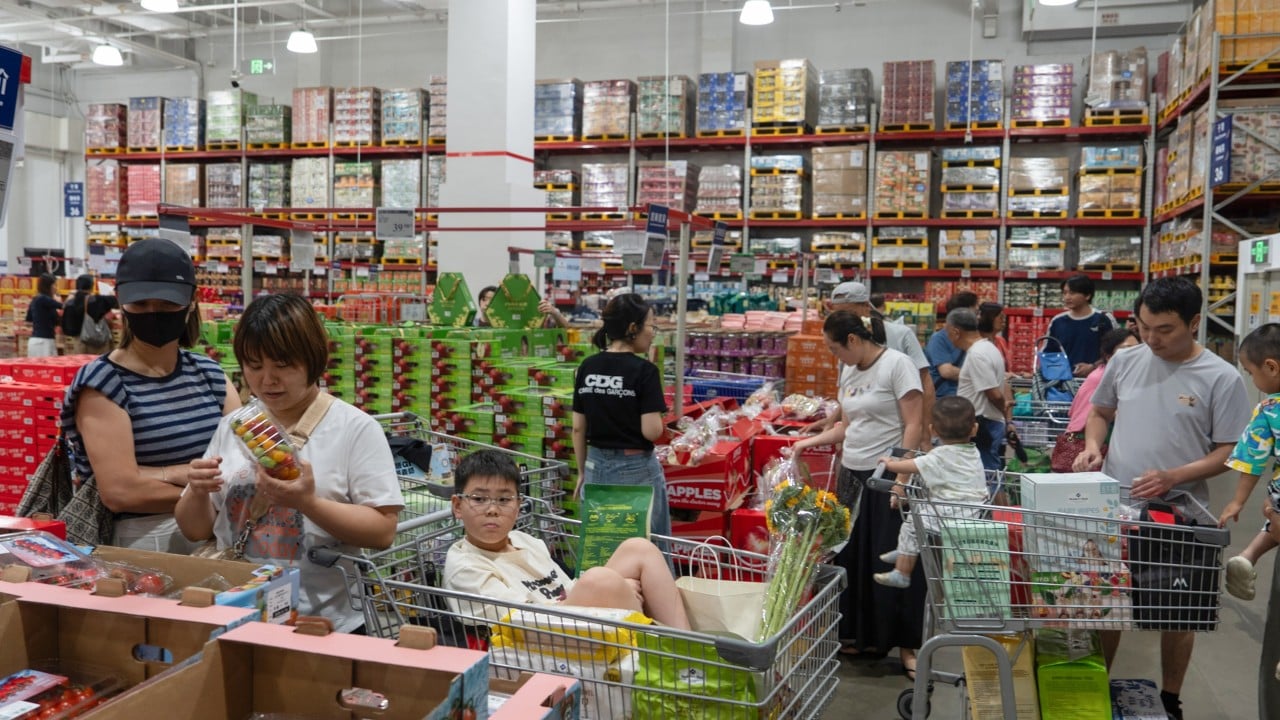
The floor tiles in Shenzhen are too clean. They reflect the harsh, white glare of overhead LEDs with a blinding precision, casting faint, ghostly outlines of frantic shoppers hurrying past towering stacks of imported wine and glistening Australian beef.
Mei stands in the middle of this aluminum-and-concrete cavern, clutching a laminated membership card. She is thirty-four, an architect who spends her weeks untangling CAD drawings and her weekends trying to figure out what to feed her family of four without poisoning them with the anxieties of modern urban life. In her cart sits a 2.5-kilogram tub of Greek yogurt, a flat of organic strawberries flown in from Yunnan, and a massive wheel of Danish cheddar. Total cost: nearly a month's worth of groceries for her parents' generation. If you enjoyed this post, you might want to read: this related article.
She does not flinch at the register. Neither do the two thousand other people lined up behind her, their oversized flatbed carts brimming with bulk-packed goods that have no business existing in the compact kitchens of inner-city high-rises.
Something seismic has shifted beneath the pavement of contemporary retail. For another look on this development, refer to the recent coverage from Forbes.
We were told the era of the big-box warehouse was over. We were promised a future of hyper-personalized, ultra-local micro-deliveries, where an algorithmic drone would drop a single organic lemon onto your balcony within nine minutes. We were told that physical square footage was a dying dinosaur, crushed under the frictionless weight of e-commerce apps blinking softly in the dark of our pockets.
Yet here stands Sam’s Club, the quiet, bulk-selling titan wearing the crimson badge of Walmart, defying the obituary writers with an arrogance so subtle it hurts.
More than 10.7 million paying members. Think about that number. That is not a passive audience clicking a link out of boredom. That is 10.7 million households handing over cold, hard cash—annual fees—just for the privilege of walking through these sliding glass doors on a Tuesday morning.
How did this happen?
To understand the roar of the warehouse floor, you have to remember the quiet panic of the Chinese consumer over the last decade. Food safety scandals did not just leave headlines; they left scars. When you have spent your childhood watching parents test milk powder with a teaspoon and a prayer, trust becomes the rarest currency on earth. The neighborhood wet market, with its chaotic charm and slippery floors, suddenly felt like a gamble.
Enter the fortress of Sam.
When the first warehouse opened decades ago, Western analysts laughed. They predicted a comical mismatch. Who in their right mind, living in a cramped apartment with a tiny refrigerator, would buy toilet paper in packs of forty-eight? How could a family of three store a whole side of salmon?
The analysts forgot one fundamental truth about human desire. We do not just buy products. We buy a proxy for control.
By demanding an annual fee, the warehouse did something brilliant. It walled off the chaos. It said: Inside these walls, the air is filtered, the cold chain is unbroken, and the imported goods are what they claim to be.
Mei walks down aisle four, her fingers trailing over boxes of Member’s Mark dishwasher tablets. She isn't just buying soap. She is buying insurance against uncertainty.
The expansion is not a logistical accident. It is a calculated march. Look at the maps of second and third-tier cities across the mainland. While legacy hypermarkets bleed out—their cavernous, fluorescent-lit halls turning into echoing tombs of discounted apparel and dusty canned goods—the membership warehouses are multiplying. They are carving out massive footprints near emerging subway lines, drawing families who drive thirty, forty, fifty minutes just to spend their Saturday morning navigating wide aisles.
They are selling space. In a city where square footage is astronomically expensive, walking through a warehouse with five-meter-high ceilings is an act of psychological decompression. You can breathe here. The aisles are wide enough to turn a cart without grazing a stranger's elbow.
Critics call it consumerism on steroids. They point to the mountains of cardboard and plastic wrap, the suburbanization of Asian urban habits, the quiet erosion of traditional street life where a vegetable vendor knew your mother's name.
They are not wrong. The cost is real. Every time a massive warehouse opens its shutters, a dozen small neighborhood shops quietly turn off their neon signs for good. The community is traded for convenience; the personal touch is swapped for a barcode scanned at lightning speed by a teenager who has not looked up in three hours.
And yet, the members keep coming. They renew at rates that make Silicon Valley subscription businesses weep.
Consider what happens next in this high-stakes chess match. Competitors are scrambling to copy the playbook. Local e-commerce giants are rushing to launch their own paid warehouse models, scrambling to secure supply chains from the fertile valleys of Sichuan to the dairy farms of Hokkaido. They realize too late that you cannot simply code a warehouse experience into an app. You have to build the physical gravity. You have to make people feel safe in the physical world.
Sam’s Club accelerated this expansion not by shouting louder, but by doubling down on the fortress mentality. They curate ruthlessly. While a traditional supermarket tries to offer forty types of soy sauce, the warehouse offers one or two—the absolute best, negotiated down to a price that defies local logic, packaged in a size that requires a dedicated pantry shelf.
Choice is exhausting. Elimination is a luxury.
Back at the register, Mei taps her phone. The green checkmark flashes. The total is staggering, but her expression is serene. She loads the massive cardboard boxes into the trunk of her electric crossover, wedging the bulk-sized tissue paper next to a box of imported avocados.
As she pulls out into the torrential river of evening traffic, the city blurs into a neon streak of red tail-lights and towering construction cranes. In a world spinning too fast to catch, she has secured her corner of the future, packed neatly in cardboard, paid for in advance, and guarded by a plastic card in her wallet.