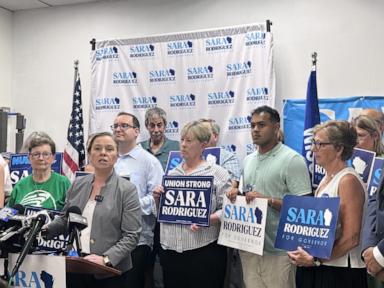
In high-stakes political campaigns, cash on hand is the ultimate metric of strategic viability. Yet, as the sudden operational halt of Sara Rodriguez’s Wisconsin gubernatorial campaign demonstrates, reported cash is often a trailing, fragile abstraction rather than a liquid reality. When a campaign discovers that its actual reserves are hundreds of thousands of dollars lower than reported—precisely at the moment television networks refuse to air unpaid advertising slots—it reveals a structural failure in internal financial controls.
This breakdown is not merely an administrative error; it is a catastrophic failure of the campaign's operational feedback loop. In corporate finance, a reconciliation failure of this magnitude would trigger immediate forensic audits and potential regulatory penalties. In a political campaign, where cash must be deployed with extreme temporal precision ahead of a fixed primary date, the consequences are immediately fatal to media distribution, voter outreach, and overall viability.
Understanding how a major statewide campaign operates under a complete capital deficit requires breaking down the core mechanisms of campaign accounting, the operational dependency on immediate liquidity, and the structural checkpoints that failed to signal the crisis before it breached the public sphere.
The Mechanics of the Capital Deficit
A political campaign operates essentially as a temporary, high-velocity start-up. It must scale fundraising and expenditures rapidly over a compressed timeframe, culminating in a single day of reckoning. Because the organization has no long-term horizon, financial control systems are frequently sacrificed in favor of rapid execution.
The structural variance between reported assets and actual liquidity in the Rodriguez campaign can be modeled mathematically. The reported cash balance of a political entity should theoretically adhere to the basic accounting identity:
$$C_{\text{actual}} = \sum R_{\text{actual}} - \sum E_{\text{actual}}$$
Where:
- $C_{\text{actual}}$ represents actual liquid cash available.
- $R_{\text{actual}}$ represents actual settled receipts.
- $E_{\text{actual}}$ represents actual settled expenditures.
In the case of this systemic failure, two simultaneous accounting errors corrupted the formula: the double-counting of contributions ($\Delta R$) and the undercounting of accrued expenditures ($\Delta E$). This created an inflated reported cash balance ($C_{\text{reported}}$):
$$C_{\text{reported}} = (R_{\text{actual}} + \Delta R) - (E_{\text{actual}} - \Delta E)$$
The delta between illusion and reality ($C_{\text{reported}} - C_{\text{actual}} = \Delta R + \Delta E$) represents the structural deficit. When this delta spans hundreds of thousands of dollars, the campaign's purchasing power collapses.
Double-Counting Inflows
The double-counting of donations typically occurs at the intersection of payment gateway APIs and compliance software. Most modern campaigns rely on digital fundraising platforms to process thousands of micro-donations. If automated integration scripts fail to reconcile transaction IDs, a single contribution can be logged twice: once when the transaction is authorized, and again when the settlement is batch-processed into the campaign's bank ledger.
Without daily, line-by-line bank reconciliation, a campaign manager looking at a software dashboard will see an artificially inflated cash position. This error is compounded when compliance staff file reports to regulatory bodies—such as the Wisconsin Ethics Commission—without cross-referencing bank statements against the internal donor database.
Undercounting Outflows
The second failure point is the systemic underreporting of outstanding liabilities. Unlike traditional businesses that utilize accrual accounting, political campaigns often default to cash-basis tracking for internal decision-making, even if they report on an accrual basis.
When media buying agencies place television, radio, or digital ad buys, they issue invoices that require rapid settlement. If a campaign books these expenses only when the cash actually leaves the bank account, rather than when the contractual obligation is signed, it creates a massive blind spot. The campaign commits to spending money it believes it has, unaware that the liabilities have already outpaced its actual liquid reserves.
The Media Squeeze: Why Political Advertising Is Untrustworthy of Debt
In the commercial sector, a business experiencing a temporary liquidity crunch can often negotiate net-30 or net-60 payment terms with vendors to maintain operations. Political campaigns do not have this luxury, particularly when dealing with broadcast media networks.
Under Federal Communications Commission (FCC) guidelines and standard industry practices, broadcast television stations require campaigns to pay for advertising slots in advance. The logic is simple: once an election passes, a losing campaign has zero incentive—and usually zero capability—to pay outstanding debts. Therefore, media agencies operate on a strict "no pay, no play" model.
The sudden disappearance of the Rodriguez campaign's scheduled advertisements was the ultimate lagging indicator of its financial insolvency. The sequence of events follows a precise causal chain:
- Media Booking: The campaign’s media buyer places an order for prime-time ad slots based on the inflated cash projection ($C_{\text{reported}}$).
- Invoicing and Demand for Payment: The broadcast networks issue invoices demanding immediate wire transfers to secure the airtime.
- Liquidity Verification Failure: The campaign attempts to execute the wire transfers, only to find that the actual bank balance ($C_{\text{actual}}$) cannot support the volume of transactions.
- Immediate Ad Cancellation: Because the funds fail to clear before the strict broadcasting deadline, the networks immediately pull the ad spots, leaving the campaign silent in critical media markets.
This silent blackout is a highly visible signal of distress to opponents, donors, and the media. It exposes the campaign's operational weakness and immediately halts momentum.
The Cost of Compliance and the Regulatory Hazard
A campaign that discovers major discrepancies in its financial reporting faces severe legal and reputational exposure. In Wisconsin, gubernatorial campaigns are subject to strict reporting requirements managed by the Wisconsin Ethics Commission.
Filing inaccurate campaign finance reports is not just an embarrassing administrative error; it carries statutory penalties. The moment a campaign realizes its public filings do not match its bank ledgers, it must initiate a voluntary disclosure and amendment process.
[Campaign Discovers Accounting Error]
         │
         ▼
[Internal Financial Audit Initiated]
         │
         ▼
[Wisconsin Ethics Commission Contacted]
         │
         ▼
[Amendments Filed to Correct Ledger]
         │
         ▼
[Potential Audit or Statutory Fines]
This correction process requires significant staff hours and diversion of resources. Instead of focusing on voter contact and fundraising, the campaign’s remaining senior leadership must spend days reconstructing past ledgers, identifying where double-counting occurred, and tracking down unpaid invoices.
Furthermore, this operational distraction occurs during a highly competitive primary. In a crowded field, voters and donors look for signals of organizational competence. A campaign that cannot manage its own balance sheet struggles to convince the electorate that it can manage a state budget.
Structural Safeguards to Prevent Capital Collapse
To avoid this type of systemic failure, modern political organizations must implement rigorous corporate-governance frameworks. Relying entirely on a campaign manager to oversee both strategy and complex compliance accounting is a structural vulnerability.
1. Dual-Control Treasury Systems
No single individual should have unchecked authority over both the entry of financial data and the authorization of cash outflows. A dual-control system requires that:
- The compliance director reconciles all donor database entries against actual bank deposits daily.
- The treasurer or a designated chief financial officer (CFO)—independent of the campaign manager—authorizes all bank wires and expenditures above a minor threshold.
2. Daily Bank-to-Book Reconciliation
Relying on weekly or monthly reports is insufficient in a high-velocity campaign. Every transaction must be reconciled daily. Any variance between the payment processor reports (e.g., ActBlue) and the actual settled funds in the bank ledger must be flagged and resolved within 24 hours.
3. Transition to Accrual-Based Internal Dashboards
Campaign leadership must make strategic decisions based on a true picture of liabilities. An internal dashboard must track:
- Committed Cash: Funds already allocated to upcoming media buys, staff payroll, and vendor contracts.
- Uncommitted Liquid Cash: The actual, real-time capital available for new strategic initiatives.
Without these safeguards, campaigns will continue to fall victim to the cash illusion, projecting strength to the public while quietly sliding toward operational insolvency. The path forward for any campaign facing this crisis is a complete reconstruction of its financial infrastructure, starting with an independent, external forensic audit of every transaction from day one.