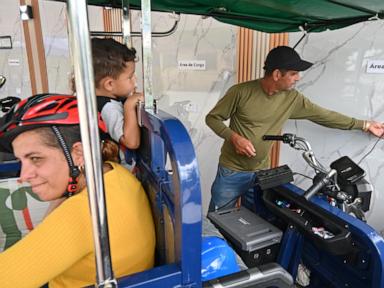
In the heart of Santa Clara, a small cluster of photovoltaic panels hums under a relentless Caribbean sun. For the locals gathering around with tangled charging cables and drained smartphones, this isn't a hobbyist’s experiment in green living. It is a lifeline. Cuba’s national power grid is currently a ghost of its former self, plagued by aging Soviet-era infrastructure, fuel shortages, and a chronic lack of investment. While the government struggles to keep the lights on in Havana, the provinces are often left in total darkness for eighteen hours a day.
These solar-powered charging stations represent a shift in how Cubans view energy. It is no longer a centralized service provided by the state, but a localized resource harvested by necessity. The arrival of functional solar kits in central Cuba has turned public squares into digital oases where the economy of the street—remittances, black market trade, and basic communication—finds a way to breathe.
The Engineering of Necessity
The Cuban energy crisis is a mathematical certainty. The island relies heavily on imported heavy crude to feed massive, crumbling thermal plants that are decades past their expiration date. When those plants fail, or when tankers are diverted, the system collapses. Into this void steps the "bicitante" and the solar hub.
Most of these charging stations are not massive industrial arrays. They are modest setups, often funded by international NGOs or private Cuban entrepreneurs who have managed to navigate the labyrinthine import laws. A typical station consists of a few hundred watts of capacity, a charge controller, and a battery bank. In a country where a simple AA battery can be a luxury item, these stations are marvels of decentralized engineering.
They work because they have to. The sun is the only reliable partner the Cuban people have left. By bypassing the national grid, these stations provide a "black start" capability for daily life. Even when the massive Antonio Guiteras power plant trips and plunges millions into silence, the panels in Santa Clara keep producing. This isn’t about hitting carbon neutrality targets. It’s about ensuring a grandmother can call her son in Miami to confirm a medicine shipment.
The Remittance Economy Runs on Lithium
To understand why a charging station matters, you have to look at the Cuban smartphone. It is the most important tool in the country. It is the bank, the marketplace, and the newsroom. Without a charge, the informal economy grinds to a halt.
Cuba operates on a dual reality. There is the official state narrative and the "revolved" reality of the streets. Much of the latter depends on apps like WhatsApp and Telegram to coordinate the purchase of eggs, fuel, or spare parts. When the phones die, the market disappears. The solar stations in central Cuba have effectively become the new town squares, replacing the state-run cafeterias as the centers of social and economic gravity.
Investors and observers often miss the scale of this micro-grid movement. While the Cuban government talks about shifting 24 percent of the country’s energy to renewables by 2030, the people are doing it now, one panel at a time. The bottleneck isn't the technology; it's the logistics of getting hardware past the port of Mariel.
Hard Currency and Hardware
The cost of a basic solar setup in Cuba is astronomical compared to the average state salary. Most equipment enters the country through "mules"—travelers who bring in components in their luggage. This has created a tiered society of energy haves and have-nots.
- The Connected: Those with family abroad who can ship in 100W panels and deep-cycle batteries.
- The Dependent: The majority who must travel to public solar hubs to pay for a few hours of juice.
- The Isolated: Rural populations far from the provincial capitals who remain in the dark.
This disparity is creating a new friction. In towns like Remedios, the presence of a functioning solar array can shift the local economy. Businesses near a charging hub see more foot traffic. They become the places where people wait, talk, and trade. Energy is becoming the primary currency of the island.
Why the Grid Won't Recover
Journalists often ask when the Cuban grid will return to "normal." The uncomfortable truth is that the current state is the new normal. The degradation of the thermal plants is likely terminal. Replacing them would require billions of dollars in foreign direct investment that isn't coming while the legal and political risks remain so high.
Solar is the only logical path forward, but the state's insistence on maintaining a centralized monopoly on power distribution is the primary obstacle. These small charging stations are successful precisely because they are small. They are nimble. They don’t require a thousand miles of high-voltage transmission lines that leak energy like a sieve.
The Maintenance Trap
Even the solar stations face a grim reality: the tropical environment is brutal on electronics. Humidity, salt air, and extreme heat degrade solar cells and fry cheap inverters. In a standard economy, you would just order a replacement part on a Tuesday and have it by Thursday. In Cuba, a blown fuse can sideline a station for months.
The technicians in central Cuba have become masters of cannibalizing old tech. You will see solar controllers repaired with parts from discarded televisions. You will see battery banks made of lead-acid cells recovered from junked Ladas. This is a "MacGyver" energy policy. It is impressive, but it is also a sign of a society living on the edge of a total systems failure.
Beyond the Charging Port
The implications of this solar movement go far beyond keeping a screen bright. It represents a subtle, persistent erosion of state dependency. For sixty years, the Cuban government was the sole provider of everything from bread to electricity. By moving to solar, even on a scale as small as a phone charger, the individual takes back a sliver of autonomy.
When you control your own power, you control your own information. You control your own ability to transact. The government knows this. They have vacillated between encouraging private solar imports to ease the burden on the grid and eyeing the independence it fosters with suspicion.
The Real Cost of Light
If you stand by a charging station in Santa Clara as the sun goes down, you see the tension. There is a sense of relief for those who got their charge, and a palpable anxiety for those who didn't. The batteries are finite. The sun is gone. The darkness returning to the surrounding blocks is heavy.
These stations are not a sign that Cuba is "fixing" its energy problem. They are a sign that the Cuban people have realized the problem won't be fixed for them. They are adapting to a permanent state of scarcity by harvesting what they can from the sky.
The strategy for anyone looking to support or analyze this sector is clear: focus on the "last mile" of energy. Big plants are failing. Large-scale solar farms are slow to build and easy to mismanage. The future of Cuban stability lies in the thousands of small, decentralized hubs that can weather the collapse of the national system.
The most valuable cargo entering Cuba today isn't food or clothes. It is the 12-volt inverter and the monocrystalline silicon wafer. These are the tools of the modern "mambises," the rebels fighting a war against an encroaching, permanent night. They are building a grid that doesn't need a government to stay online.
Stop looking for a massive national recovery. Watch the squares in the provinces. Watch the guys with the screwdrivers and the panels. That is where the island is being rebuilt.


