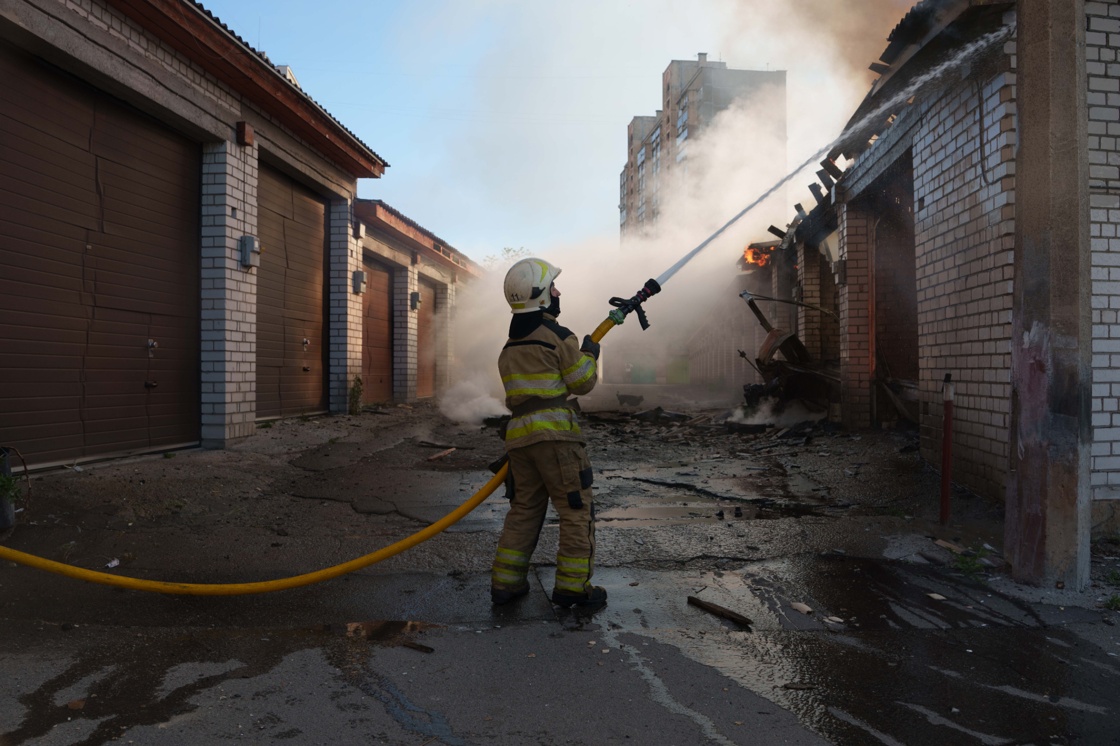
Russia conducted another massive, coordinated strike across Ukraine overnight, deploying a deadly mix of low-cost Shahed loitering munitions and high-velocity cruise missiles to overwhelm local air defenses. The attack targeted critical infrastructure and residential areas in Kyiv, Kharkiv, and southern port regions, resulting in civilian casualties and localized power grid failures. While headlines routinely capture the immediate devastation of these raids, the real story lies in the evolving, high-stakes technological attrition warfare happening beneath the surface. Moscow is rapidly altering its strike combinations to exploit specific vulnerabilities in Ukraine’s Western-supplied defense systems.
Understanding this shift requires looking past the raw numbers of intercepted targets. For months, the primary metric of success for Ukraine has been its interception rate, often hovering between 75% and 90%. However, this metric masks a stark economic reality. Russia is intentionally using waves of cheap, Iranian-designed drones to force Ukraine to expend its limited stockpile of highly sophisticated, million-dollar air defense missiles before the actual cruise and ballistic missiles enter the airspace.
The Economics of Exhaustion
The mathematics of modern air defense are inherently asymmetrical. A single Shahed-136 drone costs Russia or its suppliers roughly $20,000 to manufacture. In contrast, an American-made Patriot interceptor missile costs approximately $4 million, while a NASAMS AMRAAM variant runs around $1 million.
When Russia launches a swarm of forty drones, the financial expenditure for Moscow is negligible. If Ukraine relies strictly on its premier surface-to-air missile (SAM) batteries to eliminate them, it suffers a catastrophic economic and inventory deficit. This is not a secret; it is the core doctrine driving current Russian aerial campaigns.
To counter this, Ukraine has deployed mobile fire teams. These units, often riding in the backs of modified pickup trucks, use searchlights, thermal imaging, and older anti-aircraft guns like the Soviet-era ZU-23-2 or German Gepard systems to shoot down drones visually. It is a gritty, low-tech solution to a high-tech problem. It works, but it has distinct limitations.
Mobile teams require clear lines of sight and early warning data. They are highly effective in flat terrain and around major urban centers where radar coverage is dense, but they struggle when Russia routes drones through deep river valleys or heavily forested corridors where low-altitude radar tracking drops off.
Adaptive Flight Paths and Sensor Blind Spots
Recent telemetry data from intercepted ordnance reveals that Russian mission planners are no longer programming straight-line trajectories. Drones and Kh-101 cruise missiles are now loaded with complex, multi-waypoint flight plans designed to skirt the edges of known Ukrainian radar installations.
A missile might fly south toward Odessa, simulate an attack run, and then execute a sharp 90-degree turn mid-flight to strike a command node or power substation in central Ukraine from the rear. This constant maneuvering forces Ukrainian radar operators to continuously hand off tracking responsibilities from one battery to another, creating brief windows of signal latency that a fast-moving missile can exploit.
Furthermore, Russia has begun painting its Shahed drones black and using carbon-fiber materials to absorb radar waves and conceal them against the night sky. Some downed models have revealed fitted Ukrainian cellular SIM cards attached to internal tracking devices. This allows Russian intelligence to monitor where the drones lose connectivity, effectively mapping out the live locations of Ukrainian mobile jamming units and air defense radar coverage in real time.
The Western Supply Chokepoint
The hard truth about Ukraine’s defense grid is its absolute dependence on foreign manufacturing timelines. Western defense industrial bases were built for deterrence and low-intensity conflicts, not prolonged, industrial-scale artillery and missile wars.
Production lines for systems like the Patriot or the European Iris-T cannot simply turn a dial to triple their monthly output. Building a single Patriot radar unit or command station takes months of highly specialized assembly, precision calibration, and component sourcing. When a battery is damaged by a Russian hypersonic Kinzhal missile, or when it runs out of interceptors, the gap cannot be filled overnight.
This reality forces agonizing choices upon Ukrainian commanders. Do they pull a Patriot battery away from the front lines to protect a thermal power plant feeding electricity to millions of civilians, or do they keep that battery near the Donbas to protect advancing mechanized brigades from Russian tactical air strikes? Protecting everything is mathematically impossible.
Electronic Warfare and the GPS Battleground
The conflict has also entered a invisible phase where radio frequencies dictate physical survival. Ukraine has deployed extensive electronic warfare (EW) networks, such as the "Pokrova" system, which spoof civilian and military GPS signals across vast swathes of the country.
By feeding false positioning data to incoming Russian missiles and drones, these EW systems can cause a weapon to miss its intended target by hundreds of meters, often sending it harmlessly into empty fields or bodies of water.
Russia has responded by upgrading the guidance packages on its cruise missiles. Newer iterations of the Kh-101 now feature optical digital terrain mapping systems called Otblesk-U. Instead of relying purely on satellite navigation, these systems use an internal camera to look at the ground below, comparing the physical landscape with a pre-loaded digital map stored in the missile's onboard computer. This makes them entirely immune to traditional GPS jamming, shifting the technological burden back onto physical kinetic interception.
The continuous mutation of these strike tactics means that static defense strategies are obsolete before they are even fully deployed. Every night provides a massive data collection window for both sides, with the next morning bringing rapid software patches, frequency adjustments, and reworked deployment schedules. The war in the skies over Ukraine is a grinding, iterative engineering race where the price of falling behind is measured in civilian lives and destroyed cities.