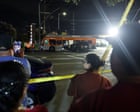
The convergence of disaster rarely follows a clean narrative arc. Instead, destruction often arrives in fragmented, compounding waves that defy simple categorization. When a speeding Ford Expedition careened into a Los Angeles Metro bus in the Chatsworth neighborhood, it obliterated the ordinary routines of working-class commuters. But the grim mathematics of that September afternoon did not stop with the crushed steel of a public transit vehicle. Within hours, the tragedy metastasized into the skies, claiming the lives of journalists and an airman who had arrived to document the wreckage.
At the center of the legal reckoning is Bailee Lynn Rios. Los Angeles County prosecutors charged the 36-year-old motorist with second-degree murder following the collision at Nordhoff Street and DeSoto Avenue. According to investigators, the mechanics of the initial impact were brutally straightforward yet entirely avoidable. Operating an SUV at high speeds while allegedly impaired by narcotics, Rios bypassed stopped traffic by veering into oncoming lanes, blowing through a red light before slamming directly into the side of the city bus.
The human cost was immediate and absolute. Daniel Castillo, a 46-year-old factory worker who favored the back seat of the bus for people-watching during his daily commute, never made the evening call home to his daughter. Gage Weida, a 31-year-old whose parents were scheduled to visit for his birthday weekend, lost his life in the same crushing impact. Six others sustained injuries. For prosecutors under District Attorney Nathan Hochman, the decision to pursue second-degree murder rather than vehicular manslaughter hinges on the doctrine of implied malice. Under California law, driving under the influence under conditions of extreme recklessness can cross the legal threshold from negligence to depraved-heart murder, signaling an intentional disregard for human life.
Yet the shadow cast by the Chatsworth intersection extended upward. As local news outlets scrambled to capture the scope of the devastation, an NBC4 and Telemundo 52 news helicopter—a Eurocopter AS350 operated by contractor Angel City Air—went down nearby, bursting into flames. Veteran pilot George Marciniw, reporter Eliana Moreno, and a man on the ground, Edy Gutierrez Mejia, perished in the secondary inferno. Video broadcast from the cockpit captured the chilling final moments as an alarm wailed, a voice uttered an abrupt warning, and the aircraft rapidly lost altitude.
Federal investigators from the National Transportation Safety Board launched parallel inquiries into both the ground collision and the aviation disaster. While authorities have maintained a clear legal separation between the vehicular charges against Rios and the ongoing aeronautical investigation, the juxtaposition underscores an uncomfortable modern reality. The insatiable demand for immediate, live aerial documentation of urban trauma places unique pressures on airborne news crews. Helicopters hover in congested airspace, often maneuvering through turbulent smoke plumes and chaotic weather patterns under intense operational strain.
Statistically, news gathering from the air has proven hazardous over decades of broadcasting. Federal accident records indicate that numerous fatal incidents involving news helicopters have unfolded across the United States since the turn of the century, claiming scores of lives. The structural risk of station-contracted aviation rarely receives public scrutiny until an abrupt catastrophic failure brings the invisible machinery of local news production into harsh relief.
As the legal proceedings grind forward with a multi-million-dollar bail holding the primary defendant, the broader ecosystem of urban transit safety and media logistics remains exposed to systemic vulnerabilities. Accountability in the courtroom addresses the immediate perpetrator of a drug-fueled highway rampage, but it leaves untouched the wider ecosystem where public roads, transit systems, and commercial air support intersect in moments of sudden catastrophe.
The community vigils in Chatsworth have faded into the quiet grief of empty seats at dinner tables and vacant airport hangers. The legal system will determine the precise decades of imprisonment owed for the lives extinguished on asphalt, but the structural cost of modern speed and continuous observation lingers long after the wreckage is cleared.