The global semiconductor supply chain has a single, invisible point of failure that keeps Beijing’s top economic planners awake at night. It isn’t the massive lithography machines from the Netherlands or the design software from Silicon Valley. It is a group of volatile, light-sensitive chemicals called photoresists. Without these specialized liquids, the multi-billion dollar fabrication plants (fabs) in Taiwan, South Korea, and the United States would be nothing more than expensive, quiet warehouses. China is currently pouring billions into an aggressive, state-backed campaign to end its total reliance on Japanese and American suppliers for these substances. If they succeed, the geopolitical leverage held by the "Chip 4" alliance will effectively evaporate.
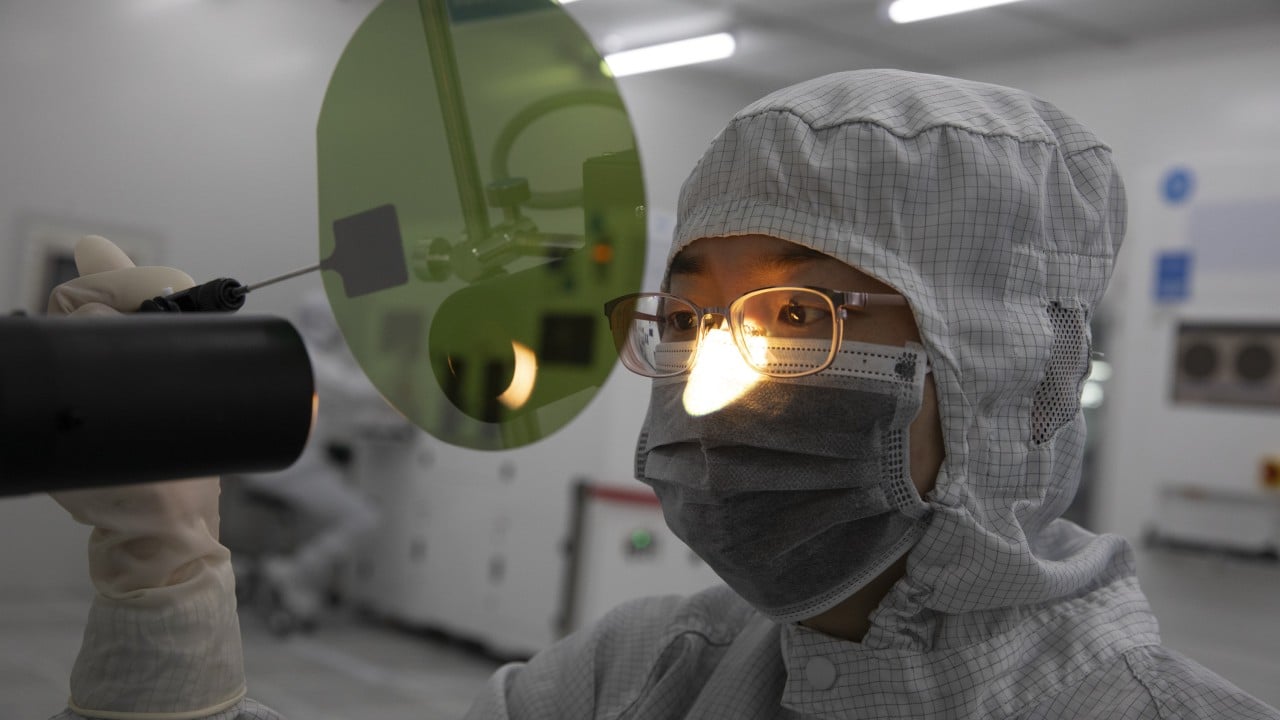
Photoresists are the "ink" of the microchip world. During the manufacturing process, a silicon wafer is coated with this chemical film. When exposed to specific wavelengths of light through a mask, the photoresist undergoes a chemical change, allowing engineers to etch microscopic circuits onto the board. The more advanced the chip, the more refined the photoresist must be. While China has made strides in low-end chips for cars and appliances, it remains dangerously dependent on foreign firms—mostly JSR, Tokyo Ohka Kogyo (TOK), and Shin-Etsu Chemical—for the high-end chemistry required for smartphones and artificial intelligence hardware.
The Chokepoint Strategy
For decades, the semiconductor industry operated on the assumption of global cooperation. Japan owned the chemistry, the U.S. owned the software and design, and the Dutch owned the light sources. This delicate balance shifted when the U.S. began using export controls as a primary tool of foreign policy. By restricting China's access to the most advanced tools and materials, the West effectively placed a ceiling on China's technological development.
Beijing viewed this as an existential threat. The response has been a massive influx of capital into domestic firms like Arpida, Nata Opto-electronic, and Crystal Clear Electronic Material. These companies are not just trying to build better products; they are trying to replicate an entire ecosystem that took Japanese firms fifty years to perfect. It is a monumental task. The chemistry involved is so sensitive that even a few parts per trillion of a contaminant can ruin a batch of wafers worth millions of dollars.
The difficulty lies in the shift from ArF (Argon Fluoride) resists to the incredibly complex EUV (Extreme Ultraviolet) resists. As chip features shrink toward 5nm and 3nm, the margins for error disappear. Domestic Chinese firms have recently claimed breakthroughs in ArF resists, which are suitable for 7nm and 14nm processes. This is the "sweet spot" for most industrial and military applications. By securing this middle ground, China ensures that even if it is cut off from the absolute frontier of technology, its core infrastructure remains functional.
The Japanese Iron Grip
To understand why China is struggling, one must look at Japan. Japanese firms control more than 90% of the market for high-end photoresists. This isn't just because they have the best factories; it's because they have the best "tribal knowledge." The formulation of these chemicals is often a guarded secret, passed down through generations of chemists. It is less like a standard manufacturing process and more like high-end perfumery or metallurgy.
When Japan restricted exports of photoresists to South Korea in 2019 due to a diplomatic spat, the Korean tech giants—Samsung and SK Hynix—panicked. It was a wake-up call for the entire world. If a close ally like South Korea could be crippled by a chemical embargo, China knew it stood no chance in a direct confrontation with the West unless it owned the supply chain from the molecular level up.
China’s strategy involves "poaching" talent as much as it involves R&D. We are seeing a quiet but intense migration of veteran engineers from Japan and Taiwan to mainland firms. These experts bring with them the "recipes" that cannot be found in any patent filing. However, the Japanese government has noticed. New regulations are being drafted to prevent the "leakage" of critical chemical technology, effectively turning photoresists into a protected national security asset.
Why Money Cannot Buy Chemistry
A common mistake made by Western analysts is assuming that China can simply outspend the problem. In the software world, more developers can speed up a project. In the chemical world, things take as long as they take. A new photoresist formulation requires thousands of hours of testing in actual lithography machines—the very machines that the U.S. has restricted China from buying in large quantities.
This creates a "chicken and egg" dilemma. To develop the resist, you need the machine. To get the machine to work properly, you need the resist. Chinese firms are forced to innovate using older-generation DUV (Deep Ultraviolet) equipment, trying to push those machines to their absolute physical limits. It is a grueling process of trial and error.
Furthermore, the purity requirements are staggering. A "clean room" for photoresist production must be significantly cleaner than a hospital operating theater. The chemicals must be stored in specialized containers that do not leach a single atom of metal into the liquid. China is currently building out this secondary infrastructure—the bottles, the filters, the ultra-pure solvents—which is a massive industrial undertaking in its own right.
The Hidden Risk for the West
While the U.S. and Japan focus on keeping China out of the high-end market, they may be inadvertently surrendering the "legacy" market. By forcing China to become self-sufficient, the West is incentivizing the creation of a massive, low-cost chemical industry that could eventually dump cheap, high-quality photoresists onto the global market.
Once China masters the chemistry for 28nm or 14nm chips, they will produce it at a scale and price point that Japanese firms cannot match. This could hollow out the profit margins of the very companies the West is trying to protect. We have seen this play out in the solar panel industry and the electric vehicle battery market. The "precision strike" China is aiming at the supply chain isn't just about catching up; it's about taking over the foundations of the industry.
There is also the issue of "backdoor" procurement. Despite the sanctions, chemicals are easier to smuggle than massive pieces of machinery. They can be relabeled, shipped through third-party countries, or sold through shell companies. The investigative reality is that the "stranglehold" is porous.
The Future of the Chemical Front
The next three years will determine if China’s gamble pays off. The recent announcement from the Chinese Ministry of Industry and Information Technology (MIIT) regarding the "domestic substitution" of ArF photoresists was a shot across the bow. While some skeptics argue these domestic versions haven't been tested at scale, the intent is clear. Beijing is no longer asking for permission to participate in the high-tech economy.
The real test will be the yield rates. It is one thing to produce a chip in a lab; it is another to produce millions of them with a 99% success rate. If Chinese fabs can achieve stable yields using domestic photoresists, the U.S. sanctions regime will lose its most effective lever. At that point, the "tech war" shifts from a battle of restrictions to a battle of pure industrial output.
Western policymakers are currently debating whether to tighten restrictions further or to try and re-integrate China into a monitored supply chain. Both options carry immense risk. Tighten too much, and you accelerate China's path to total independence. Relax too much, and you lose your strategic advantage.
The struggle over these volatile liquids proves that the most important components of the modern world are often the ones you cannot see. The outcome of the 21st century's greatest geopolitical rivalry may not be decided by carriers or missiles, but by the purity of a chemical film sitting on a silicon wafer in a darkened room in Shanghai or Osaka.
The move toward total self-reliance is not a project that can be abandoned halfway. China has burned its bridges. For the firms in the middle of this fray, the mandate is simple: innovate or disappear.
Would you like me to analyze the specific market share data of the top five Chinese photoresist manufacturers compared to their Japanese counterparts?