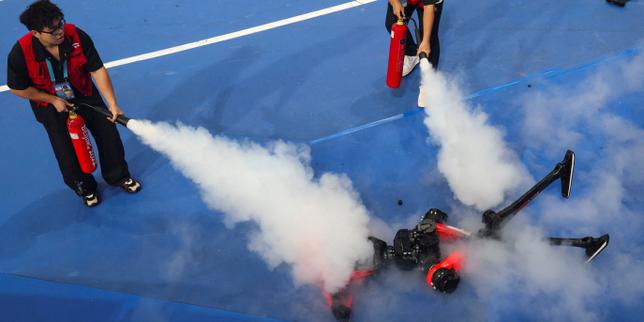
When a mechanical sprinter crosses a 100-meter track in 8.64 seconds, crushing Usain Bolt's legendary human benchmark, it makes for incredible headlines. But what happens right after the finish line tells the real story of modern robotics. At the recent World Humanoid Robot Games in Beijing, the winning machine didn't just break records—it slammed straight into a padded barrier, sparked violently, and required fire extinguishers before being carried off on a stretcher.
That single, chaotic moment at the National Speed Skating Oval captures the current paradox of China's booming robotics industry. The hardware is sprinting ahead at a dizzying pace, yet the actual practical integration into everyday life remains a massive hurdle.
The Spectacle Versus the Factory Floor
Over two thousand robots and hundreds of teams from sixteen countries gathered for five days of high-stakes competition. We watched androids play soccer, box, execute standing high jumps that cleared human records, and even mix cocktails. Companies like Unitree and various phone manufacturers are pumping billions into physical AI, turning out agile frames that can jump high, run fast, and look remarkably graceful on a controlled track.
Controlled environments are easy to master. Real warehouses, chaotic construction sites, and unpredictable household hallways are entirely different beasts.
Industry veterans point out that while hardware feats draw crowds, true economic value is measured elsewhere. Jonathan Hurst, a robotics professor at Oregon State University, notes that true progress happens when humanoids work autonomously for hours on end inside factories without short-circuiting or needing a technician with a stretcher.
Software Is the Real Bottleneck
You can build legs with 10 extra centimeters of length or optimize titanium joints all you want, but software intelligence limits what these machines can actually achieve. Most commercial androids currently run models with limited parameters. Giving a machine the generalized intelligence to fold laundry, cook dinner, or navigate an unfamiliar office space requires massive leaps in software capability that hardware-focused companies haven't fully cracked yet.
Wang Xingxing, founder of Unitree, offered a reality check during the exhibition forums, suggesting it will still take several years before robots can handle roughly 80 percent of tasks in totally unfamiliar settings.
Morgan Stanley projects tens of thousands of humanoid shipments this year alone, driven heavily by government-backed training programs and experimental deployments. Yet, actual commercial utilization in retail or heavy labor remains scarce outside of staged demos. Most machines still struggle to recover gracefully from unexpected physical collisions or dynamic obstacles without human intervention.
What Comes Next for Embodied AI
If you are tracking where this technology is heading, stop looking at the sprint times. Look instead at data collection methods. The race is no longer just about who can build the strongest actuator or the fastest bipedal runner. It is about who can gather enough diverse physical training data to solve the generalisation problem.
Companies capturing real-world operational data through simulation and sensor-equipped human testers will pull ahead of those just building expensive toys for exhibition floors. The spectacle in Beijing proved that China dominates the manufacturing and hardware velocity of humanoid robotics. Now comes the hard part: teaching them how to survive the real world without catching fire at the finish line.