The Sound of the Shift
The radiator in the corner of the small apartment clicks and groans. It is a familiar, mechanical heartbeat in the dead of winter, but lately, the sound brings a subtle tightening in the chest. Every click costs more than it did last month. Across the kitchen table, a laptop screen glows with a different kind of warmth, displaying a digital clock that has crept terrifyingly close to midnight.
Most people do not think about global collapse when they look at their utility bills. They think about checking accounts, frozen grocery prices, and whether they can stretch a gallon of milk through Tuesday. But the connection is there, invisible and absolute.
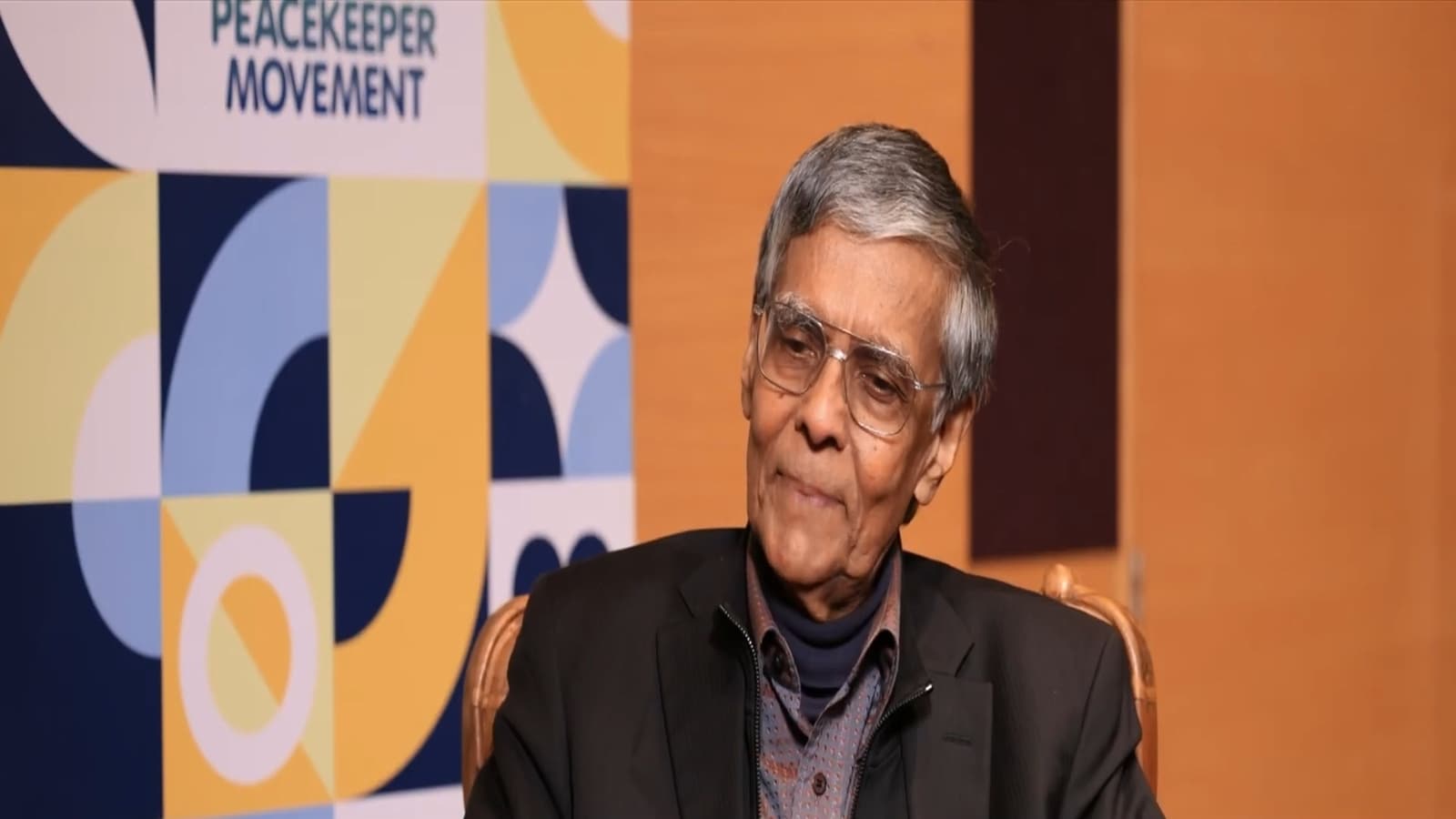
When Professor Mohan Munasinghe, a man who shared the 2007 Nobel Peace Prize for his work on climate change, spoke recently about the world teetering on the brink of a third world war, he wasn't just talking about missiles and troop movements. He was talking about that radiator. He was talking about the bread on the table.
We have a habit of viewing global crises as separate, tidy boxes. We put the war in Ukraine in one box, the rising cost of living in another, and the erratic, violent shifts in global weather patterns in a third. It makes the world feel manageable. It allows us to sleep at night.
But the boxes are an illusion. They are all pipes feeding into the same central engine, and right now, that engine is overheating.
The Triple Match
To understand how a localized conflict spirals into a civilizational threat, you have to look at the architecture of human survival. Imagine three dry, wooden structures built so close together that their eaves touch. The first is energy security. The second is economic stability. The third is social cohesion.
For decades, global leadership operated under the assumption that if one structure caught fire, the others could act as firebreaks. If an economic downturn hit, cheap energy would fuel the recovery. If energy spiked, a robust global market would absorb the shock.
What Munasinghe points out—and what the daily reality of millions now confirms—is that all three structures are ablaze simultaneously.
Consider the mechanics of the current squeeze. When major geopolitical fault lines fracture, the immediate reflex is isolation. Countries tighten their borders, hoard their resources, and weaponize their supply chains. The price of natural gas skyrockets. Because modern agriculture relies heavily on natural gas to produce fertilizer, the cost of growing food spikes next. Suddenly, a decision made in a high-security briefing room thousands of miles away dictates the price of a loaf of bread in a suburban supermarket.
This is not a hypothetical chain reaction. It is the precise mechanism that drives hyperinflation, and hyperinflation is the traditional prelude to political madness. When people cannot feed their children, the abstract virtues of diplomacy and international law lose their meaning. The ground becomes fertile for demagogues, radical shifts, and the terrifyingly casual acceptance of extreme solutions.
The Illusion of Distance
There is a dangerous comfort in distance. We watch news broadcasts of geopolitical maneuvering with a detached, cinematic fascination. It feels like a movie where the stakes are high but ultimately confined to the screen.
History shows us this detachment is a luxury that expires quickly. In the early months of 1914, the average European citizen was far more concerned with local labor strikes and the summer heat than the rumblings in the Balkans. The machinery of alliance and mobilization was so complex, so deeply integrated, that once the first gear turned, no human hand could reach into the apparatus to stop it.
Today, that apparatus is infinitely more complex, bound together by fiber-optic cables, automated trading algorithms, and nuclear launch protocols that measure response times in seconds rather than days.
The danger of a third world war in the modern era does not stem from a collective desire for destruction. No sane leader wants a nuclear wasteland. The danger stems from miscalculation. When a system is under extreme stress—when economies are fracturing and energy supplies are insecure—the margin for error shrinks to zero. A single misread radar blip, a stray drone crossing a disputed border, or a cyberattack on a power grid can trigger a cascade of automated escalations.
The pressure creates a psychological trap. Leaders, terrified of appearing weak to their domestic audiences who are already suffering from economic anxiety, double down on rhetoric. They draw lines in the sand. Then, the sand shifts.
The Forgotten Bottom Line
Amid the grand strategy, we tend to forget who actually pays the bill for these systemic failures. The focus stays on the billionaires, the prime ministers, and the generals. But the true weight of a global crisis is borne by what economists call the "global south"—and what the rest of us should simply call people.
During his decades of work with the Intergovernmental Panel on Climate Change, Munasinghe observed a recurring pattern. When the wealthy nations of the world experience a tremor, the developing world experiences an earthquake. A twenty percent increase in the price of grain is an inconvenience in Chicago or London; it is a sentence of malnutrition in Nairobi or Dhaka.
When these populations are pushed past the point of endurance, they move. Mass migration is not an ideological choice; it is a biological imperative. If your land no longer yields crops because the climate has shifted, and you cannot afford to buy imported food because the global economy has fractured, you walk toward survival.
Yet, instead of addressing the root cause of this pressure, the wealthier sectors of the globe respond by building higher walls and investing in more sophisticated security systems. This is the equivalent of trying to cure a fever by smashing the thermometer. It addresses the symptom while allowing the infection to mutate.
The Technology Trap
We built a world designed for efficiency, not resilience. In our pursuit of just-in-time delivery and optimized profit margins, we stripped out the redundancies that keep human societies stable during a storm.
Our energy grids are a prime example. The transition to cleaner energy sources is a existential necessity, a point that climate scientists have spent lifetimes proving. But the execution of that transition has been compromised by political short-termism. We dismantled old energy infrastructures before the new ones were fully capable of carrying the baseline load, leaving the system highly vulnerable to sudden geopolitical shocks.
When the shock arrived, the immediate response was not a smarter, faster deployment of sustainable tech. It was a panicked retreat to the dirtiest alternatives available. Coal plants were restarted. Environmental regulations were suspended.
This is the tragedy of short-term survival thinking. The actions taken to survive the economic crisis of this winter directly guarantee that the climate crisis of the next decade will be more severe. It is a debt compounded daily, drawn against the future of the very people we are trying to protect.
The Human Core of Diplomacy
Fixing a machine this vast requires more than policy papers and international summits where leaders read prepared statements to empty rooms. It requires a fundamental reassessment of what constitutes security.
For generations, we defined security by the size of an arsenal or the strength of a currency. If a nation had enough missiles to deter an enemy and enough gold to back its banks, it was considered safe. But true security is bottom-up, not top-down. A nation is only as stable as its most vulnerable citizen. If a population is broken by economic despair and alienated by inequality, no amount of military hardware can prevent internal collapse.
The solution starts with a shift in focus toward resource equity. This sounds like utopian rhetoric until you look at the cold math of global survival. We produce enough food to feed every human being on earth. We possess the technological blueprint to transition to sustainable energy without starving developing economies. What we lack is the political will to manage these resources as a shared global commons rather than as chips in a high-stakes poker game.
It is easy to feel powerless in the face of this reality. The forces moving the pieces across the board seem too vast, too indifferent to the desires of ordinary people. But systems are made of choices, and choices can be altered.
The Final Chord
Outside, the wind picks up, rattling the windowpane against its frame. The radiator gives one last, sharp metallic ring before falling silent.
The digital clock on the screen remains, its hands frozen in a permanent, symbolic warning. It is a reminder that peace is not the natural state of human affairs; it is a fragile, artificial construct that requires constant, deliberate maintenance.
Every time we choose to prioritize short-term national advantage over long-term global stability, we turn the key a fraction of an inch tighter. The danger we face is not that a single monster will decide to destroy the world. The danger is that a collection of well-meaning, terrified individuals, trying desperately to protect their own small corners of the map, will accidentally tear the map in half.