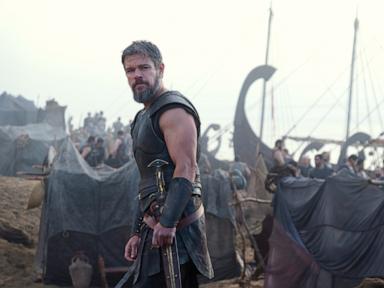
The theater is always too cold before the projector hums to life. You sit in the dark, the vinyl of the seat chilling your neck, listening to the collective rustle of three hundred strangers settling into their coats. There is a specific kind of quiet that precedes a Christopher Nolan film. It is not the relaxed hush of people waiting to be amused; it is the tense, holding-of-breath silence of passengers waiting for a roller coaster to clear the first chain lift.
We went into the theater expecting Homer. We expected bronze swords, roaring seas, and perhaps the thunderous wrath of Zeus rendered in the deafening bass of modern IMAX sound.
We got something far more terrifying. We got ourselves.
With his adaptation of The Odyssey, Nolan did not merely translate an ancient text. He dismantled it. He took the oldest survival story in Western literature, pulled out its gears, polished them until they reflected our own modern anxieties, and put them back together in a shape that ticks. It is a film about the sea, yes. But more than that, it is a film about the suffocating, unyielding gravity of time.
Three Hours on the Water, Twenty Years in the Dark
To understand what Nolan has done here, you must first understand how he views the concept of home. In his hands, Ithaca is not a physical island. It is an anchor at the end of a rope that is fraying by the second.
Consider the structure. The film does not begin with the wooden horse or the fall of Troy. It begins in the middle of a grey, featureless ocean. The camera clings to the water level, rising and falling with a sickening regularity that makes your chest tighten. There are no sweeping crane shots. There is only Odysseus, played with a brittle, hollow-eyed intensity by Cillian Murphy, staring at a horizon that refuses to yield.
He has been gone for twenty years. But in Nolan’s structure, those twenty years do not run in a straight line.
Instead, we are given three distinct strands of time, running at different speeds, overlapping and colliding like waves against a cliffside.
First, there is the timeline of Telemachus on Ithaca, spanning a single, desperate week as the suitors circle his mother like wild dogs. This strand moves with the frantic, sweat-slicked pacing of a political thriller.
Second, we have Penelope, occupying a single day—the final day—as she weaves and unweaves her shroud, her desperate stalling tactic transformed into a tense, silent battle against the ticking of a grandfather clock that seems to echo through the stone halls of her palace.
Third, we have Odysseus on the sea, spanning ten subjective years that feel, by turns, like ten minutes and ten centuries.
The editing is merciless. We cut from a second of Penelope pulling a single thread from her loom to a month of Odysseus drifting in a dead calm. The effect is dizzying. You begin to lose your grip on when things are happening. You realize, with a jolt of quiet horror, that this is exactly what Odysseus is experiencing. The sea is not just water; it is a giant, liquid clock that has lost its hands.
The Monster in the Mirror
In school, we are taught to think of the monsters of The Odyssey as grand, mythological beasts. We think of the Cyclops as a giant with a single eye, or the Sirens as feathered women singing on the rocks.
Nolan discards these literal interpretations. He replaces the digital spectacle we have grown numb to with practical, psychological weight.
Take the encounter with Polyphemus. There is no massive, poorly rendered CGI giant here. Instead, Odysseus and his men are trapped in a subterranean salt mine, plunged into absolute darkness. The "monster" is a colossal, automated mining excavator left behind by some forgotten occupation, its single, blinding searchlight sweeping through the dust like a hostile eye. The sound design does the work of a thousand visual effects. The machine doesn't roar; it groans with the screech of shifting metal and the rhythmic, thudding crunch of stone being pulverized.
When it crushes a man, it is not an act of malice. It is simply a machine doing what it was programmed to do. The horror is in its complete indifference to human life.
This is the recurring motif of the film. The obstacles Odysseus faces are not sentient evils; they are forces of nature and technology that do not care if he lives or dies. The Lotus-Eaters are not a tribe of lazy islanders, but a colony of shipwrecked sailors who have succumbed to a localized, airborne toxin that erases short-term memory. They sit in the ruins of their ships, smiling blankly, unable to remember their own names or why they ever wanted to leave.
It is a terrifying sequence. You watch strong men look at photos of their wives and feel absolutely nothing. The fear is not that they will be eaten, but that they will willingly choose to disappear.
The Ghost in the Machine
The emotional weight of the film, however, rests entirely on the shoulders of Penelope.
Traditionally, Penelope is portrayed as the patient wife, waiting passively at home while her husband has adventures. Nolan rejects this passivity. Her loom is not a hobby; it is a counter-offensive.
As played by Elizabeth Debicki, Penelope is a mathematician of survival. She knows that the moment she finishes the shroud, her life—and her son’s life—forfeit. Every night, as she pulls the threads apart, she is literally clawing back time. The cinematography treats her loom like a complex computer, the wooden shuttles clacking with the speed and precision of a telegraph wire. She is sending a message into the void, hoping her husband will receive it before the final thread is spun.
The tragedy is that they are operating on different planes of reality.
In one of the film’s most devastating sequences, Nolan uses cross-cutting to show Odysseus trapped on the island of Ogygia with Calypso. Here, Calypso is not a seductive goddess, but a solitary researcher living in an isolated, high-altitude weather station, surrounded by screens monitoring the dying world below. She offers him immortality—not through magic, but through a preservation chamber that will suspend his aging indefinitely.
"You can live forever," she tells him.
"But I won't be home," he replies.
"Home is a memory," she says, pointing to the static-filled screens. "And memories decay."
We cut back to Ithaca. We see Penelope looking at a faded charcoal sketch of her husband. The paper is soft at the edges, worn thin from years of her thumb tracing his jawline. The physical relic is rotting. The memory is fading. If Odysseus stays on the island, he will survive, but the man who left Ithaca will have ceased to exist.
The Weight of the Bow
By the time we reach the final act, the tension in the theater is almost unbearable. There are no grand speeches. There is no triumphant music.
When Odysseus finally returns to Ithaca, he does not look like a hero. He looks like a ghost. He is scarred, filthy, and his eyes have the vacant, twitching look of a man who has spent too much time looking at things that cannot be unseen. He does not even recognize his own home. The stone walls look too small; the sky looks too bright. He is a stranger in the house he built with his own hands.
The archery contest is shot with an agonizing lack of flourish. The suitors are not cartoonish villains; they are desperate, hungry men who have realized the world they knew is collapsing around them.
When Odysseus takes up the heavy composite bow, the camera zooms in on his hands. They are shaking. Not from fear, but from the sheer physical toll of his journey. The wood of the bow groans under the tension.
You find yourself leaning forward in your seat. You are not root-and-branch cheering for a slaughter. You are watching a man try to bend his own past into a shape he can use.
He draws the string back. The sound of the wind outside the palace dies away. The ticking of the clock stops.
For a fraction of a second, there is absolute silence.
Then, the release.
The Cost of the Return
We go to the movies to escape our lives, to watch legends perform deeds we could never dream of. But Nolan’s Odyssey suggests that the greatest struggle is not the journey away from home, but the struggle to exist in the place we left behind.
As the lights slowly rose in the theater, nobody moved. Nobody reached for their phones. We sat there, blinking against the sudden brightness, feeling the phantom weight of the salt water in our lungs.
We had watched a man cross the world, survive monsters, and defeat his enemies, only to find that the hardest part of the journey was looking his wife in the eye and realizing they were both survivors of different, equally brutal wars.
The screen went black. The credits rolled in silence.
And outside, the city of 2026 was still there, loud and indifferent, its lights blinking in the dusk like distant islands we are all trying to find our way back to.