Step off the boardwalk in the Florida Everglades at four in the morning during a January cold snap, and the silence will unsettle you before the chill ever does.
Thirty years ago, that same pre-dawn darkness was deafening. It hummed with the frantic, overlapping chorus of tree frogs, the sudden splash of marsh rabbits fleeing through sawgrass, and the rustle of raccoons foraging along the muddy banks. Today, when the temperature drops into the forties, the swamp holds its breath. The native mammals are gone, swallowed whole over three decades of relentless ecological erasure. Yet beneath the dark, tannin-stained water and inside the tangled roots of collapsed melaleuca trees, something massive is wide awake, waiting out the frost in a way biologists never fully understood until they wired hundreds of apex predators with radio transmitters and followed them into the dark. For a deeper dive into this area, we recommend: this related article.
Consider a hypothetical wildlife tracker—let us call him Marcus—standing knee-deep in brackish mud near the Shark River Slough, holding a directional Yagi antenna above his head. His boots are suctioned to the peat. The air smells of rotting vegetation and wet limestone. Through his headphones, a steady, rhythmic ping cuts through the static. Ping. Ping. Ping. It is a VHF signal bouncing off a surgically implanted battery the size of a AA cell, stitched safely into the body cavity of a fourteen-foot Burmese python.
For years, the prevailing wisdom among both casual observers and seasoned land managers was comfortably simple. Burmese pythons are tropical giants, native to the steamy river valleys of Southeast Asia. Cold weather, the theory went, was our greatest natural ally. When a rare South Florida freeze rolled down the peninsula, the snakes were supposed to grow sluggish, fail to regulate their body heat, and die off in droves—just as thousands did during the historic freeze of 2010. To get more details on this issue, detailed reporting can be read on The Guardian.
That assumption felt reassuring. It suggested nature had built-in guardrails to stop an invasive species from conquering the American Southeast.
We were wrong.
When a multi-agency coalition of researchers—spanning the U.S. Geological Survey, the Conservancy of Southwest Florida, and university field teams—pooled decades of telemetry data, they were not looking at a handful of rogue reptiles. They were analyzing the movements of 356 individual Burmese pythons tracked across the Greater Everglades ecosystem. What emerged from those hundreds of thousands of GPS pings and radio bearings was not a story of tropical vulnerability. It was a masterclass in survival, revealing a winter habit that changes everything we thought we knew about how to fight them.
The Architecture of a Winter Ghost
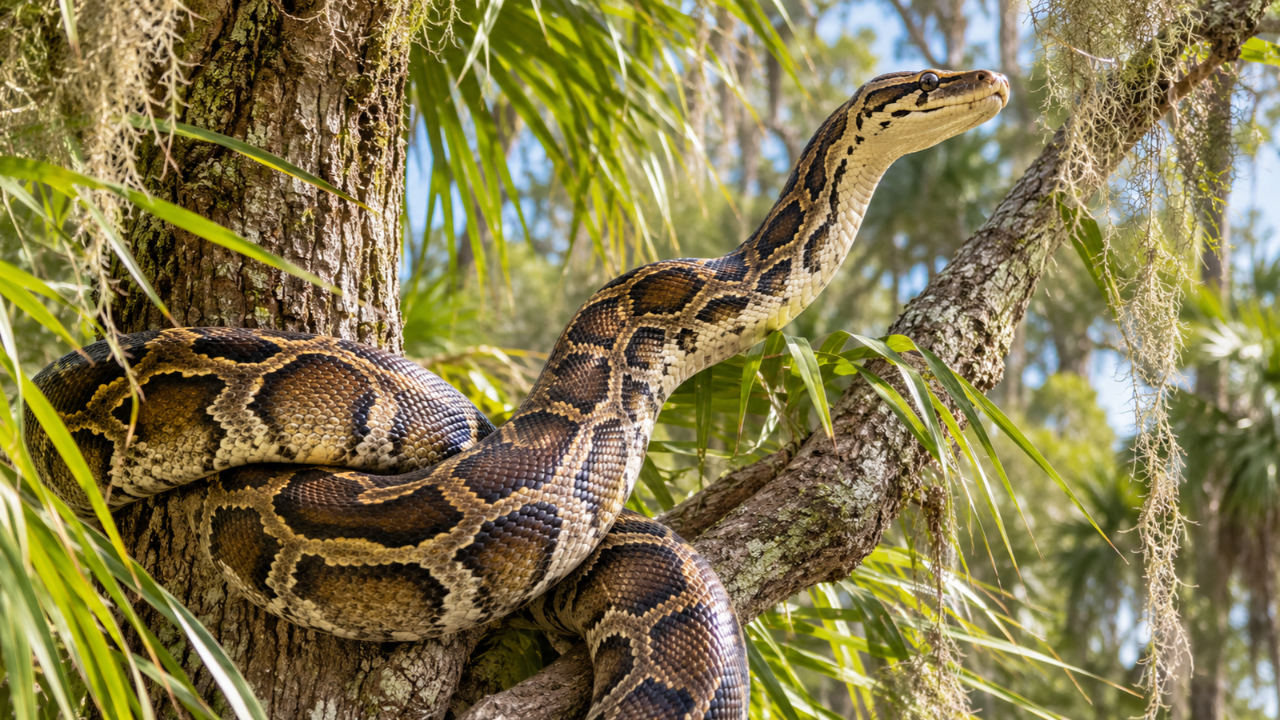
To understand what those 356 snakes were doing, you first have to abandon the image of a python draped lazily across a sunny limb. In the summer, when the Everglades boils under ninety-five-degree heat and ninety percent humidity, pythons are notoriously difficult to find. A twelve-foot snake weighing ninety pounds can vanish into six inches of water and sawgrass as if it were made of smoke. Their skin—a mottled mosaic of tan, olive, and dark brown blotches—is an evolutionary masterpiece of disruptive camouflage. You can stand three feet from a coiled python and stare directly at it without your brain registering anything other than dead leaves and shadows.
Biologists call this the detection problem, and it is the single greatest obstacle in Everglades restoration. You cannot remove what you cannot see.
When winter arrives in South Florida, the rules of the swamp change. Water levels recede during the dry season, concentrating wildlife into shrinking pockets of moisture. Temperatures dip, sometimes plunging below fifty degrees Fahrenheit. Because pythons are ectotherms—relying entirely on their external environment to generate body heat—cold air threatens their basic cellular functions. If a python’s core temperature drops too low for too long, digestion halts, immune systems crash, and muscles lock up.
So where did the 356 tracked snakes go when the mercury fell?
They did not scatter blindly, nor did they simply lie exposed on the banks hoping for the sun to rescue them. Instead, the telemetry data revealed a striking, repeatable behavioral shift. As temperatures dropped, the snakes actively sought out subterranean refugia—underground burrows dug by gopher tortoises, hollowed-out root balls of toppled Australian pines, limestone solution holes, and the dense, insulating mats of invasive vegetation along man-made canal levees.
Think of an old brick oven holding its heat long after the fire has died down. That is how a limestone solution hole functions in the Everglades. While the air above the marsh drops into the thirties, the earth and groundwater a few feet below remain a steady, protective sixty-five to seventy degrees.
The pythons were not merely stumbling into these thermal shelters by accident. The data showed individual snakes returning to the exact same underground burrows winter after winter, navigating across miles of featureless marsh with uncanny spatial memory. Even more startling was what happened once the cold front passed. Rather than staying hidden, the snakes emerged en masse onto elevated canal banks and sunlit clearings to bask, soaking up the midday warmth before retreating back underground before dusk.
When Solitary Hunters Become Neighbors
If you ask a herpetologist to describe the social life of a Burmese python, the answer is usually a single word: nonexistent. Outside of the spring breeding season, these are solitary ambush predators. They do not hunt in packs. They do not share territory out of affection.
Yet the tracking of those 356 snakes uncovered a winter phenomenon that turned solitary hunters into temporary roommates.
During severe cold snaps, researchers following radio signals to a single burrow frequently discovered not one python, but multiple snakes coiled together underground. In some instances, a single subterranean cavity harbored half a dozen massive reptiles pressed tightly against one another.
Why would a fiercely independent predator tolerate company? Thermal physics. By clustering together inside an insulated burrow, the snakes dramatically reduced the amount of surface area exposed to the cooler air, slowing heat loss in much the same way huddle-forming penguins survive Antarctic gales—except these were cold-blooded giants borrowing warmth from the earth and trapping it between their scales.
And there is an unintended consequence to this winter huddle that hits at the very heart of the Everglades crisis.
When winter gives way to early spring, those exact same underground shelters double as mating arenas. By tracking male "scout" pythons—snakes surgically fitted with transmitters and released back into the wild specifically to lead biologists to hidden females—researchers watched winter survival seamlessly transition into reproduction. A female tucked inside a canal-bank burrow stays warm enough to survive January, emerges to bask in February, and is immediately surrounded by males who followed her scent trail straight to her winter doorstep.
One female python can lay anywhere from fifty to over a hundred eggs in a single clutch. Multiply that by the survival rate enabled by underground thermal refuges, and the math becomes terrifying.
The Invisible Stakes of a Silent Marsh
It is easy, reading statistics from a distance, to treat the Florida python invasion as an exotic curiosity—a bizarre wildlife headline tucked between weather reports and sports scores. You have to smell the mud to feel what is actually being lost.
Walk through Everglades National Park with someone who has worked those waters for forty years, and they will point to a stretch of sawgrass prairie and tell you what used to live there. Between 1997 and 2012, comprehensive roadkill surveys and spotlight counts documented a catastrophic collapse in native mammal populations across the southern Everglades:
- Raccoon populations plummeted by 99.3 percent.
- Opossums dropped by 98.9 percent.
- Bobcats declined by 87.5 percent.
- Marsh rabbits, cottontails, and foxes virtually vanished from the core landscape.
These were not gradual declines caused by shifting weather patterns or subtle habitat degradation. They were an ecological wipeout. Every single one of those species ended up inside the stomachs of Burmese pythons—snakes that arrived in South Florida through the exotic pet trade in the late twentieth century, released by overwhelmed owners or freed when Hurricane Andrew shattered breeding facilities in 1992.
When you remove the mid-sized mammals from a wetland, the entire food web unravels. Panthers lose prey. Alligators lose competition and food sources. Wading birds find their nesting colonies raided by snakes that can climb cypress trees with effortless, muscular grace. Even the disease ecology of the swamp shifts; mosquitoes that once fed on raccoons and opossums begin feeding heavily on remaining rodents, altering the transmission dynamics of viruses like Everglades virus.
I still remember the first time I saw a necropsy performed on a sixteen-foot female captured near the Tamiami Trail. She weighed over a hundred and forty pounds, thick around the middle as a telephone pole. When the biologists opened her digestive tract, they pulled out the intact hooves of a white-tailed deer fawn, alongside the dense fur of two marsh rabbits. That single meal had taken her weeks to digest, fueled by the warm Florida sun.
Watching that, you realize the sheer biological efficiency of the animal. A python does not kill out of malice. It is not a monster. It is simply an extraordinary evolutionary machine dropped into an ecosystem that has zero evolved defenses against it. Native Florida prey species recognize the silhouette of a hawk from above and the scent of a bobcat from the brush. They have no genetic memory of a silent, fifteen-foot constrictor lying motionless beneath six inches of duckweed.
Turning a Survival Habit into a Vulnerability
For decades, wildlife managers felt as though they were bailing out a sinking boat with a teaspoon. Bounty programs and annual python challenges captured hundreds of snakes, generating headlines and rallying public awareness, yet barely denting a wild population estimated in the tens of thousands—and possibly over a hundred thousand. Searching three million acres of roadless swamp for camouflaged needles in a watery haystack was a losing game.
That is why the behavioral map drawn by those 356 tracked pythons matters so deeply. It shifts the battlefield from random searching to predictive hunting.
Consider what happens when you know exactly when and where a ghost has to become visible.
The telemetry data proved that pythons are bound by strict thermal rules. During specific winter weather windows—particularly the crisp, sunny mornings immediately following a cold front when nighttime temperatures dipped below fifty degrees—the snakes face a biological imperative. They must leave their dark burrows and expose themselves to direct sunlight on elevated ground to raise their core temperatures.
Suddenly, the needle in the haystack climbs onto the top of the hay.
Armed with this data, biologists and licensed python removal agents no longer have to patrol endlessly in the dark hoping for a lucky spot along a levee. Instead, they can deploy targeted teams along specific habitat edges—canal banks, tree islands, and tortoise-burrow networks—during precise meteorological windows. Thermal imaging drones, already tested across open marsh, become exponentially more effective when cold-blooded snakes are soaking up morning sun against cool background vegetation.
Even more importantly, understanding winter refugia allows researchers to intercept breeding aggregations before eggs are laid. Capturing a single gravid female in February prevents up to a hundred hatchlings from dispersing into the sawgrass in June. Tracking those 356 snakes did not hand scientists a magic wand to erase an entrenched invasive species, nor does it mean pythons will soon march unchecked into downtown Atlanta—extreme, prolonged freezes still set hard northern limits on their range. What it gave them is something far rarer in conservation biology: leverage.
The Pulse Beneath the Sawgrass
Return in your mind to that quiet boardwalk at four in the morning, with frost rimming the wooden railings and mist rising off the black water of the slough.
To the untrained eye, the winter swamp looks dormant, frozen in time until spring warmth returns. Down below the surface, tucked inside ancient limestone pockets and beneath the gnarled roots of swamp bays, dozens of massive coils are pressed together in the dark, sharing the quiet heat of the earth. They are patient. They have survived ice ages in their ancestral homelands, and they have mastered the rhythms of an American wetland that was never meant to hold them.
Yet above them, along the limestone levees and muddy trails, radio receivers are clicking softly in the cold air. For the first time in thirty years, the hunters know which doors the ghosts are hiding behind—and they are waiting for the sun to come up.


